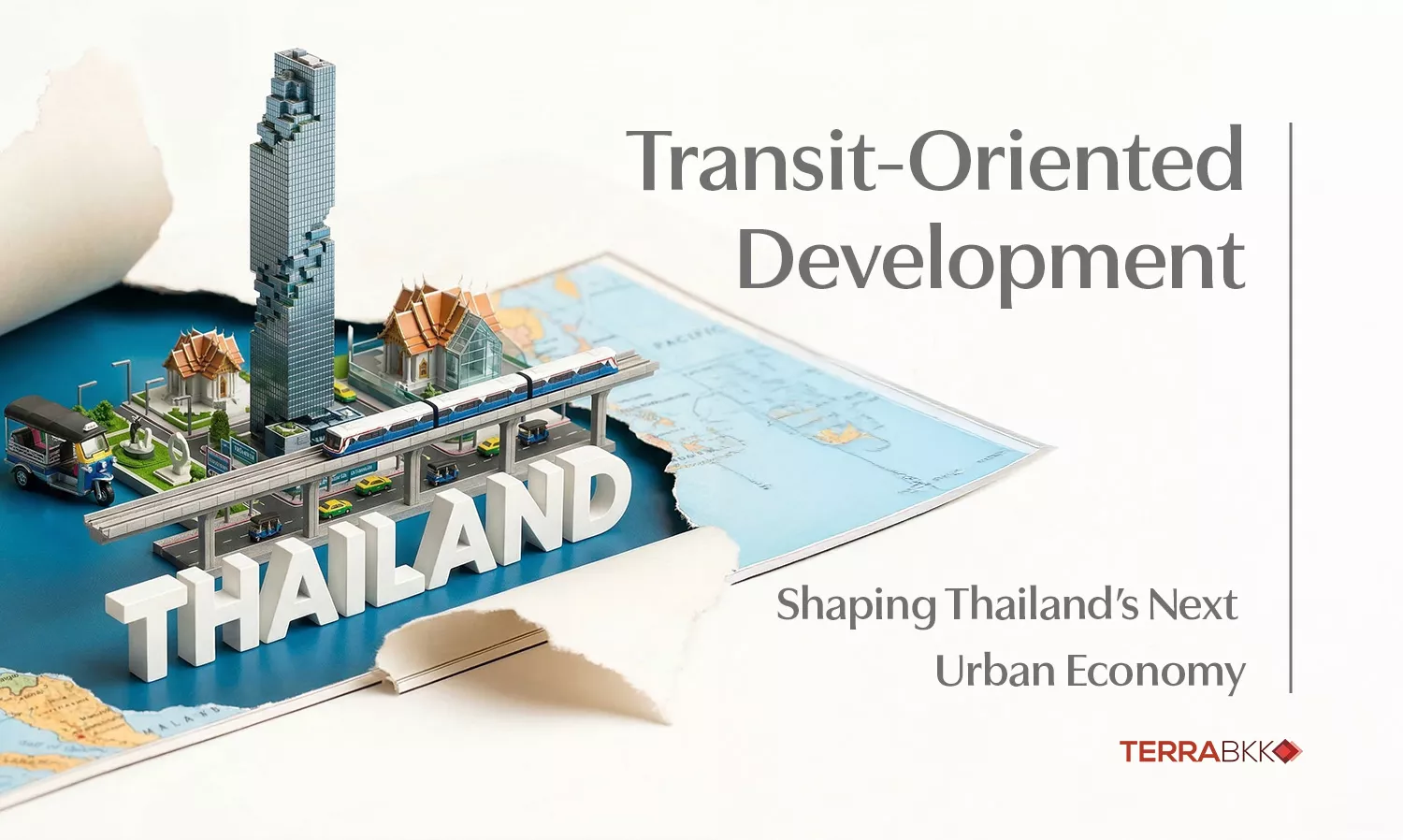
TOD กับอนาคตเมืองไทย: พลิกโครงสร้างพื้นฐาน สู่โครงสร้างเศรษฐกิจใหม่
แผนปฏิบัติการพัฒนาเมืองภายใต้แนวคิด TOD (Transit-Oriented Development) พ.ศ. 2568-2585 ถือเป็นหนึ่งในนโยบายโครงสร้างพื้นฐานที่สำคัญที่สุดของประเทศไทยในรอบหลายทศวรรษ เพราะเป็นครั้งแรกที่ “การพัฒนาเมือง” ถูกวางให้เดินไปพร้อมกับ “ระบบราง” อย่างเป็นระบบในระดับประเทศ ไม่ใช่เพียงการขยายเส้นทางคมนาคม แต่คือการออกแบบรูปแบบการใช้ชีวิตใหม่ ที่ทำให้เมืองเติบโตอย่างมีทิศทางและยั่งยืนมากขึ้น
หัวใจของแผนนี้คือการพัฒนา “พื้นที่รอบสถานี” ให้กลายเป็นศูนย์กลางการใช้ชีวิต (Urban Node) ที่รวมทั้งที่อยู่อาศัย พาณิชยกรรม และพื้นที่เศรษฐกิจไว้ด้วยกัน โดยมีเป้าหมายครอบคลุมถึง 177 สถานีทั่วประเทศ ทั้งรถไฟทางคู่และรถไฟความเร็วสูง ซึ่งสะท้อนให้เห็นว่ารัฐกำลังมอง TOD เป็นโครงสร้างหลักในการขับเคลื่อนเมืองในอนาคต ในเชิงแผนงาน
การพัฒนาแบ่งออกเป็น 4 ระยะ เพื่อให้สอดคล้องกับความพร้อมของโครงสร้างพื้นฐานและตลาดอสังหาฯ โดยเริ่มจากระยะเร่งด่วน (2568–2570) จำนวน 3 พื้นที่ ซึ่งทำหน้าที่เป็น “พื้นที่ต้นแบบ” ก่อนจะขยายไปสู่ 80 พื้นที่ในระยะสั้น (2571–2575) และต่อเนื่องไปยังระยะกลาง 54 พื้นที่ และระยะยาวอีก 40 พื้นที่ จนครบทั้งระบบในปี 2585
สำหรับ “ระยะเร่งด่วน” ซึ่งเป็นเฟสสำคัญในการกำหนดทิศทาง TOD ไทยในระยะยาว แต่ละพื้นที่ถูกออกแบบให้มีบทบาทเฉพาะตัว ดังนี้
พัทยา: จากเมืองท่องเที่ยวสู่ Global Lifestyle & Business Hub
โครงการ TOD พัทยาถูกยกระดับให้เป็น “ศูนย์กลางเศรษฐกิจระดับภูมิภาค” ที่เชื่อมโยงโครงสร้างพื้นฐานสำคัญของประเทศ ทั้งรถไฟความเร็วสูงเชื่อม 3 สนามบิน และการพัฒนาในพื้นที่ EEC โดยมีเป้าหมายสร้าง “เมืองใหม่รอบสถานี” ในรัศมีประมาณ 1,000 เมตร ผ่านแนวคิด Mixed-use ที่ผสานการทำงาน การอยู่อาศัย และไลฟ์สไตล์ไว้ในพื้นที่เดียวกันอย่างครบวงจร
โครงการครอบคลุมทั้งย่านธุรกิจและออฟฟิศ ศูนย์การค้า โรงแรม พื้นที่ MICE รวมถึงที่อยู่อาศัยหลากหลายระดับ และพื้นที่สาธารณะ ซึ่งช่วยยกระดับพัทยาจากเมืองท่องเที่ยว ไปสู่การเป็น Global Lifestyle & Business Hub ที่มีบทบาททางเศรษฐกิจมากขึ้น พื้นที่รวมประมาณ 1.6 ล้านตร.ม. และถูกแบ่งออกเป็น 3 ระยะ เพื่อให้การเติบโตของเมืองเป็นไปอย่างมีทิศทางและสอดคล้องกับดีมานด์ในแต่ละช่วงเวลา
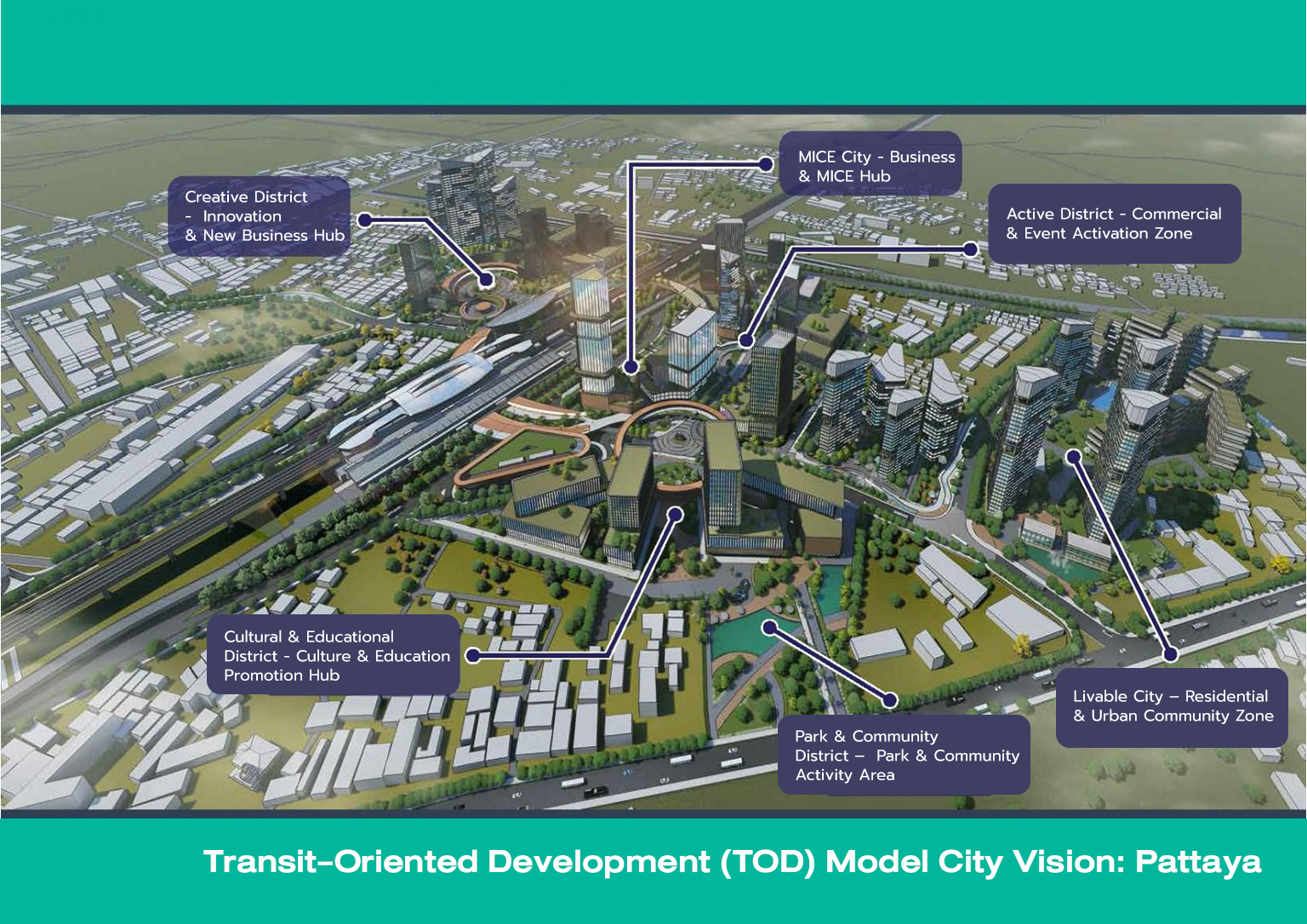
- ระยะสั้น (2569-2572) มุ่งวางโครงสร้างพื้นฐานหลักของเมือง ทั้งถนน ระบบเชื่อมต่อ และโครงข่ายการเดินทางทางเท้า-จักรยาน พร้อมเริ่มพัฒนาโซนเศรษฐกิจ เช่น ศูนย์ประชุมและพื้นที่ธุรกิจ เพื่อดึงดูดการลงทุนและสร้างกิจกรรมทางเศรษฐกิจตั้งแต่ระยะแรก
- ระยะกลาง (2573-2577) เป็นการขยาย “ชีวิตของเมือง” โดยเพิ่มพื้นที่อยู่อาศัย พื้นที่สีเขียว และอาคารสำนักงาน พร้อมเชื่อมโยงพื้นที่เศรษฐกิจเข้ากับชุมชนเดิม เพื่อสร้างสมดุลระหว่างการทำงาน การอยู่อาศัย และคุณภาพชีวิต
- ระยะยาว (2578-2582) พัฒนาไปสู่ “เมืองเต็มรูปแบบ” ที่รองรับทั้งเศรษฐกิจ การค้า การบริการ และการอยู่อาศัยอย่างครบวงจร พร้อมยกระดับระบบขนส่ง การเข้าถึง การออกแบบที่ Universal Design และโครงสร้างพื้นฐาน เพื่อรองรับการเติบโตอย่างยั่งยืน
ภาพรวมของ TOD พัทยาจึงไม่ใช่เพียงการพัฒนาเมืองท่องเที่ยวแบบเดิม แต่เป็นการ “ยกระดับโครงสร้างเมือง” ให้กลายเป็นศูนย์กลางด้านไลฟ์สไตล์และธุรกิจในระดับสากล ที่เชื่อมโยงเศรษฐกิจ การท่องเที่ยว และการอยู่อาศัยเข้าด้วยกันอย่างครบวงจรในจุดเดียว
ขอนแก่น: ต้นแบบ “เมืองเศรษฐกิจอีสาน” บนโครงสร้างระบบราง
การพัฒนาเมืองภายใต้แนวคิด TOD ของจังหวัดขอนแก่น วางบทบาทให้เป็น “ศูนย์กลางเศรษฐกิจของภาคตะวันออกเฉียงเหนือ” โดยมีสถานีรถไฟขอนแก่นเป็นแกนกลาง เชื่อมโยงการคมนาคม เศรษฐกิจ และการใช้ชีวิตเข้าด้วยกันในรูปแบบเมืองกระชับ (Compact City) ที่เน้นระบบขนส่งสาธารณะเป็นหลัก อีกทั้งยังมีจุดแข็งจากฐานเศรษฐกิจเดิม ทั้งการศึกษา การแพทย์ และการค้าชายแดน รวมถึงโครงการ LRT ที่ช่วยเสริมศักยภาพการพัฒนาในอนาคต โครงการมีการคาดการณ์พื้นที่พัฒนาอสังหาริมทรัพย์รวมประมาณ 2.99 ล้านตารางเมตร แบ่งการพัฒนาออกเป็น 3 ระยะ เพื่อให้สอดคล้องกับการเติบโตของเมือง
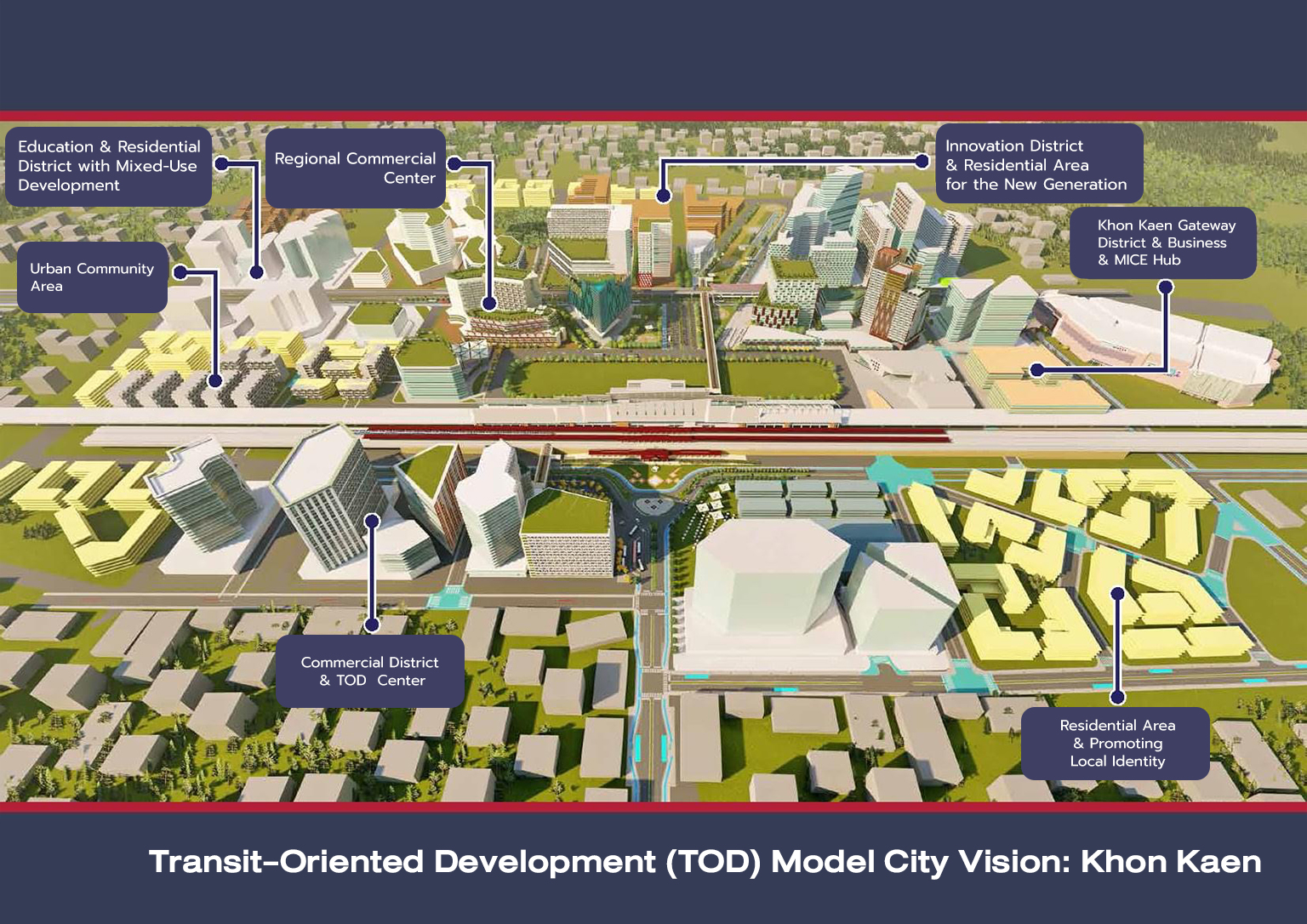
- ระยะสั้น (2569–2572) เน้นการพัฒนาพื้นที่ ส่งเสริมด้านการค้า การลงทุน การพัฒนานวัตกรรม การสร้างแรงงาน ศูนย์การประชุมและการแสดงสินค้า และการสนับสนุนการพัฒนา
- ระยะกลาง (2573–2577) เติมเต็มเมืองด้วยที่อยู่อาศัย พื้นที่สีเขียว สำนักงานเพื่อรองรับการลงทุน การส่งเสริมพื้นที่ แหล่งงาน ศูนย์ประชุมและการแสดงสินค้าเพื่อกระตุ้นเศรษฐกิจโดยรอบบริเวณถนนศรีจันทร์ และถนนมิตรภาพ เพื่อสร้างสมดุลของการใช้ชีวิตและการทำงาน
- ระยะยาว (2578–2582) พัฒนาไปสู่ “เมืองเต็มรูปแบบ” รอบสถานีรถไฟขอนแก่นอย่างเต็มประสิทธิภาพ โดยส่งเสริมพื้นที่ทางเศรษฐกิจ การค้าและการบริการ ที่พักอาศัย พื้นที่สีเขียวและพื้นที่เปิดโล่ง รวมทั้งการพัฒนาพื้นที่แหล่งงาน พื้นที่ด้านการศึกษาและโครงสร้าง พื้นฐานต่าง ๆ
โดยสรุป TOD ขอนแก่นคือการยกระดับเมืองสู่การเป็น “Economic Hub ของอีสาน” ที่เติบโตบนระบบราง และมีศักยภาพเป็นต้นแบบเมืองภูมิภาคของไทยในอนาคต
การพัฒนาเมืองรอบสถานีรถไฟให้เป็น “ศูนย์กลางเศรษฐกิจของอีสาน” บนแนวคิดเมืองกระชับที่เชื่อมการเดินทาง เศรษฐกิจ และการอยู่อาศัยเข้าด้วยกัน จากการสร้างฐานเศรษฐกิจ เพื่อเติมเต็มคุณภาพชีวิต สู่เมืองสมบูรณ์แบบ รองรับการเติบโตในระยะยาวอย่างยั่งยืน
อยุธยา: สมดุล “เมืองประวัติศาสตร์-เมืองเศรษฐกิจใหม่”
การพัฒนา TOD ในจังหวัดพระนครศรีอยุธยา ถูกวางให้เป็นโมเดลที่ผสาน “การอนุรักษ์” เข้ากับ “การพัฒนาเมืองใหม่” โดยเริ่มจากระยะเร่งด่วนในช่วงปี 2567-2568 ซึ่งเน้นการขุดค้นทางโบราณคดีและเตรียมความพร้อมด้านโครงสร้างพื้นฐาน ก่อนจะเริ่มการพัฒนาอสังหาริมทรัพย์อย่างเต็มรูปแบบตั้งแต่ปี 2569 เป็นต้นไป
โครงการมีมูลค่าการลงทุนภาคเอกชนรวมกว่า 26,000 ล้านบาท โดยแบ่งสัดส่วนการพัฒนาเป็นภาคพาณิชยกรรมประมาณ 20% เช่น ศูนย์การค้า ศูนย์ประชุม สำนักงาน โรงแรม และร้านค้า เพื่อสร้างกิจกรรมทางเศรษฐกิจ ขณะที่อีก 80% เป็นการพัฒนาด้านที่อยู่อาศัย ทั้งคอนโดมิเนียมและที่อยู่อาศัยรูปแบบต่าง ๆ รองรับการขยายตัวของเมือง รวมพื้นที่พัฒนาประมาณ 1.16 ล้านตารางเมตร
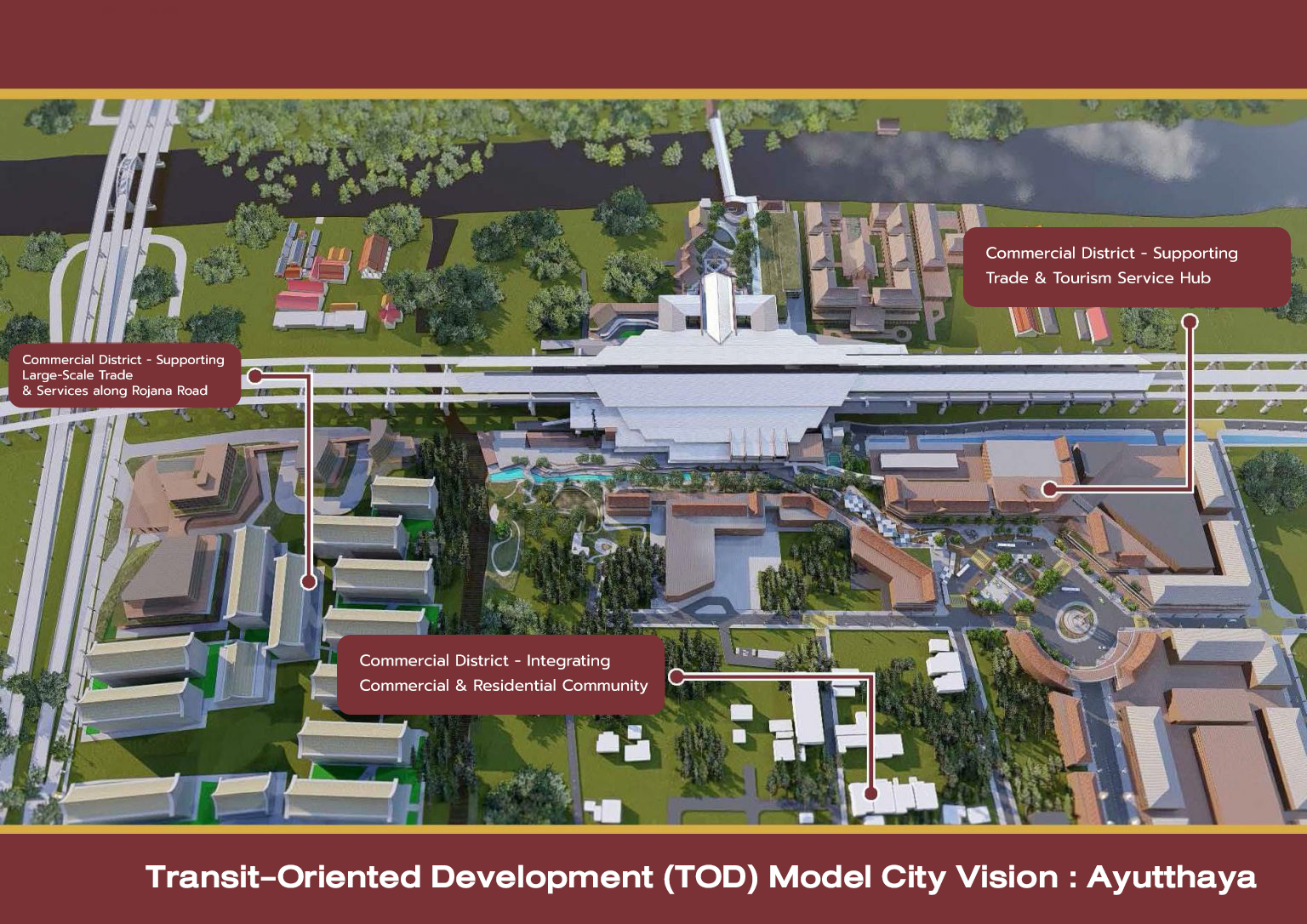
นอกจากนี้ ภาครัฐยังมีบทบาทในการสนับสนุน “ที่อยู่อาศัยสำหรับผู้มีรายได้น้อยถึงปานกลาง” เพื่อให้การพัฒนา TOD อยุธยาเกิดความสมดุลและเข้าถึงได้ทุกกลุ่ม และพัฒนาเมืองเพื่อรักษาอัตลักษณ์เมืองมรดกโลก ควบคู่กับการสร้างเศรษฐกิจใหม่ ซึ่งจะทำให้เมืองเติบโตอย่างยั่งยืนทั้งในมิติประวัติศาสตร์และอนาคต
TOD ช่วยจัดระเบียบการเติบโตของเมืองให้กระชับ ลดการขยายตัวแบบกระจัดกระจาย สร้างศูนย์กลางเศรษฐกิจใหม่ กระจายโอกาสจากเมืองหลักสู่เมืองรอง ยกระดับคุณภาพชีวิต ด้วยการเข้าถึงขนส่งสาธารณะ ลดรถติดและค่าใช้จ่าย ผสานเทคโนโลยี Smart City เพื่อเพิ่มประสิทธิภาพการบริหารเมือง จึงเป็นกลไกสำคัญในการพัฒนาเศรษฐกิจและเมืองอย่างยั่งยืน
Transit-Oriented Development: Shaping Thailand’s Next Urban Economy
Thailand’s Action Plan for Urban Development under the Transit-Oriented Development (TOD) concept (2025–2042) represents one of the most significant infrastructure policies in recent decades. For the first time, “urban development” is being developed in tandem with “rail network” at a national scale. This is not just about expanding the transportation networks—it is about redefining how cities grow, shaping new living schemes that are more structured, efficient, and sustainable.
The core of this project lies in the transformation of areas around the stations into integrated urban transportation centers that combine residential, commercial, and economic functions in one place. The initiative covers 177 stations nationwide, including double-track railways and high-speed rail systems, and put TOD as a foundational framework for future urban development.
The implementation is divided into four phases, aligned with infrastructure readiness and real estate market dynamics. The implementation begins with an urgent phase (2025–2027) covering three pilot areas, which serve as sandboxes. The next phase continues on 80 areas (2028–2032), followed by 54 areas in the following phase and 40 areas afterward, with full nationwide implementation targeted by 2042.
Pattaya: From Tourism City to a Global Lifestyle & Business Hub
The TOD development in Pattaya is being elevated into a “regional economic hub,” strategically connected to key national infrastructures. This includes the high-speed rail linking three major airports and developments within the Eastern Economic Corridor (EEC).
The vision is to create a “new city around the station” within a radius of approximately 1,000 meters, based on a mixed-use concept that seamlessly integrates work, living, and lifestyle. The development encompasses business districts, office spaces, retail centers, hotels, MICE facilities, diverse residential options, and public spaces—effectively transforming Pattaya from a tourism-driven city into a Global Lifestyle & Business Hub with stronger economic significance.
With a total development area of approximately 1.6 million square meters, the project is structured into three phases:
- Phase 1 (2026–2029): Focus on building core infrastructure, including roads, connectivity networks, and pedestrian and cycling networks. Key economic zones such as convention centers and business districts will be initiated to attract early investment.
- Phase 2 (2030–2034): Expand the “life of the city” by adding residential areas, green spaces, and office developments, while integrating new economic zones with existing communities to create a balanced urban ecosystem.
- Phase 3 (2035–2039): Evolve into a fully developed city supporting commerce, services, and residential life, with enhanced transport systems, accessibility, universal design, and sustainable infrastructure.
Overall, TOD Pattaya is not simply a redevelopment of a tourism city—it is a structural transformation into an internationally connected hub where economy, tourism, and urban living converge seamlessly.
Khon Kaen: A Prototype “Economic Hub of the Northeast” on Rail Infrastructure
Under the TOD framework, Khon Kaen is positioned as the “economic center of Northeastern Thailand,” with Khon Kaen Railway Station serving as the core of a compact city model that integrates transportation, economy, and lifestyle through public transit-oriented development.
The city’s existing strengths—including education, healthcare, and cross-border trade—combined with the Light Rail Transit (LRT) project, further enhance its development potential. The total projected real estate development area is approximately 2.99 million square meters, divided into three phases:
ผ
- Phase 1 (2026–2029): Emphasis on trade, investment promotion, innovation development, workforce creation, and the establishment of convention and exhibition centers to stimulate early economic activity.
- Phase 2 (2030–2034): Strengthen the urban fabric by adding residential developments, green spaces, and office buildings to support growing investments. Economic activities will be concentrated along key corridors such as Srichan Road and Mittraphap Road, creating a balance between work and living.
- Phase 3 (2035–2039): Develop into a fully functional station-centered city, with expanded economic zones, commercial and service sectors, residential areas, green spaces, employment hubs, educational institutions, and supporting infrastructure.
TOD Khon Kaen represents a strategic elevation of the city into a regional economic hub driven by rail infrastructure—positioning the city as a future model for regional urban development in Thailand.
Ayutthaya: Balancing “Historic Preservation” and a New Economic City
The TOD development in Phra Nakhon Si Ayutthaya is designed as a model that integrates “heritage conservation” with “modern urban development.” The urgent phase (2024–2025) focuses on archaeological excavation and infrastructure preparation before full-scale real estate development begins in 2026.
The project involves private sector investment exceeding THB 26 billion, with approximately 20% allocated to commercial development—including retail centers, convention facilities, offices, hotels, and retail spaces—to drive economic activity. The remaining 80% is dedicated to residential development, including condominiums and various housing types, accommodating urban expansion across a total development area of approximately 1.16 million square meters.
Importantly, the government also plays a role in supporting “affordable housing for low- to middle-income groups,” ensuring that TOD development in Ayutthaya remains inclusive and accessible. At the same time, urban planning prioritizes the preservation of the city’s UNESCO World Heritage identity while fostering new economic growth—creating a sustainable balance between history and the future.
TOD serves as a powerful framework to restructure urban growth—promoting compact development, reducing urban sprawl, and creating new economic centers that distribute opportunities beyond primary cities to secondary ones.
It enhances quality of life by improving access to public transportation, reducing traffic congestion and cost of living, while integrating Smart City technologies to improve urban management efficiency.
Ultimately, TOD is not just an infrastructure strategy—it is a transformative framework that reshapes both cities and economies, paving way for sustainable, inclusive, and future-ready urban development in Thailand.