The Benefits of a Weak Baht: Thai Export Growth Expected at 5% in 2022
Dr. Chaiyan Charoensuk, President of the Thai National Shippers' Council (TNSC) stated that in March 2022, Thailand's international trade showed that exports were valued at 28.8596 billion USD, growing by 19.5%, and in Thai baht, this amounted to 922.313 billion baht, an increase of 28.7% (excluding gold, oil, and military equipment, exports in March grew by 8.9%). Meanwhile, imports were valued at 27.4006 billion USD, an increase of 18%, and in Thai baht, this was 887.353 billion baht, growing by 26.8%. This resulted in a trade surplus for Thailand in March 2022 of 1.4591 billion USD, or 34.960 billion baht.
In the overall picture of Thailand's international trade from January to March 2022 compared to the same period last year (YoY), it was found that total exports were valued at 73.6014 billion USD, growing by 14.9%, and in Thai baht, this was 2.401444 trillion baht, an increase of 26.1% (excluding gold, oil, and military equipment, exports during January to March grew by 8.7%). Meanwhile, imports were valued at 74.5453 billion USD, an increase of 18.4%, and in Thai baht, this was 2.466654 trillion baht, growing by 29.9%. This resulted in a trade deficit for Thailand from January to March 2022 of 944 million USD, or 65.210 billion baht.
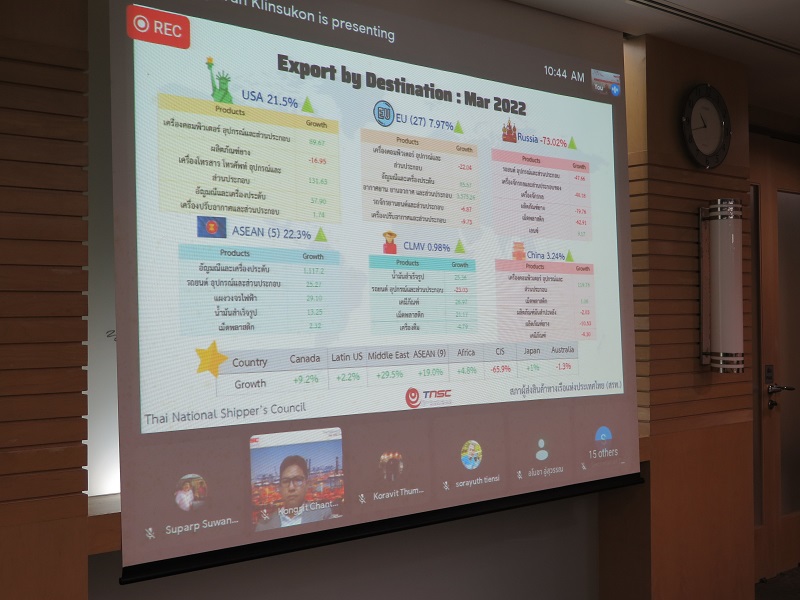
The TNSC forecasts Thai exports in the second quarter of 2022 to grow by 3.5 - 5%, maintaining an overall forecast for the entire year of 5% (as of May 2022), with significant risk factors hindering growth in 2022 including:
1) The conflict between Ukraine and Russia has slowed global trade, particularly in goods that Russia and Ukraine have the potential to export worldwide, such as oil, natural minerals, and consumer goods, especially agricultural products and processed foods, which have seen rising prices and shortages. Recently, Russia has begun to halt energy supplies to Poland and Bulgaria.
2) High energy prices have increased the value of oil-related products, which in turn has raised production costs for nearly all types of goods, including transportation costs that must adjust according to global energy market prices, leading to a significant increase in commodity prices worldwide.
3) Freight rates have slightly decreased but remain high on routes to Europe due to the overall conflict between Russia and Ukraine, while freight rates on routes to the eastern United States have increased due to sustained high demand for transportation. Meanwhile, China is experiencing a lockdown in Shanghai, a major port, resulting in delays of over a week for ships waiting to dock. Some shipping lines have implemented blank sailings, and some operators are beginning to avoid transporting to major ports.
4) A continuous shortage of labor in the manufacturing sector is compounded by a potential increase in labor costs, impacting a manufacturing sector already facing high production costs.
5) Shortages and price volatility of raw materials, such as semiconductors, steel, natural minerals, and essential and intermediate consumer goods.
6) The COVID-19 pandemic situation has seen many countries gradually relax entry measures, including Thailand, which reopened on May 1. This has made travel for tourism and business more fluid, while some countries still maintain strict COVID testing measures before entry, such as China, which has recently seen a significant increase in COVID-19 cases amid the spread of the easily transmissible Omicron variant. Nonetheless, it is essential to closely monitor and assess the pandemic situation.
In this regard, the Thai National Shippers' Council has made several important recommendations:
1. Increase the minimum wage
1.1) The government should consider adjusting the minimum wage based on inflation rates while managing inflation to not exceed 5%, so that businesses do not bear excessive burdens. It is also recommended to implement gradual increases, as businesses currently face relatively high labor costs, especially for imported foreign labor averaging about 12,000 baht per person. Therefore, if the increase is too high, it may impact SMEs that are still recovering from the effects of COVID-19 and may not have sufficient capacity to raise the minimum wage at this time.
1.2) The government should consider controlling or reducing the cost of living for citizens, such as transportation costs via public transport (Mass transportation), water, electricity, and energy costs (oil and LPG), as well as the costs of essential commodities for daily living. This would help reduce the daily expenses of citizens and lower production costs for businesses, both in terms of labor and machinery, instead of controlling the prices of goods from businesses amid rising production costs, such as oil prices, transportation, and raw materials used in production. If the costs for businesses are lower, they can manage their costs within the system and do not need to pass the burden onto consumers.
2. Maintain stable domestic oil prices at a reasonable level through mechanisms or tools to control impacts on businesses and consumers.
3. Accelerate the search for additional market expansion opportunities in potential secondary markets that may provide opportunities for Thai products to replace those affected by reduced orders from Russia and Ukraine.
4. Strengthen trade relationships to enhance and stimulate trade activity through exhibitions and business matching, and push for increased trade into the RCEP market to maximize benefits from the agreement.