"New Office Buildings" Will Change Starting from 2021
"Office buildings" are places that are used throughout the day by many people. After the emergence of the new disease, COVID-19, how will the direction change? What should design trends focus on to meet the working and lifestyle needs of today's people? Listen to insights from Dr. Jakkrich Leuangjaroenrat, Studio Director at Gensler (Thailand) Co., Ltd.Gensler, a company specializing in architecture, interior design, and urban planning, ranked number 1 in the world for design by Architectural Record in 2020, who shared exclusive insights with TerraBKK first.
About Gensler
Developing tools for planning and designing buildings for a diverse world.
During the COVID-19 crisis last year, many things had to come to a halt. Many design firms took this opportunity to improve their tools for greater efficiency. Gensler is one of the most prominent examples, using last year to develop and enhance its tools, enabling designers to use data to drive the design of neighborhoods, buildings, and interiors quickly. It also helps visualize completed projects at a human scale, allowing for designs that better accommodate diverse groups of people. Reference from www.fastcompany.com

Exterior Design of Buildings in the New Normal Era
When it comes to change, we must acknowledge that changes are already happening because people's behaviors adapt to their environments. In the past, we didn't care much about global warming, and we didn't see the need to change our eating and living habits. However, as we observe the changes in the world that create problems affecting humanity, such as rising temperatures, heavier rainfall, and stronger winds, people are starting to change their behaviors. Today, we discuss the changes brought about by the new disease. Last year, we had no idea what COVID-19 was, but this year we understand it better. However, whether we understand it well enough is something we need to consider in the long term. We can see that what has happened has certainly impacted us, especially regarding buildings, lifestyles, and interior spaces, which will definitely undergo adjustments.

"New Office Buildings" Will Change Starting from 2021
We need to look at it in groups, meaning if we consider residential buildings, office buildings, shopping malls, and hotels, as Thailand is a tourist city.
When discussing office buildings, we must first consider what factors necessitate change. The first factor is mobility, which refers to the movement of people. In the past, people relied on buses, but now we have electric trains, making it easier for people to move from the north, south, and west to the center.
The next factor is that everyone now has the option to choose whether to work in the office or stay home, along with changing environmental conditions. Lastly, health and environmental conditions, particularly concerning new diseases, are components that blend together, impacting both the interior and exterior of buildings.
For future office buildings, when considering space, we must evaluate whether the interior space is suitable. Currently, new diseases emerge rapidly, and we may not be able to make significant changes because these buildings were completed before the pandemic.
Thus, we need to consider two aspects: buildings completed before the pandemic and buildings that need to be newly constructed to respond to new diseases.
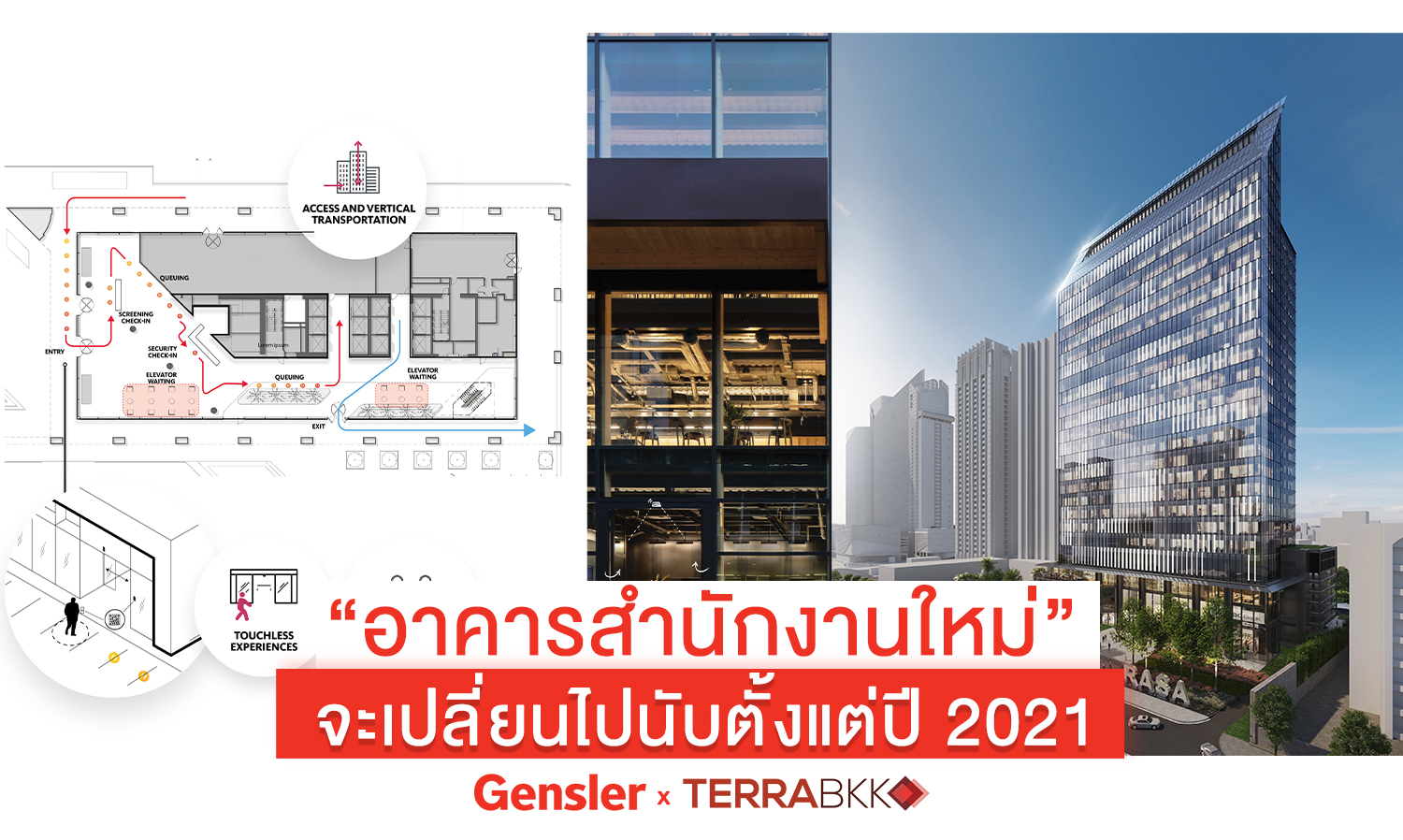
For existing buildings, people will need to change their behaviors, such as adjusting entry and exit patterns to reduce cross-traffic. How should offices adjust to minimize encounters? Utilizing common areas to reduce contact can take various forms. If the building is large with ample public space, there may be areas designed to prevent people from crossing paths. However, if the space is smaller, we may need to find solutions, such as installing partitions to reduce encounters. Additionally, installing temperature detection devices is essential to ensure we know the status of individuals entering our space to protect employees.
Lastly, there should be applications like 'Chana' or 'Mor Chana,' or even applications used abroad, to allow employees to install and track their risk of infection from others in the workplace.

New diseases impact changes in work behavior
The behavior of using office spaces will change. Previously, all employees had to come to work at the same time, but in the future, if people have the option, 50% may work in the office while the other 50% can work from home. Consequently, offices will not need to accommodate all employees, and the size of the space will decrease. The building itself may not need to shrink, but the usable area will be smaller.
Secondly, we envision that if office buildings in Bangkok are tall structures with open spaces only at the bottom, Gensler believes that in the future, every floor of the building should have open areas or terraces for people to breathe fresh air before returning to work. We see that outdoor air is cleaner than indoor air, especially considering PM 2.5 levels in our country. On days with clear air, the outside is cleaner than inside because indoor air is recirculated. We believe that in the future, fresh air must be brought in from outside.
Furthermore, we also consider that if people have the option to travel, the common areas that are not office spaces must also be rethought. For instance, regarding parking spaces, if today the law states that one car requires 60 square meters, and in the future, more people turn to public transport, resulting in fewer drivers, these parking spaces may become unnecessary. Therefore, how can we utilize these spaces effectively in the future?

Therefore, new buildings must incorporate new designs to accommodate future changes in parking space requirements, especially in cases of legal changes and fewer drivers.
Secondly, there are new transportation options. For instance, if I say I prefer not to travel by electric train but would rather ride a bicycle, modern buildings may need to include bike storage, showers, and lockers, considering future needs. I believe these changes are inevitable as the world is rapidly evolving, and this is a trend.
Regarding health within office buildings, it involves spatial planning to minimize encounters when unnecessary, along with the development of touchless technology, such as replacing lift buttons with mobile applications that use scanning instead of touch, merging health and technology together.
I believe that buildings in Thailand are beginning to adapt, and older buildings need to adjust as well. Designers of new buildings must think innovatively to ensure that office buildings incorporate additional elements to meet the changing environmental conditions and lifestyles of people.