Fiscal Policy Office Reveals 'Thai Economy December 2021' Recovers from the Benefits of Reopening - Tourism - Exports
Fiscal Policy Office reported that the Thai economy in December 2021 improved compared to the previous month, especially in private consumption, domestic tourism, foreign tourists, and exports, which continued to grow at a high level. However, the situation of the Omicron variant of COVID-19 needs to be monitored closely.
.jpg)
Mr. Pornchai Teeravech, Director of the Fiscal Policy Office stated that the economic indicators for private consumption showed signs of improvement from the previous month, reflected by the number of newly registered motorcycles, which grew by 16.6% compared to the same period last year and increased by 4.8% after adjusting for seasonal effects.
This aligns with the Consumer Confidence Index, which rose to 46.2 from 44.9, due to the improved COVID situation leading to increased economic activities, with both the public and businesses spending more. Meanwhile, the value-added tax collection at constant prices continued to grow by 25.8% compared to the same period last year and increased by 8.8% after adjusting for seasonal effects. However, the sales volume of passenger cars decreased by 29.1% compared to the same period last year, and the real income of farmers fell by 4.2% year-on-year.
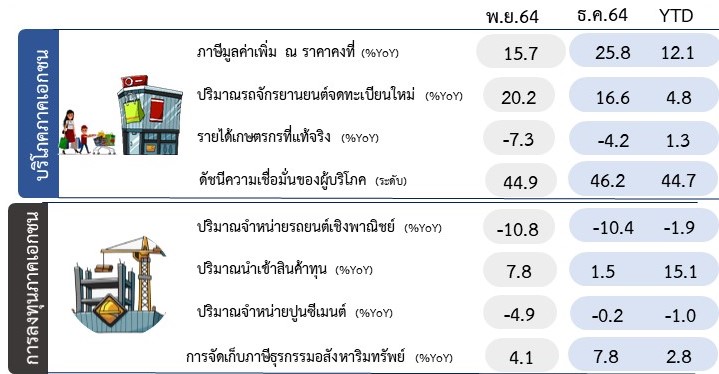
On the other hand, the economic indicators for private investment showed signs of improvement from the previous month, particularly in machinery, as reflected by the volume of capital goods imports, which grew by 1.5% compared to the same period last year. The sales of commercial vehicles contracted at a slower rate of 10.4% year-on-year but increased by 1.7% compared to the previous month after adjusting for seasonal effects.
For investment in the construction sector, the volume of domestic cement sales slightly decreased by 0.2% compared to the same period last year but increased compared to the previous month. Meanwhile, property transaction taxes grew by 7.8% and increased by 2.1% after adjusting for seasonal effects.
Meanwhile, the value of exports continued to grow, with total export value in US dollars reaching $24,930.3 million, an increase of 24.2%. Excluding oil and related products, gold, and military equipment, the growth rate was 23%. The products that performed well included:
1. Agricultural and food products, especially cassava products, rice, fresh fruits (chilled, frozen, dried, canned, and processed), and rubber, which grew by 48.1%, 24.9%, 23.7%, and 22.7%, respectively.
2. Products related to working from home, such as computers, equipment and components, and telephones and devices, as well as household appliances like microwaves, refrigerators, air conditioners, and televisions and components.
3. Products related to infection prevention and control, such as medical instruments and equipment, and pharmaceutical products, which continue to receive ongoing orders.
4. Intermediate goods or raw materials, such as steel and products, chemicals, plastic pellets, electrical circuit boards, and machinery and components.
5. Automotive products, equipment, and components continued to grow at a high rate of 45%.
The main trading partners of Thailand showed continuous improvement in all markets, especially exports to major markets such as Australia, the USA, and South Korea, which grew by 54.4%, 36.5%, and 35.0%, respectively, compared to the same period last year.

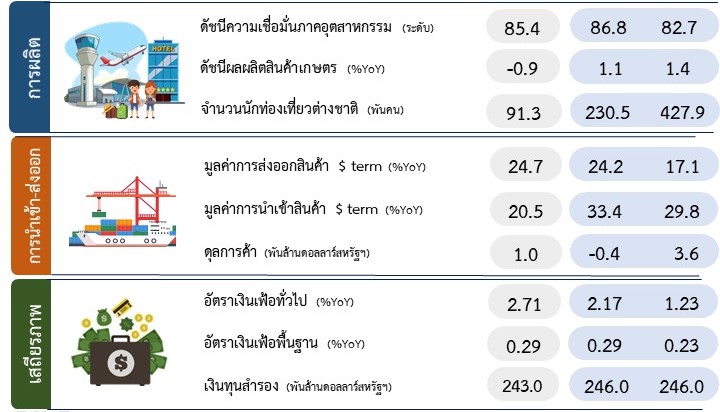
The indicators for the Thai economy on the supply side showed signs of improvement, with the industrial confidence index rising to 86.8 from 85.4 in the previous month, following the recovery of domestic demand after the COVID situation improved, as well as the continued growth of the export sector.
Regarding tourism services, there were 230,497 foreign tourists of special categories, including Thailand Privilege Card holders, business travelers, and health tourists seeking medical services in Thailand, marking the highest increase in 21 months.
Most of these tourists came from Germany, the UK, Russia, the USA, and Sweden, supported by measures allowing tourists from 63 countries to enter Thailand without quarantine (Test and Go). Domestic tourism also saw 15.95 million Thai tourists, representing a growth of 4.7%, marking the first growth in six months.
Meanwhile, the agricultural sector grew by 1.1%, decreasing compared to the previous month after adjusting for seasonal effects by -4.2%, due to declines in key crops such as paddy, corn, cassava, pigs, and chickens. However, the production of factory sugarcane and palm oil continued to grow.
Nevertheless, the economic stability remains good, reflected by the general inflation rate in December 2021 at 2.17%, while the core inflation rate stood at 0.29%. The public debt ratio at the end of November 2021 was 59.6% of GDP, which is still within the fiscal discipline framework set by the Fiscal Responsibility Act of 2018.
As for external stability, it remains at a stable level and can withstand risks from global economic fluctuations, reflected by international reserves at the end of December 2021, which stood at a high level of $246 billion.