Sustainable Aviation Fuel: The Gap Between Global Demand and Supply and Thailand's Role
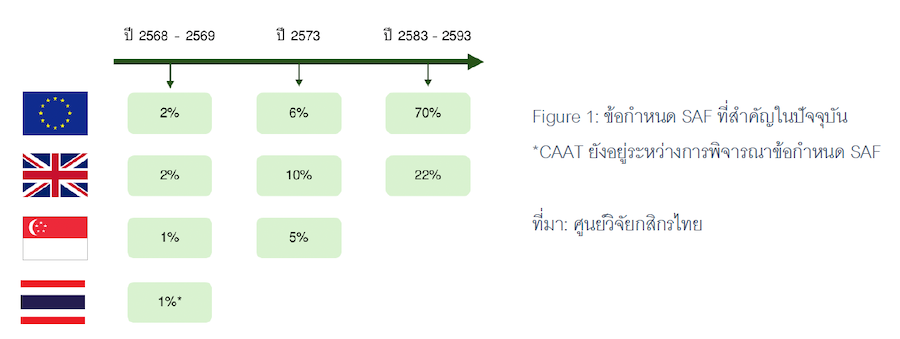
- Global aviation regulatory bodies are beginning to set regulations regarding the target proportion of Sustainable Aviation Fuel (SAF) that airlines must use by 2025, with the European Union setting a target of 2%, followed by regional targets of 1% for Singapore and Thailand by 2025.
- Global supply is significantly lower than demand. The European Union needs to increase production capacity by more than 40 times to meet the initial SAF target.
- If a new SAF production facility in Thailand can secure raw materials, it will enable Thai airlines to have sufficient SAF until 2030.
Introduction
What is SAF? The aviation industry is responsible for 2-3% of global carbon dioxide emissions, making it a crucial sector in reducing carbon emissions across industries. One of the primary mechanisms is replacing conventional aviation fuel with Sustainable Aviation Fuel (SAF), which is already being used by over 40 airlines.
SAF is a renewable fuel that can power aircraft with significantly lower carbon emissions compared to conventional fossil-based aviation fuel, expected to reduce emissions by up to 80% compared to traditional aviation fuel.
The key point of SAF is that it is a "Drop-in Fuel," meaning it can be used in existing aircraft without engine modifications. This allows SAF to be blended with conventional aviation fuel at a maximum ratio of 50% currently.
Analysis
Regulations and Supply Gaps: Currently, there is a gap between upcoming SAF requirements and global SAF production supply, which may prevent the European Union, a leader in SAF regulations, from achieving its SAF usage targets.
There is currently global pressure for airlines to adopt SAF, with the European Union leading the way by setting a target for airlines to use 2% SAF by 2025, rapidly increasing to 70% by 2050. In the ASEAN region, Singapore is the first country to set a regulation of 1% by 2025, while the Civil Aviation Authority of Thailand (CAAT) is also considering a 1% requirement by 2025.
However, current supply is insufficient to meet demand. The European Union needs to increase production capacity by more than 40 times to meet the SAF target. Currently, flights entering the European Union consume 65 million tons of aviation fuel annually, while production facilities in the EU can produce only 0.24 million tons, accounting for just 0.04% of total fuel.
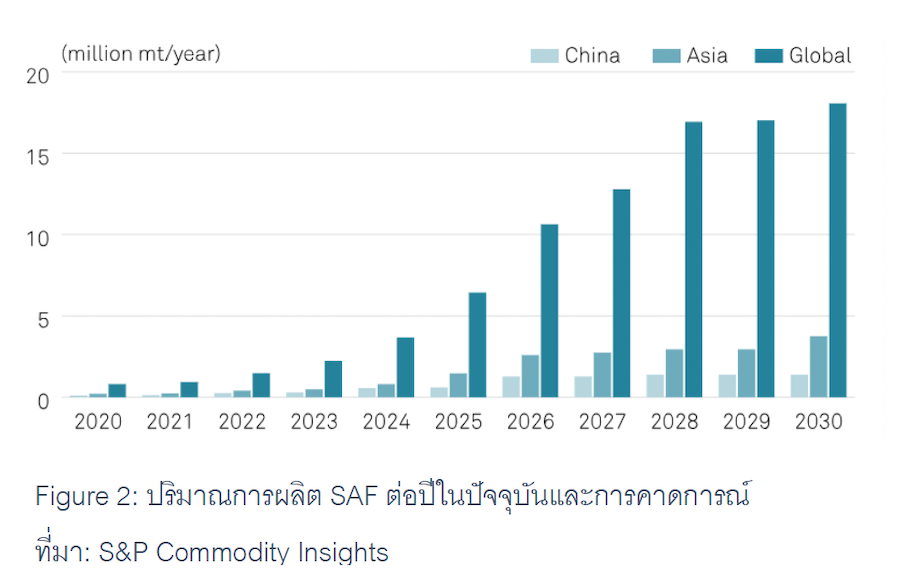
Global SAF supply is significantly lower than demand, with global SAF supply at 1.5 million tons per year, tripling from 2023. Despite this significant increase, it accounts for only 0.53% of global aviation fuel demand in 2024 (with global aviation currently using 316 million tons of fuel).
Current production capacity is below the estimated demand for SAF, which is 24 million tons per year needed to meet requirements. Despite numerous new project announcements each year, supply is concentrated, with 76.8% of total projected production coming from 10 companies.
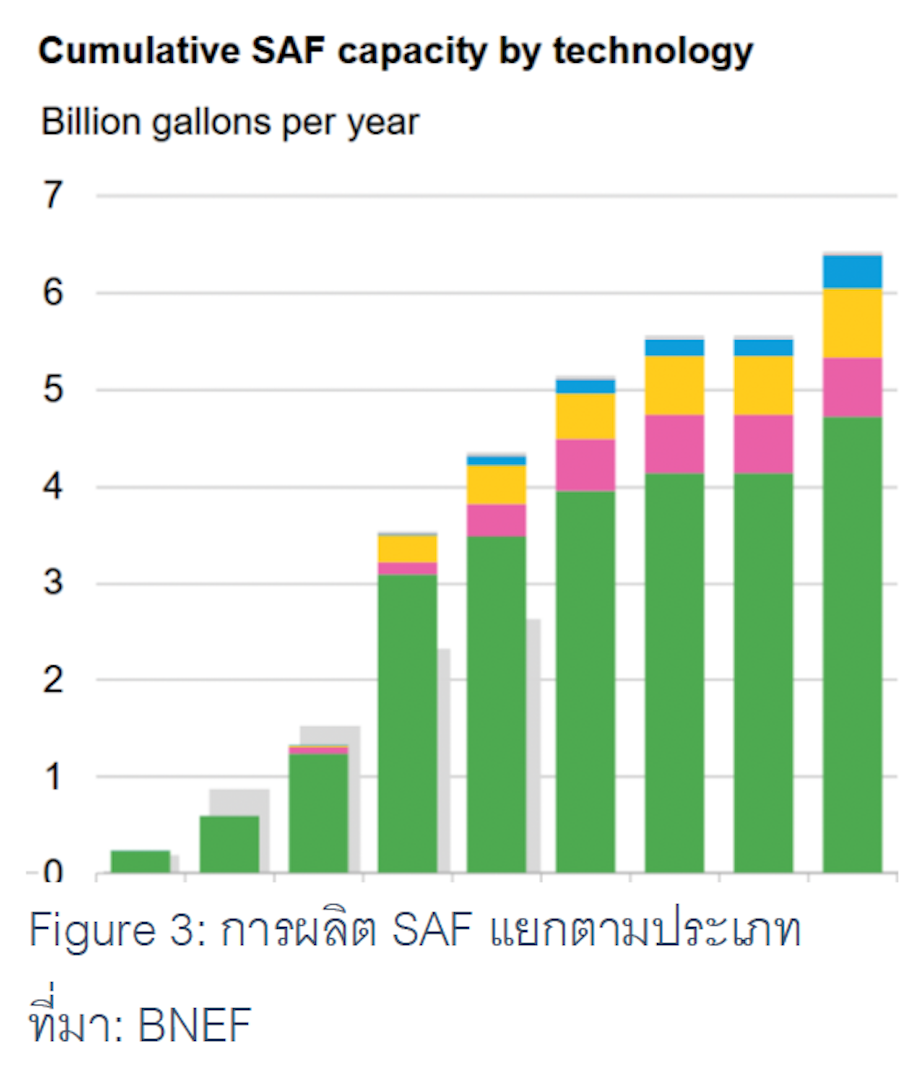
Currently, almost all SAF is produced using waste oils and converted into SAF through a process called Hydroprocessed Esters and Fatty Acids (HEFA), as it is similar to traditional oil refining, which is the same process used by Thailand's only SAF production facility.
It is expected that SAF production using the HEFA process will create sufficient supply to meet the 2030 target, but challenges from limited raw materials will affect future production capacity. Although alcohol-based fuels and gas-to-liquid alternatives are lower-cost raw materials than HEFA, both face technological barriers, necessitating adjustments and technology development to support SAF costs and impacts on airline profitability. Currently, SAF is priced 1.5 to 3 times higher than conventional aviation fuel, which poses a significant barrier for airlines, as fuel costs account for about 31% of operational expenses, while the global aviation industry has a low profit margin of around 2.6% to 3.1%.
Rising fuel costs will undermine profitability, limiting the blending rate of SAF to no more than 6.4% to 7.5% (if Cost Structure is not adjusted). This makes it challenging for airlines to adopt SAF widely without support or subsidies from the government.
Thailand's Role in Implementing SAF
The Civil Aviation Authority of Thailand (CAAT) is studying the feasibility of enforcing a 1% SAF requirement by 2025, in line with Singapore, where most airlines will already be affected by Singapore's and the European Union's regulations. For Thailand's requirement, it will only apply to domestic flights.
In Thailand, there is only one operator, the first in Thailand focusing on SAF, which is Bangchak Corporation, currently constructing a facility in Phra Khanong with a goal to produce 2.3 million barrels of SAF per year by 2025. If successful, the SAF volume will be sufficient for both domestic use and export (accounting for 6.5% of Thailand's aviation fuel consumption).
Appendix
The Chemistry of SAF
SAF consists of hydrocarbons similar to those found in conventional aviation fuel but has lower sulfur and aromatic content and lower energy density.
The reduction in sulfur results in lower emissions of harmful pollutants, such as sulfur oxides (SOx) and particulates. However, the lower aromatic content may affect fuel system seals, which is why SAF currently needs to be blended with conventional aviation fuel for use in existing aircraft engines.
The carbon chain of SAF is relatively shorter, with an energy density lower by 15-20% compared to conventional aviation fuel, meaning slightly more fuel is needed to achieve the same power output. SAF is hydrogenated with an average chain length of C11, while Jet-A1 fuel consists of a variety of carbon chain lengths, including C9, C10, C14, and C17.
How is SAF produced? SAF is produced using several methods, the most common of which are:
- Hydroprocessed Esters and Fatty Acids (HEFA): The most widely used method, HEFA SAF is produced from waste oils, fats, and used cooking oils.
- Alcohol-to-Jet (AtJ): Converts alcohol, such as ethanol, into aviation fuel, allowing for agricultural feedstocks like sugarcane.
- Fischer-Tropsch (FT): Converts biomass into synthetic hydrocarbons through gasification.
- Gas to Liquids (GtL): Uses gases, such as H2, mixed with CO2 to produce SAF.
- Power to Liquids (PtL): Uses renewable energy to capture CO2 from the air and mix it with water using electricity to create SAF.
- Pyrolysis: Uses heat to break down materials into other substances.