Thai Export Growth Target Adjusted to 5-8%, Confidence in Growth Opportunities Amid Volatility
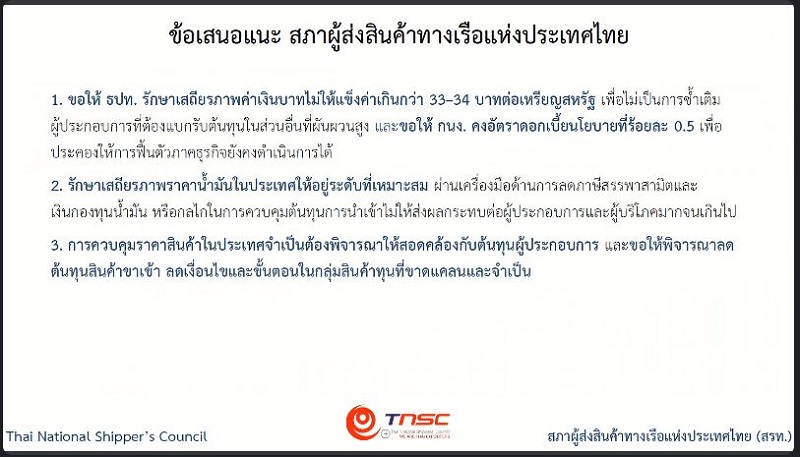
Thai National Shippers' Council (TNSC)<\/strong><\/span> <\/strong><\/span>adjusts export growth target to 5-8%<\/strong><\/span> and is confident that there are still growth opportunities in the second half of the year despite volatility. The government is advised to support businesses through measures to stabilize the Thai baht, keeping it from appreciating beyond 33-34 baht per US dollar, maintaining domestic oil price stability, and controlling essential domestic product prices. It is necessary to consider reducing the costs of imported goods and simplifying conditions and procedures for scarce and essential products.<\/strong><\/span><\/p>
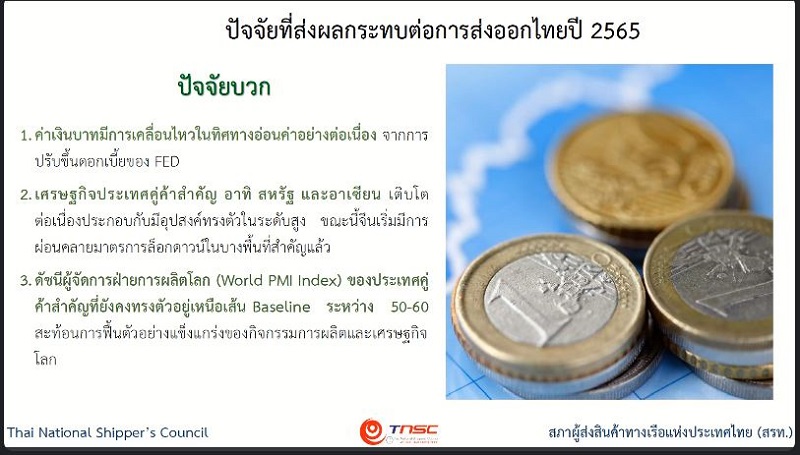
Dr. Chaiyan Charoensuk, President of the Thai National Shippers' Council (TNSC)<\/strong><\/span> stated that the TNSC forecasts Thai exports in the second quarter of 2022 to grow by 3-5% while maintaining the overall forecast for 2022 at 5-8%<\/strong><\/span>. The positive factors<\/span><\/strong> include a weakened baht, continuous growth in key trading partner economies such as the United States and ASEAN, the easing of lockdown measures in some areas of China, and the global Purchasing Managers' Index (PMI) of key trading partners remaining above the baseline line of 50-60, reflecting a strong recovery in manufacturing activity and the global economy.<\/p>
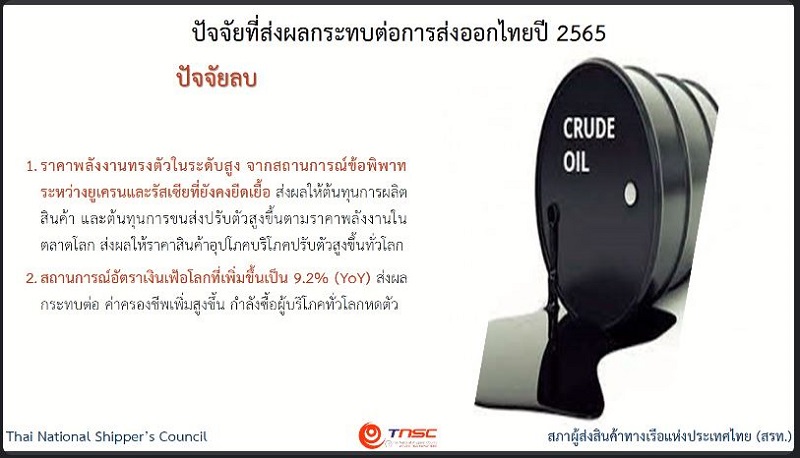
However, it is necessary to monitor risks<\/strong><\/span> from high energy prices due to the ongoing situation between Ukraine and Russia, which has led to increased transportation costs in line with global energy prices. Additionally, the global inflation rate has risen to 9.2%, impacting the cost of living. The shipping situation remains tight on many routes, and freight rates for maritime transport remain high. Furthermore, the shortage of raw materials and fluctuating prices have led many countries to begin implementing measures to restrict the export of agricultural and food products.<\/p>
<\/p>
<\/p>
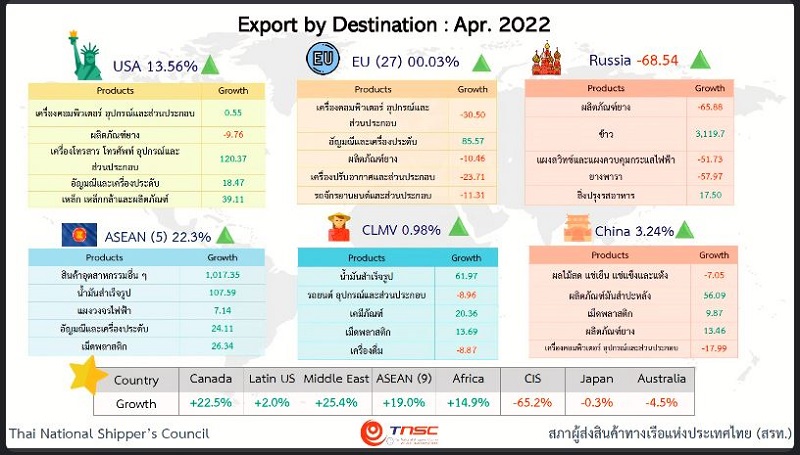
In April 2022, the international trade situation of Thailand<\/strong><\/span> showed that exports were valued at 23,521.4 million USD, expanding by 9.9% compared to the same month last year (YoY), with a value in Thai baht of 782,146 million, expanding by 19.3% (excluding gold, oil, and military equipment, exports in April expanded by 6.9%).<\/p>
Meanwhile, imports were valued at 25,429.8 million USD, expanding by 21.5%, with a value in Thai baht of 856,253 million, expanding by 31.7%. This resulted in Thailand's trade balance in April 2022 showing a deficit of 1,908.4 million USD or 74,107 million baht.<\/p>
For the first four months (January - April 2022), Thailand's total exports were valued at 97,122.8 million USD, expanding by 13.7%, with a value in Thai baht of 3,183,591 million, expanding by 24.3% (excluding gold, oil, and military equipment, exports from January to April expanded by 8.2%).<\/p>
Imports were valued at 99,975.1 million USD, expanding by 19.2%, with a value in Thai baht of 3,322,907 million, expanding by 30.3%. This resulted in Thailand's trade balance from January to April 2022 showing a deficit of 2,852.4 million USD or 139,316 million baht.<\/p>
<\/p>
Nevertheless, the TNSC requests the Bank of Thailand to maintain the stability of the baht, keeping it from appreciating beyond 33-34 baht per US dollar<\/span><\/strong>, as well as to maintain domestic oil price stability at appropriate levels through measures such as reducing excise taxes and the oil fund, or mechanisms to control import costs to avoid excessive impacts on businesses and consumers. Additionally, controlling domestic product prices should be aligned with the costs incurred by businesses, and consideration should be given to reducing the costs of imported goods and simplifying conditions and procedures for scarce and essential products.<\/p>
 <\/p>
<\/p>
 <\/p>
<\/p>
 <\/p>
<\/p>
 <\/p>
<\/p>
 <\/p>
<\/p>
 <\/p>
<\/p>