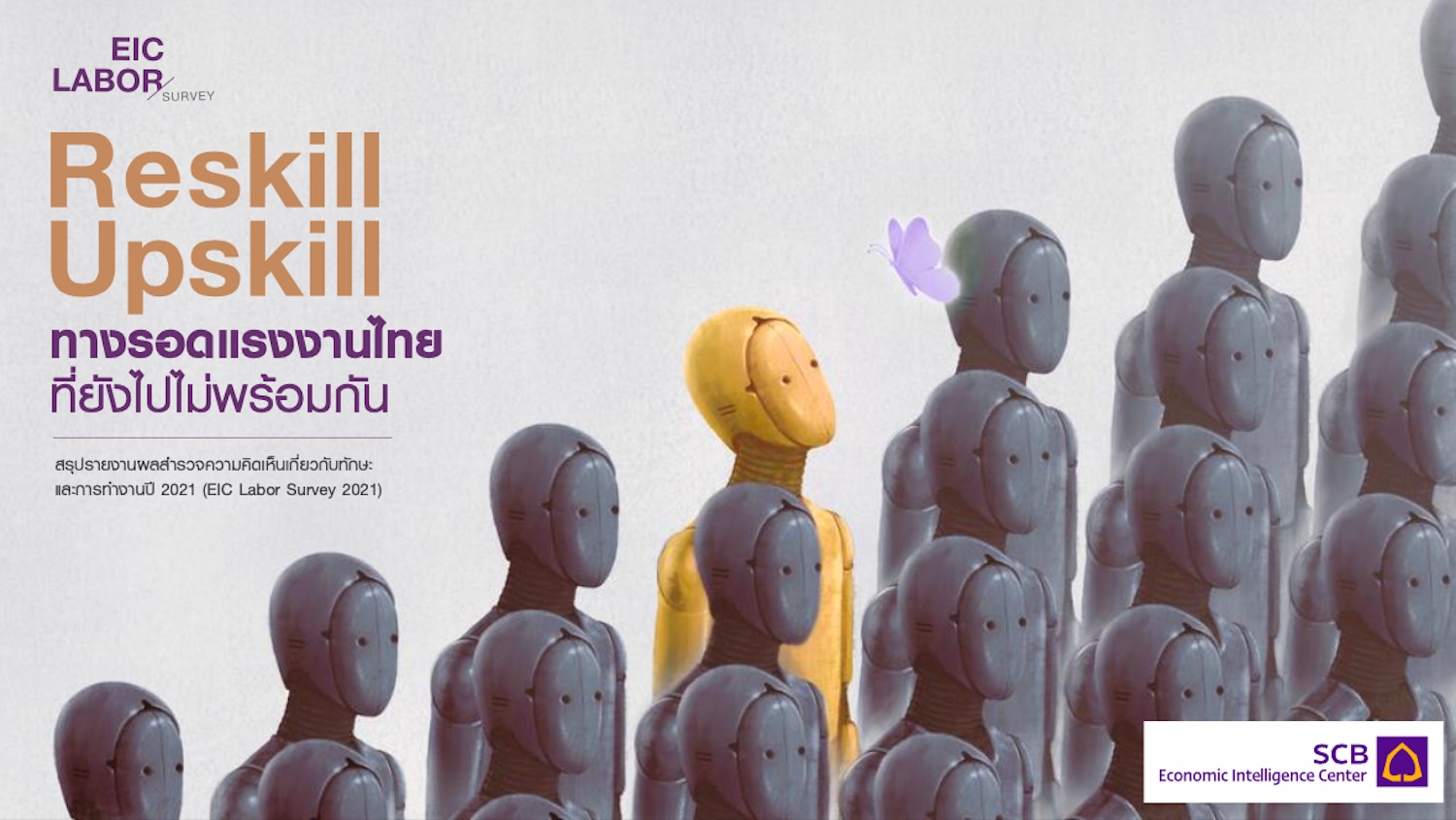
Reskilling/Upskilling: A Lifeline for Thai Workers Facing Disparities - Summary of the 2021 EIC Labor Survey
Skill Development (Reskilling-Upskilling) has become more crucial than ever for all workers. Thai labor has been severely impacted by the COVID-19 pandemic, with many losing income and job security. Moreover, recovery from these impacts is unlikely to be swift due to slow economic growth and ongoing negative factors. This crisis has particularly affected low-skilled and low-income workers. Additionally, future labor demand is shifting, with businesses hiring less and job types evolving with technological advancements, adding further pressure on many workers already battered by the crisis. A key solution moving forward for workers in this environment is to accelerate skill development, including reskilling for those whose previous skills are in declining demand and may be replaced by technology, and upskilling to enhance existing skills for greater economic value. Skill development will enable Thai workers to recover from the current economic crisis and adapt to a rapidly changing world.
Results from the 2021 EIC Labor Survey indicate that about half of the respondents have engaged in skill development during the COVID-19 period, but not all groups have equal opportunities. According to the survey data, 56% of respondents have developed their skills to some extent over the past year, primarily through self-directed learning. The main reasons for skill development were to support their current jobs and a desire to learn more. Most who have developed their skills found it quite beneficial. However, access to skill development remains unequal among different groups, particularly for low-income individuals, who have a significantly lower proportion of skill development compared to higher-income individuals. Among respondents earning less than 15,000 baht per month, only 40% reported having developed their skills in the past year, while those earning over 100,000 baht had a skill development rate of 69%. Furthermore, SME employees have fewer opportunities for skill training compared to those in large companies or government jobs, with only 36% of SME employees receiving skill development through employer-provided courses, compared to about 69% for employees in large private companies and government sectors. This inequality in access to skill training is a significant issue that the government may need to address, as these individuals are often the same ones most affected by the recent crisis. The lack of opportunities for skill development will exacerbate existing inequalities.
Looking ahead, the majority of Thai workers are interested in skill development, with financial and investment skills being the most sought-after. Online learning is the top choice for all age groups. The survey data shows that 87% of respondents are interested in developing their skills over the next year, with financial and investment skills topping the list, followed by foreign languages and business skills. These three skills rank in the top three across all age groups. Meanwhile, technology skills such as programming, data analysis, or app development, which are expected to be in high demand in the modern world, are moderately popular. Regarding skill development channels, 72% of respondents interested in skill development chose online options (e.g., online courses, YouTube, or various social media platforms) as their top choice, which is the most popular option across all age groups, including seniors. In terms of willingness to invest in skill development, 45% of respondents believe that skill development will incur no costs, partly due to the popularity of free online channels. Only 4% of respondents interested in skill development are willing to spend a high amount (more than 20% of monthly income).
The level of interest and investment in skill development varies according to individual attitudes towards work and self-capacity. Data analysis reveals that workers' attitudes, based on questions about self-sufficiency in skills (“Are your skills sufficient?”) and job security (“Will your job still exist in five years?”), often lead to different interests and behaviors regarding skill development. Those who worry about their skills being insufficient and job insecurity tend to be more eager to develop their skills, showing a higher proportion of interest in skill development, willingness to pay for training, and readiness to invest time in skill development compared to other groups. Notably, those who responded with “unsure” regarding their skills or job security displayed the least enthusiasm for skill development, even less than those confident in their jobs and skills. This difference highlights the importance of providing information and raising awareness about individual competitiveness, which is a starting point for motivating the desire to develop personal skills.
EIC views the skill development of Thai workers as crucial for the country's future, requiring comprehensive and inclusive support across five key areas, starting with:
(1) Providing information and guidance on the necessity of skill development across all professions in line with global changes, along with personalized advice. Understanding one's own needs and the work environment will help workers see pathways and goals, which are essential starting points for self-development.
(2) Promoting lifelong learning, which is essential in the new world where skill development must be continuous. This includes creating accessible, low-cost learning resources and environments with diverse options suitable for all ages. Free online channels, which are the most popular among Thai respondents, are a key tool to address this need. At the same time, promoting skill development should also consider
(3) Creating positive experiences. Survey data shows that more than two-thirds of learners still face obstacles in their past skill development. Focusing on the learning experience could help reduce barriers while enhancing learning efficiency for many through well-designed learning experiences.
(4) Recognizing skill development is important. Survey results indicate that workers express a desire for recognition, such as certification and courses designed by reputable businesses or organizations. Gaining recognition from employers and society will ensure that the outcomes of skill development are practically applied, benefiting both workers and businesses, and enhancing the competitiveness of the economy.
(5) Supporting disadvantaged groups. The survey has already shown that there are still disadvantaged groups in skill development. Therefore, comprehensive support for skill development in Thailand must include specific measures to assist disadvantaged workers, who are often the ones most in need of skill development, to ensure that all Thai workers can survive the crisis and adapt together.
For more interesting information from the EIC Labor Survey 2021, visit >>> https://www.scbeic.com/th/eic_analysis/list/1637810651935
For slides from the seminar, click >>>