
Fiscal Policy Office Weekly Economic Report as of September 23, 2021
The Fiscal Policy Office (FPO) reports the weekly economic situation as of September 23, 2021, as follows:
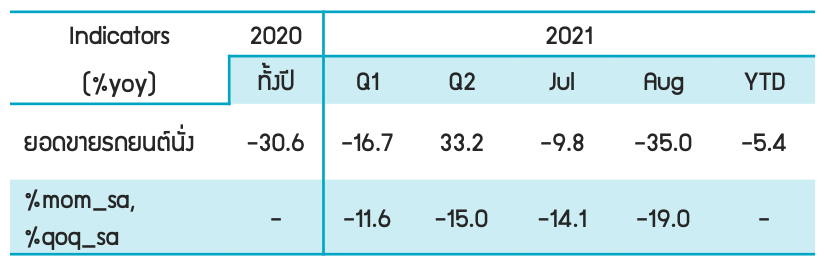
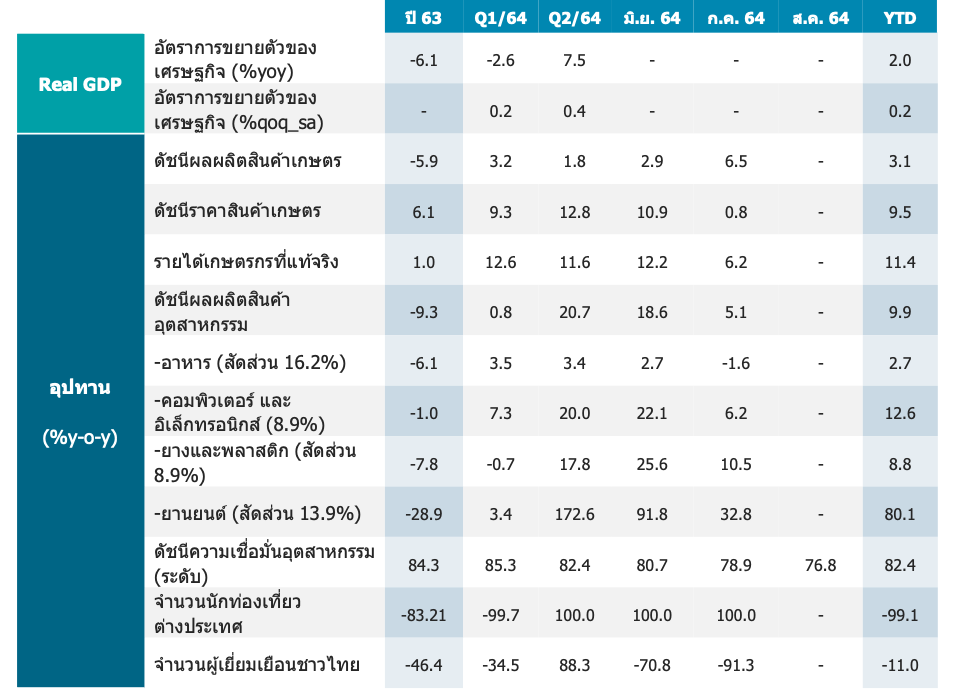
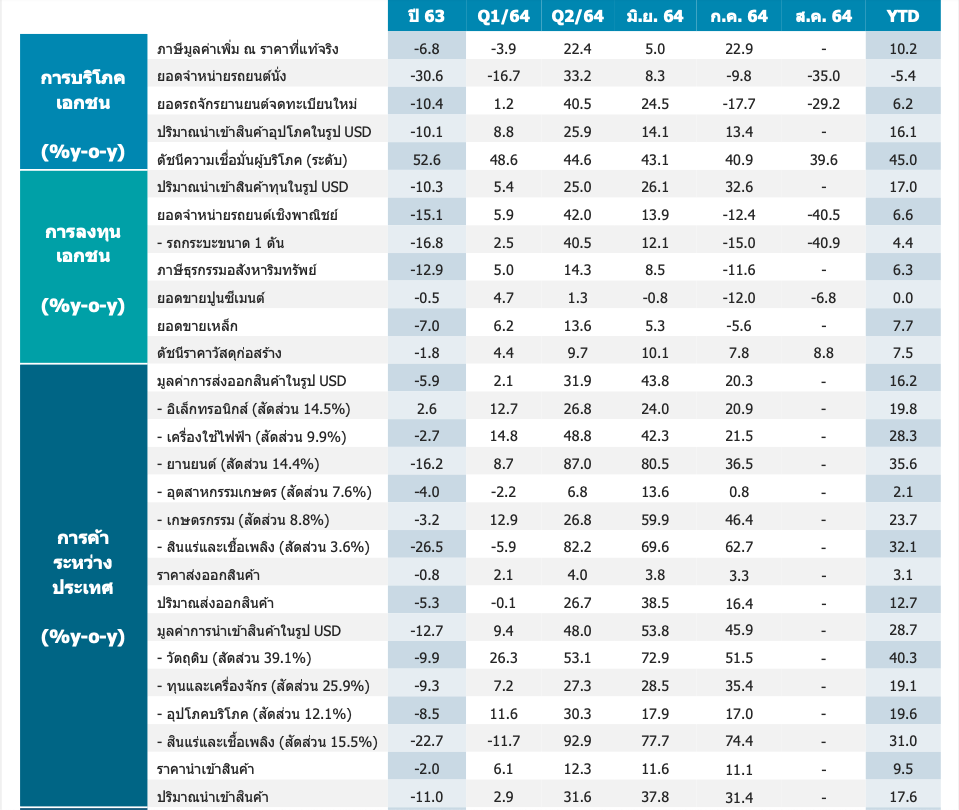
1. The sales volume of passenger cars in August 2021 contracted by -35.0% compared to the same period last year.
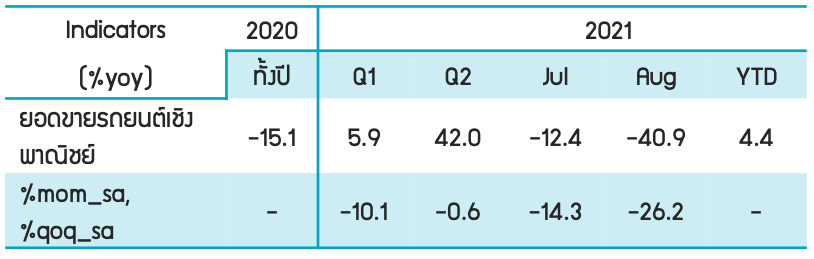
2. The sales volume of commercial vehicles in August 2021 contracted by -40.5% compared to the same period last year.
Thai Economic Indicators
The sales volume of passenger cars in August 2021 was 13,845 units, contracting by -35.0% compared to the same period last year, and when adjusted for seasonal effects, it contracted by -19.0% compared to the previous month.
This contraction is partly due to the cancellation of the Big Motor Sale 2021, which is usually held in August, due to lockdown measures prohibiting large gatherings, resulting in decreased purchasing power. Additionally, high household debt levels have led many financial institutions to maintain strict lending practices. Furthermore, the ongoing shortage of electronic components continues to impact the automotive manufacturing sector.
The sales volume of commercial vehicles in August 2021 was 28,331 units, contracting by -40.5% compared to the same period last year, and contracting by -26.2% when adjusted for seasonal effects, with the sales volume of one-ton pickup trucks contracting by -40.9% compared to the same period last year.
The domestic sales of commercial vehicles are contracting at an accelerating rate, primarily due to the new wave of COVID-19, which has caused consumers to slow down their spending, along with outbreaks among workers in automotive manufacturing companies and issues related to the shortage of chips and automotive parts, leading manufacturers to halt production of certain models, making it impossible to deliver to customers. However, the easing of government pandemic control measures in September 2021 is expected to help restore economic confidence and support a recovery in commercial vehicle consumption in the near future.
International Economic Indicators
United States
- New housing starts in August 2021 grew by 3.9% from the previous month (seasonally adjusted), while July 2021 contracted by -6.2% from the previous month (seasonally adjusted), with a significant increase in new condominium construction. Year-on-year, this represents a growth of 17.4% compared to the same period last year. However, new housing starts in the U.S. continue to be affected by rising construction material prices and labor shortages.
- New building permits in August 2021 grew by 6.0% from the previous month (seasonally adjusted), accelerating from the previous month's growth of 2.3% (seasonally adjusted), due to an increase in building permits for single-family homes and condominiums this month.
- Existing home sales in August 2021 contracted by -2.0% from the previous month (seasonally adjusted), while July 2021 grew by 2.2% from the previous month (seasonally adjusted), affected by rising home prices, low housing stock, and increasing construction material prices. Year-on-year, this represents a contraction of -1.5% compared to the same period last year.
- The median price of existing homes in August 2021 grew by 14.9% compared to the same period last year.
Japan
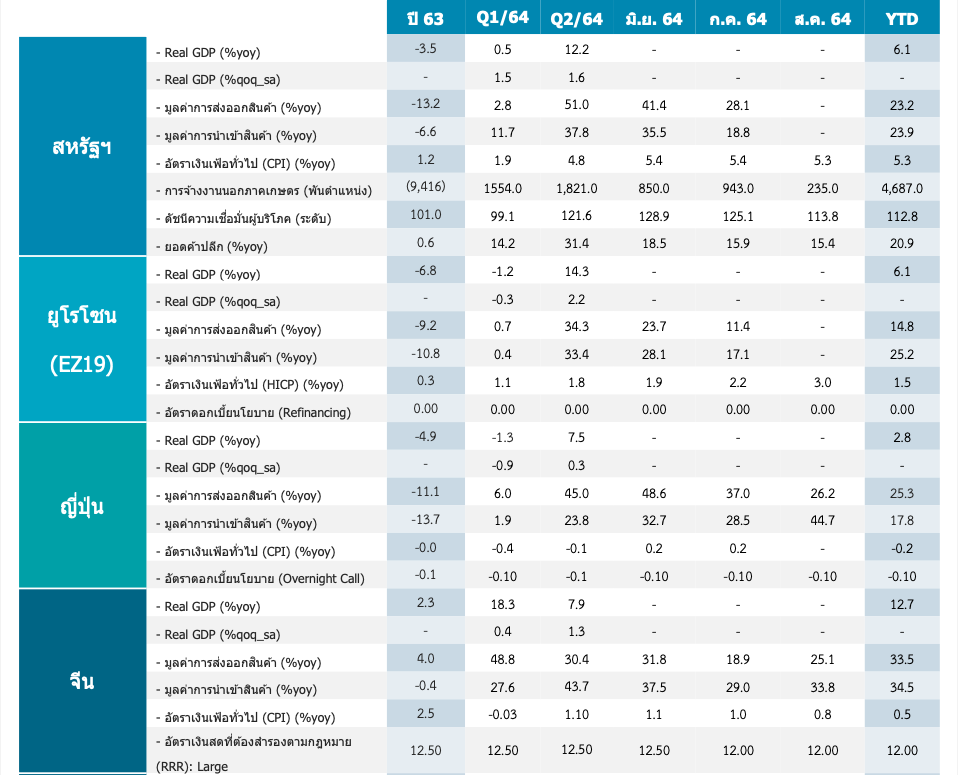
The Bank of Japan maintained its policy interest rate at -0.1% per annum due to the ongoing COVID-19 pandemic situation.
European Union
The consumer confidence index (preliminary) for September 2021 stood at -4.0 points, an increase from -5.3 points in August 2021, as consumers have a more positive outlook on the Eurozone economy.
Australia
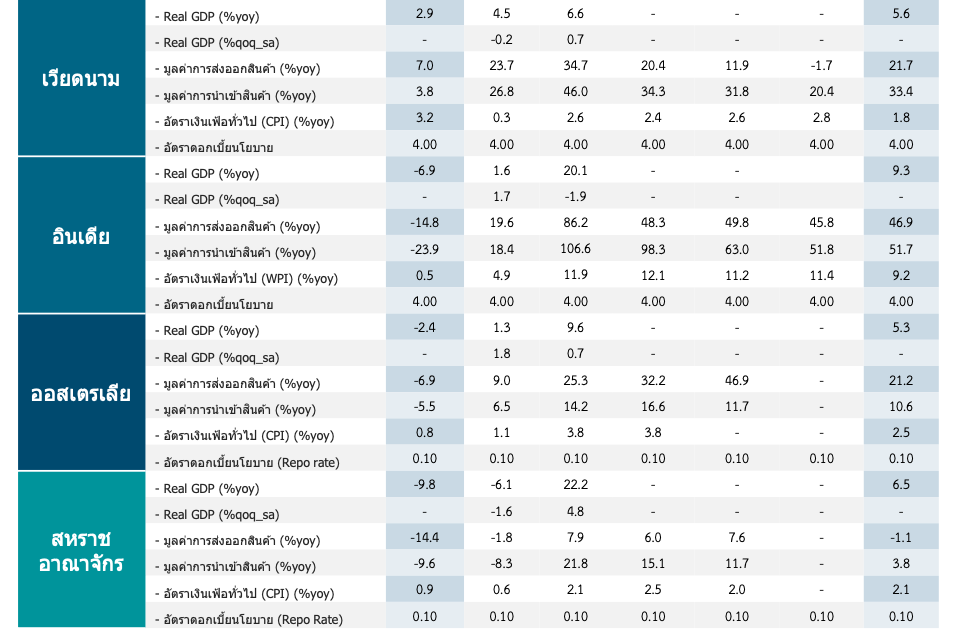
The PMI index for the manufacturing sector in September 2021 rose to 57.3 points from 52.0 points in August 2021 due to increased factory orders and production.
The PMI index for the services sector in September 2021 rose to 44.9 points from 42.9 points in August 2021. However, the PMI index remains below 50.0 points, indicating that the services sector is still contracting, largely due to the reintroduction of lockdown measures.
Singapore
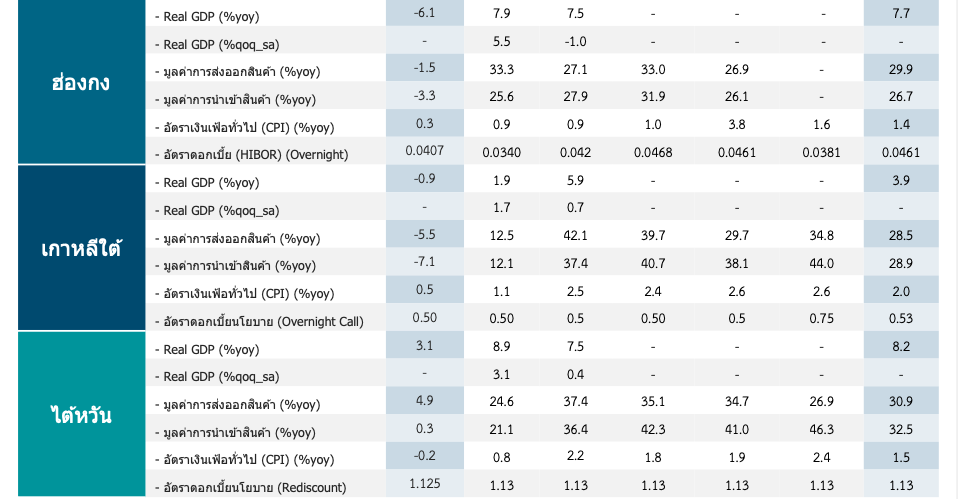
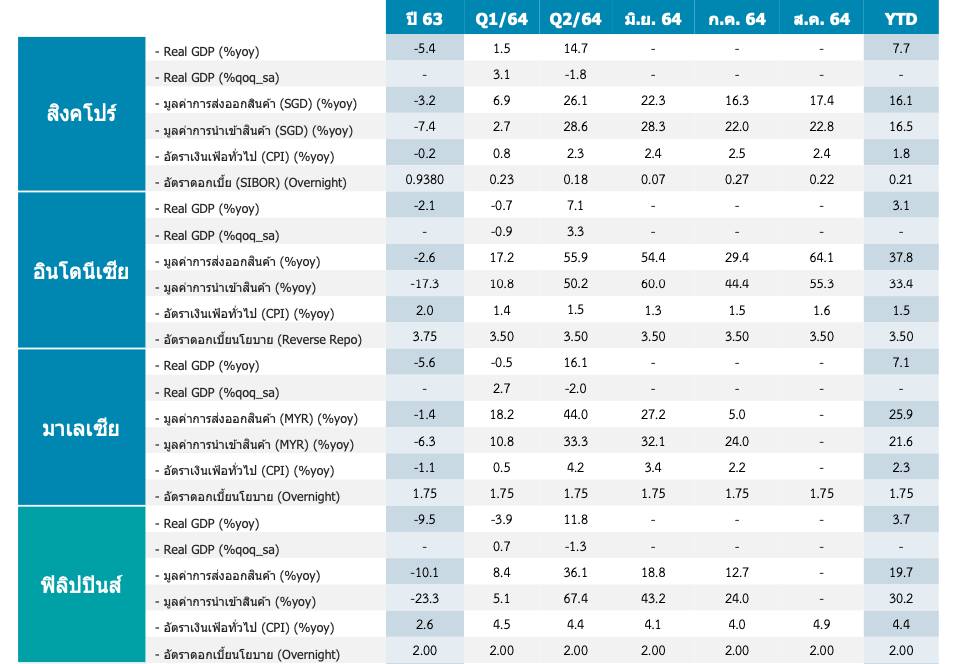
The inflation rate in August 2021 was 2.4% compared to the same period last year, down from 2.5% in the previous month, primarily due to clothing prices.
Indonesia
The Bank of Indonesia announced it would maintain its policy interest rate at 3.5% per annum to support economic recovery.
Hong Kong
The inflation rate in August 2021 was 1.6% compared to the same period last year, down from 3.7% in July 2021 compared to the same period last year, due to a low base resulting from government measures to reduce rents for property tenants to mitigate the impact of the pandemic in 2020. However, when excluding the effects of various government relief measures, the inflation rate in August 2021 would have increased from the previous month to 1.2% compared to the same period last year, primarily due to rising prices in utilities, transportation, food, and clothing.
Taiwan
The unemployment rate in August 2021 was 4.08% of the total labor force, down from 4.36% in the previous month, the lowest level since May 2021 and approaching pre-pandemic levels of approximately 3.7-3.8% of the total labor force.
Money Market Indicators and Exchange Rates
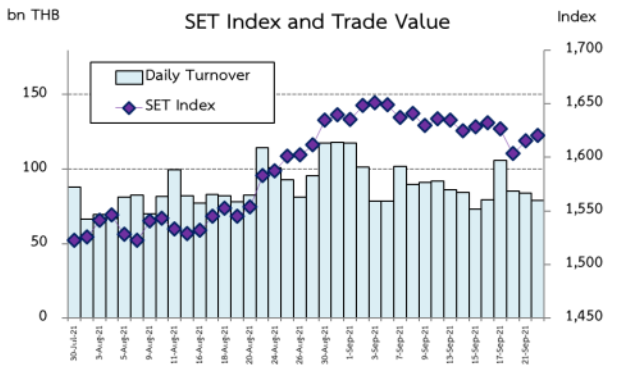
The SET index slightly decreased from the previous week, in line with other regional stock markets that also declined from the previous week, such as Nikkei225 (Japan), CSI300 (Shanghai), and STI (Singapore). On September 22, 2021, the index closed at 1,619.59 points, with an average trading value between September 20-22, 2021, of 82,650.82 million baht per day. Foreign investors, domestic institutional investors, and securities account investors were net sellers, while domestic retail investors were net buyers. During September 20-22, 2021, foreigners sold securities net -618.27 million baht.
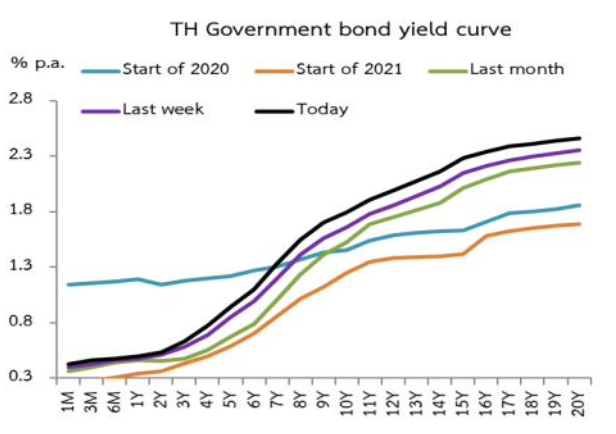
The overall yield on government bonds increased by 2 to 23 basis points. This week, there were no government bond auctions. During September 20-22, 2021, foreign investor capital outflows from the bond market totaled -8,719.30 million baht, and from the beginning of the year until September 22, 2021, foreign investor capital inflows into the bond market totaled 77,835.72 million baht.
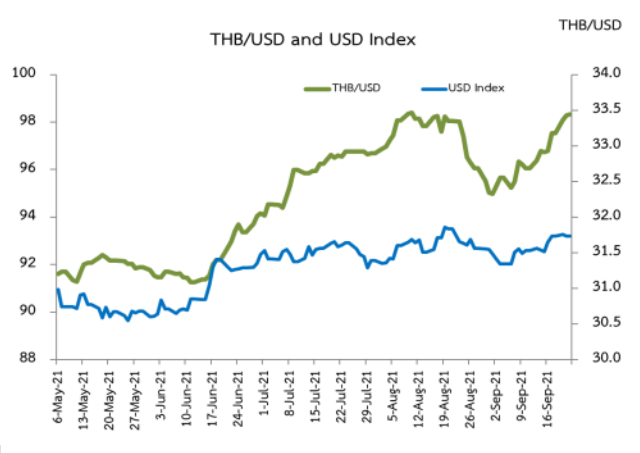
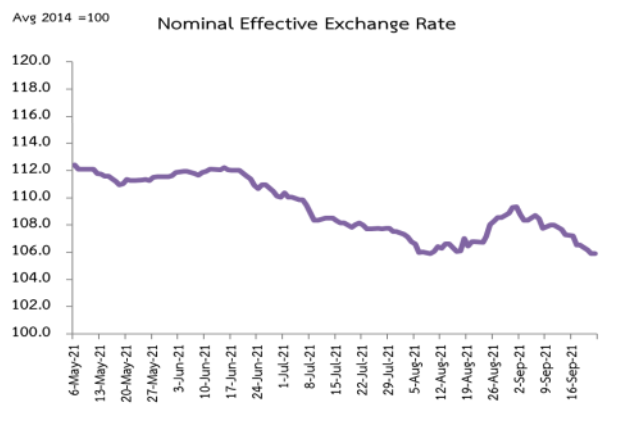
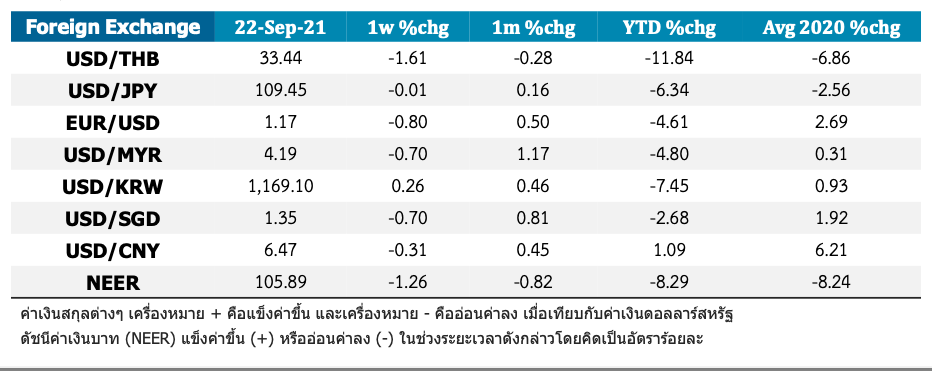
The Thai baht weakened against the previous week, closing at 33.44 baht per US dollar on September 22, 2021, a depreciation of -1.61% from the previous week. This is in line with the depreciation of the euro, ringgit, Singapore dollar, and yuan against the US dollar, while the won appreciated against the US dollar compared to the previous week. The baht depreciated more than other major currencies in the region, resulting in the nominal effective exchange rate (NEER) of the baht weakening by -1.26% from the previous week.
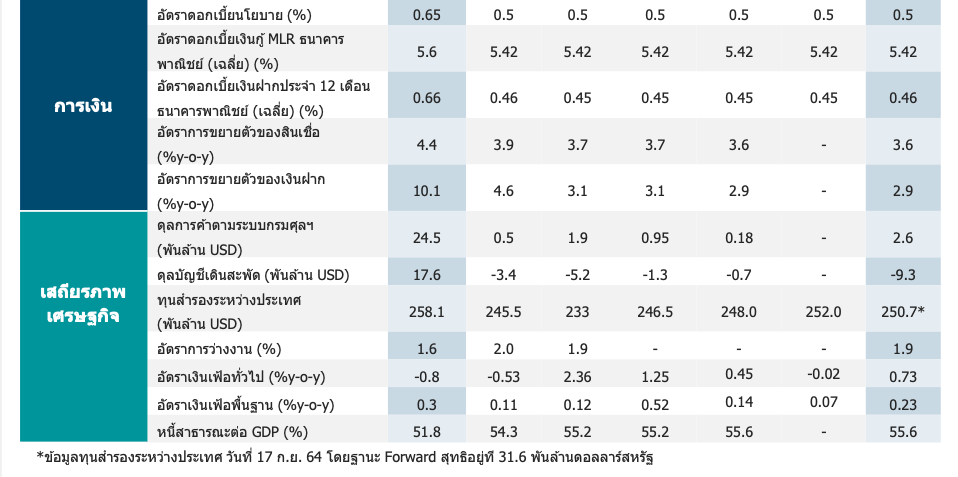
Economic Indicators
Global Economic Indicators
Thank you for the information from the Macroeconomic Policy Bureau, Fiscal Policy Office, Ministry of Finance, 02-273-9020 Ext. 3259