EIC Evaluates July Exports: Continued High Growth Compared to Last Year from Low Base, but Signs of Slowing Momentum from Previous Month
EIC assesses that July exports continue to show high growth compared to last year due to a low base, but there are signs of slowing momentum from the previous month due to the impact of the COVID-19 pandemic affecting both demand from trading partners and supply from partial factory closures, which poses significant risks to exports in the near future.
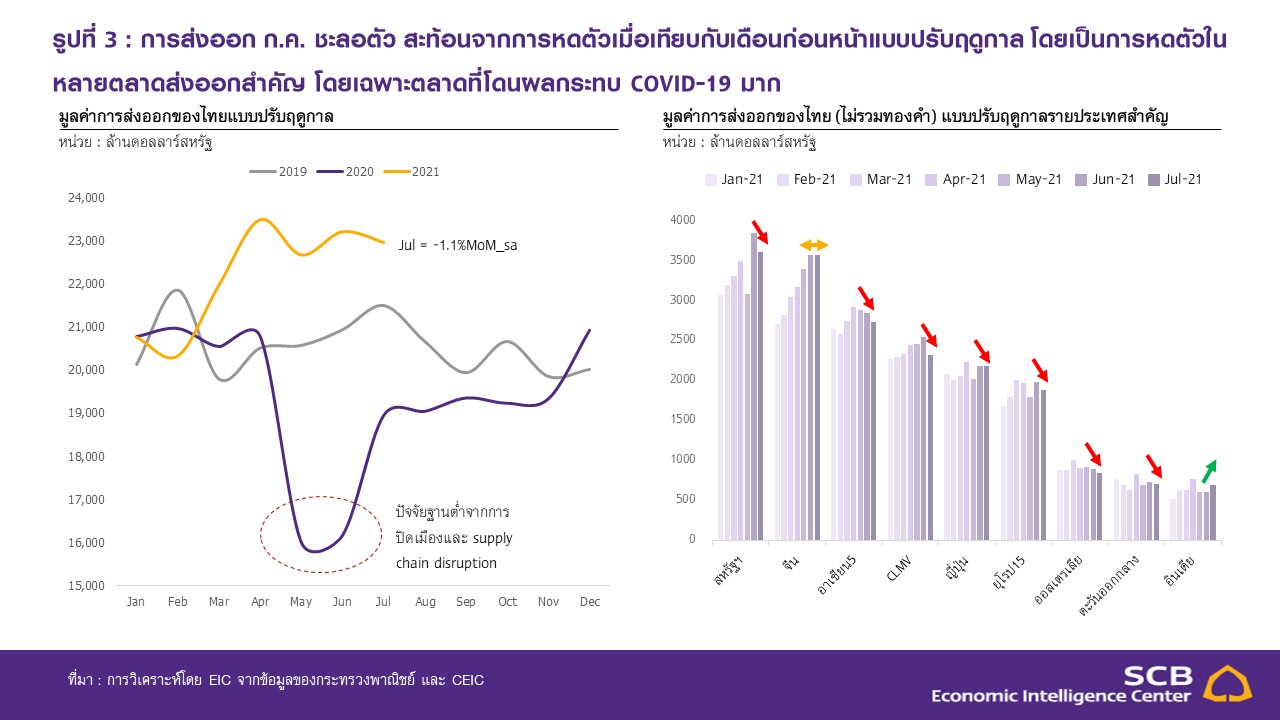
- Exports in July still grew significantly compared to last year, with a value growth of 20.3% YOY, driven by a low base, expanding across nearly all product categories and markets. However, there are early signs of slowing momentum due to the global COVID-19 outbreak, reflected in a seasonally adjusted month-on-month contraction of -1.1% MoM_sa, indicating a decline in several key markets, especially in ASEAN (ASEAN 5 and CLMV), as well as the US and Europe.
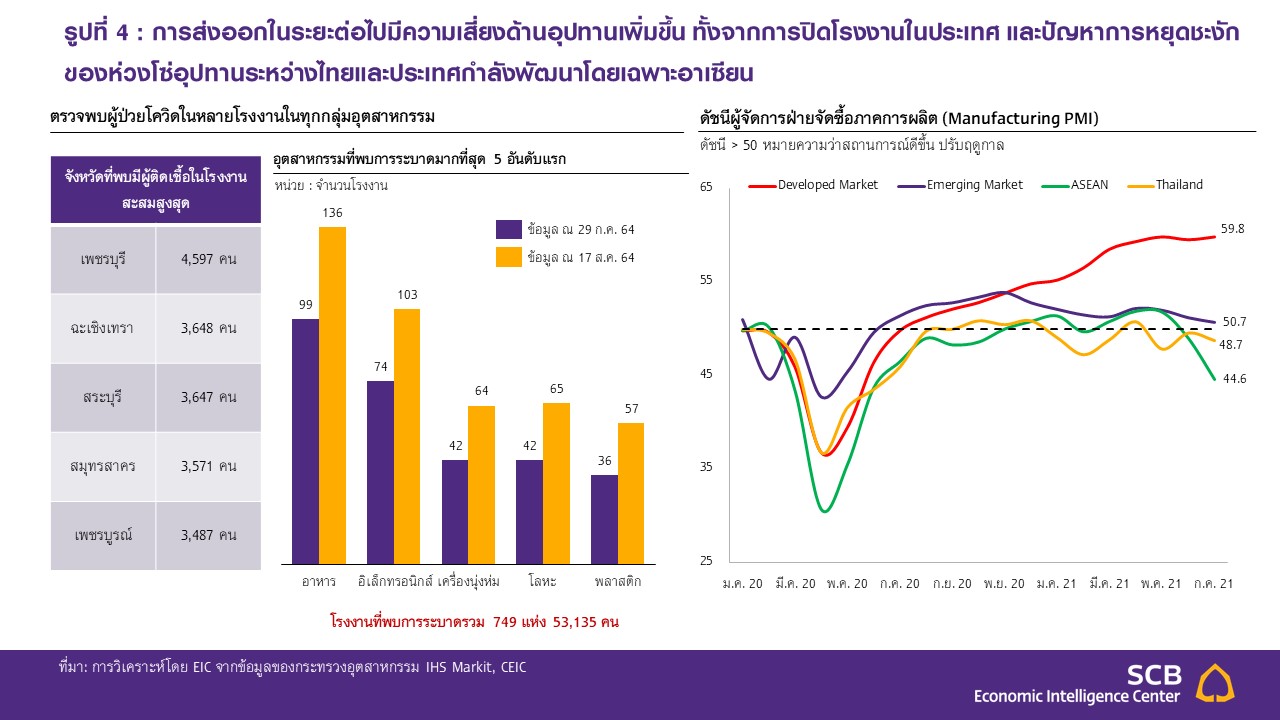
- For exports in the remaining months of the year, it is crucial to monitor supply-side risks that are beginning to show signs of impact, as indicated by an increasing number of factories in the country temporarily shutting down in recent times. Additionally, there are risks from potential supply chain disruptions, particularly in the production chain between Thailand and developing countries, especially ASEAN, as reflected in the declining Manufacturing PMI index for these countries in recent months.
- The slowdown in the export sector aligns with EIC's previous forecast that exports in the second half of the year would cool down from the strong performance in the first half due to a rising base effect towards the end of last year, along with the ongoing impacts of the latest global outbreak, which continues to pressure the export sector for the remainder of the year. Therefore, the forecast for 2021 exports remains at 15.0%.
Key points
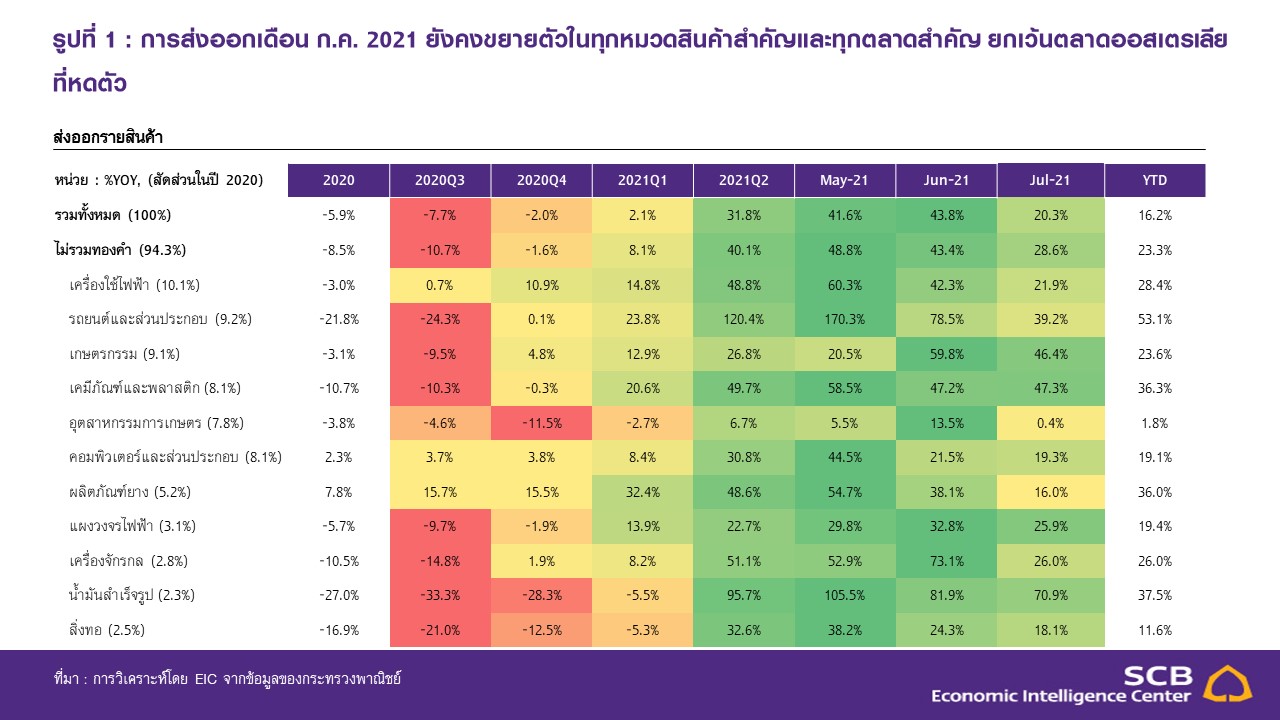
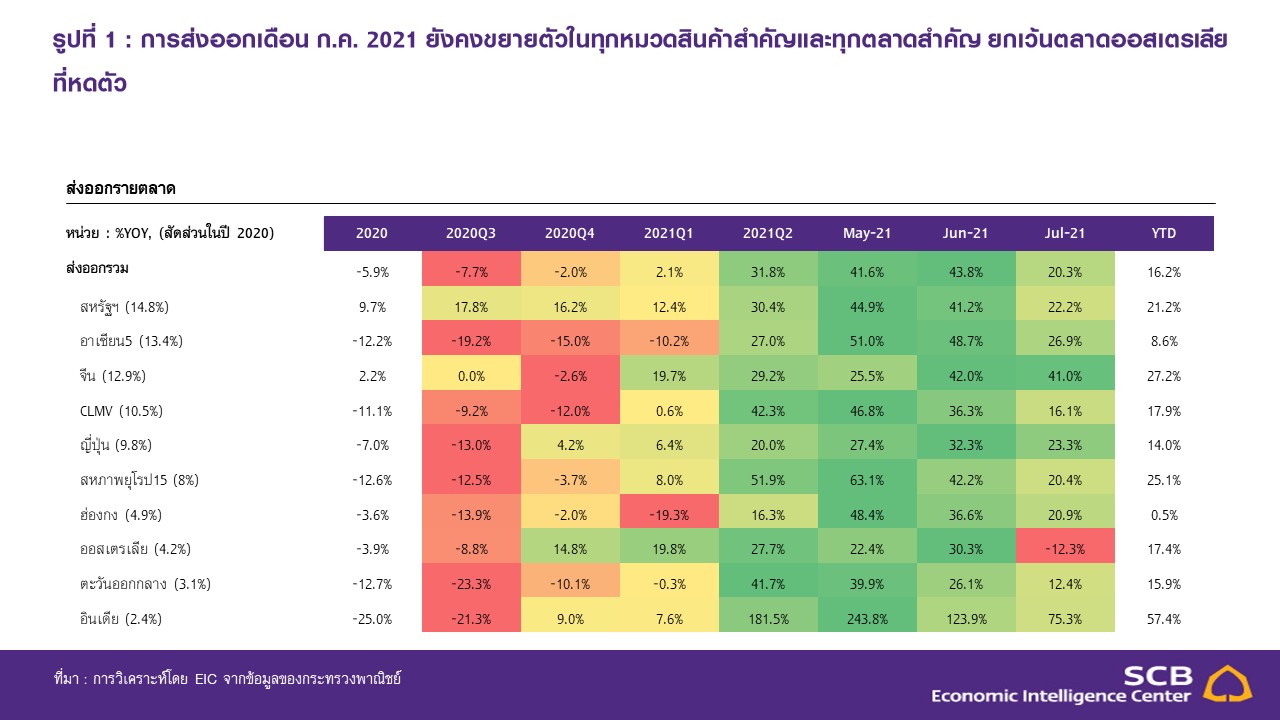
The value of exports in July 2021 grew by 20.3% YOY, slowing down from the previous month's growth of 43.8% YOY. Excluding gold, exports would have grown by 28.6% YOY, resulting in a 16.2% YOY growth in the first seven months of 2021, and 23.3% YOY growth when excluding gold.
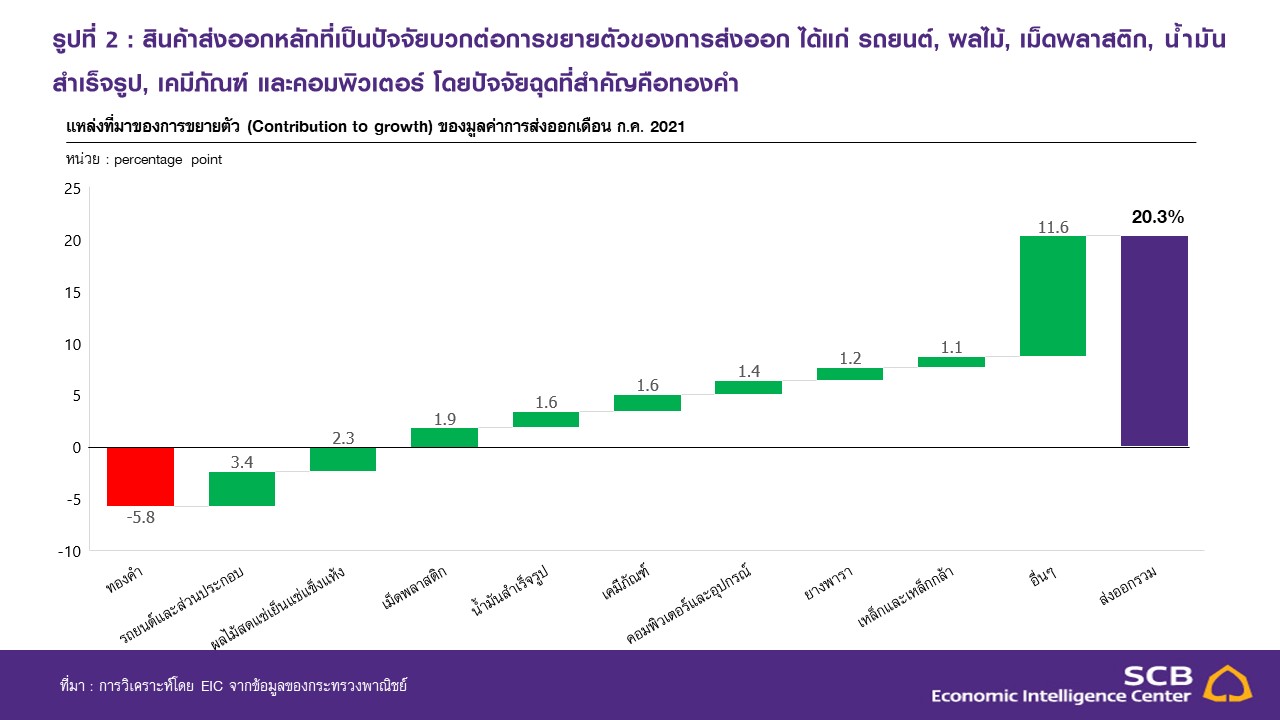
In terms of exports by product, exports continued to grow across all major product groups:
- Automobile and parts exports grew by 39.2% YOY, continuing for eight consecutive months, with significant growth in key markets such as Vietnam (105.4% YOY), Australia (68.2% YOY), the US (88.9% YOY), and Malaysia (121.9% YOY).
- Fresh, chilled, frozen, and dried fruit exports grew by as much as 122.8% YOY, with significant growth in key markets like China (79.81% YOY), the US (19.7% YOY), and Malaysia (133.1% YOY), while key markets that contracted significantly included Hong Kong (-19.6% YOY) and Vietnam (-51.85% YOY).
- Refined oil exports grew by 70.9% YOY due to high energy demand and continuously high oil prices, with key markets showing growth including Cambodia (59.4% YOY), Malaysia (40.5% YOY), and the Philippines (339.3% YOY).
- Chemical exports grew by 54% YOY, with significant growth in key markets such as China (38.9% YOY), Vietnam (57.7% YOY), and Japan (55.2% YOY). Plastic pellet exports also performed well, growing by 57.8% YOY, particularly in the Indian (78.7% YOY), Indonesian (71% YOY), and Vietnamese (53.5% YOY) markets.
- Computer and equipment exports increased by 20.7% YOY due to the demand for electronic goods at home during the COVID situation, continuing for the eighth consecutive month, especially hard disk drives (HDD), which grew by 31.1% YOY.
- Rubber exports grew by 121.2% YOY, with significant growth in key markets such as China (49.8% YOY), Malaysia (41% YOY), and the US (78.5% YOY).
- Steel, iron, and products grew by 59.4% YOY, with significant growth in key markets such as China (49.8% YOY), Malaysia (41% YOY), the US (78.50% YOY), and India (158.7% YOY).
In terms of exports by market, exports grew in nearly all major markets, especially India and China, except for Australia, which contracted.
- Exports to India continued to grow at a high rate of 75.3% YOY, marking six consecutive months of growth, with key products showing growth including automobiles and parts (360.5% YOY), plastic pellets (83.8% YOY), chemicals (69.1% YOY), and steel, iron, and products (94.8% YOY).
- Exports to China grew by 41% YOY, marking eight consecutive months of growth, with key products showing growth including fresh, chilled, frozen, and dried fruits (173.9% YOY), rubber (129% YOY), cassava products (75.57% YOY), and chemicals (53.3% YOY).
- Exports to ASEAN 5 grew by 26.9% YOY, with key products showing growth including automobiles and parts (141.7% YOY), refined oil (69.1% YOY), computers (81% YOY), and steel, iron, and products (192.8% YOY).
- Exports to Japan grew by 23.3% YOY, with key products showing growth including automobiles and parts (14.2% YOY), copper and copper products (124.1% YOY), plastic pellets (69.2% YOY), and chemicals (40.6% YOY).
- Exports to Australia reversed to a contraction of -12.3% YOY, with key products showing contraction including air conditioning units and parts (-6.4% YOY), cosmetics, soap, and skincare products (-21.9% YOY).
- Canned and processed seafood (-40.1% YOY) still had supporting factors from exports of automobiles and parts (21.3% YOY), rubber products (24.2% YOY), and plastic pellets (38.7% YOY).
Figure 1: July 2021 exports continued to grow across all major product categories and markets, except for Australia, which contracted.
Source: Analysis by EIC from Ministry of Commerce data.
Figure 2: Major export products contributing positively to export growth include automobiles, fruits, plastic pellets, refined oil, chemicals, and computers, while a significant drag factor is gold.
Source: Analysis by EIC from Ministry of Commerce data.
In terms of import value, July 2021 saw a growth of 45.9% YOY, slightly slowing from the previous month's growth of 53.8% YOY, marking six consecutive months of growth, consistent with the growth in exports. This growth occurred across all major import categories, including fuel products (74.4% YOY) driven by both a low base and rising prices compared to last year, capital goods (35.4% YOY), consumer goods (17% YOY), and vehicles and transport equipment (75.4% YOY). Meanwhile, the import of raw materials and semi-finished products also grew by 51.5% YOY, but excluding gold, the growth would be 50.1% YOY. In the first seven months of 2021, imports grew by 28.7% YOY, resulting in a trade surplus of $2,622.6 million in the first seven months.
* Implication
Exports in July show early signs of slowing down due to the global COVID-19 outbreak. Although the YOY growth is high due to a low base, when compared to the previous month on a seasonally adjusted basis, there is a contraction of -1.1% MoM_sa, indicating declines in several key markets, especially those heavily impacted by COVID-19, such as ASEAN (ASEAN 5 and CLMV), as well as the US and Europe. This reflects that Thailand's export situation is beginning to be affected by demand from the latest outbreak.
Figure 3: July exports slowed down, reflected in the contraction compared to the previous month on a seasonally adjusted basis, indicating declines in several major export markets, especially those heavily impacted by COVID-19.
Source: Analysis by EIC from Ministry of Commerce and CEIC data.
Furthermore, future exports must monitor supply-side risks that are beginning to show signs of impact, as reflected in the increasing number of factories temporarily shutting down to address infection issues. If the outbreak in the country remains severe and leads to more or longer factory closures, it will pose significant risks to production for export in the near future. Additionally, there are potential supply chain disruptions, particularly in the supply chain between Thailand and developing countries, especially ASEAN, as reflected in the clearly declining Manufacturing PMI index for these countries in recent months.
Figure 4: Future exports face increasing supply-side risks from factory closures in the country and potential supply chain disruptions between Thailand and developing countries, especially ASEAN.
Source: Analysis by EIC from various news sources, IHS Markit, and CEIC data.
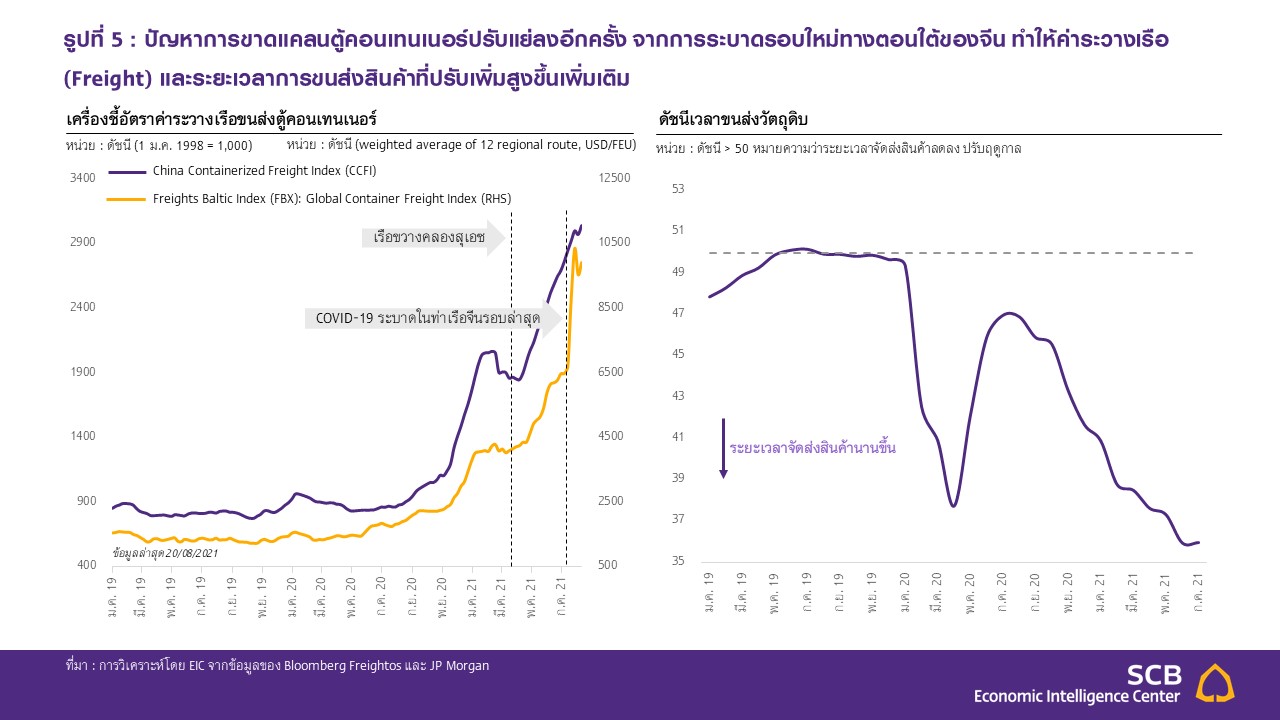
Regarding the issues of container and semiconductor (chip) shortages, these remain ongoing pressure factors. Recently, Chinese authorities ordered partial closures of the Ningbo-Zhoushan port in Shanghai on August 11, 2021, after one employee tested positive for the Delta variant of COVID-19. The closure of Ningbo-Zhoushan, which is the third busiest port in the world, has worsened the container shortage issue and increased freight rates and shipping times. Additionally, the chip shortage has impacted several industries, such as the automotive industry, where Toyota recently announced a 40% reduction in global production during September due to chip shortages, which may affect Thailand's automotive export volumes in the fourth quarter.
Figure 5: The container shortage issue has worsened again due to the new outbreak in southern China, leading to further increases in freight rates and shipping times.
Source: Analysis by EIC from Bloomberg, Freightos, and JP Morgan data.
In summary, the slowdown in the export sector aligns with EIC's previous forecast that exports in the second half of the year would cool down from the strong performance in the first half due to a rising base effect towards the end of last year, along with the ongoing impacts of the latest global outbreak, which continues to pressure the export sector for the remainder of the year. Therefore, the forecast for 2021 exports remains at 15.0%, while monitoring the increasing risks from the impacts of the latest COVID-19 outbreak affecting both demand (economic conditions of major trading partners) and supply (factory closures in the country and potential supply chain disruptions).
Analysis from EIC website >>> https://www.scbeic.com/th/detail/product/7753
Presented by:
Phanadorn Aruneeniramarn, Senior Economist, Economic Intelligence Center (EIC), Siam Commercial Bank Public Company Limited
Wichan Kulati, Analyst, Economic Intelligence Center (EIC), Siam Commercial Bank Public Company Limited
Economic and Business Research Center, Economic Intelligence Center (EIC), Siam Commercial Bank Public Company Limited
EIC Online: www.scbeic.com
Line: @scbeic