Investment in Thailand's Tire Industry Faces Increased Risks After US AD
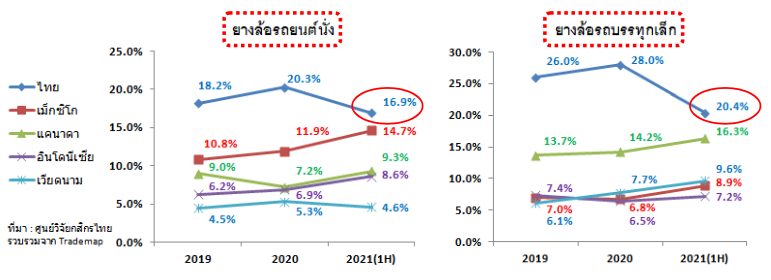
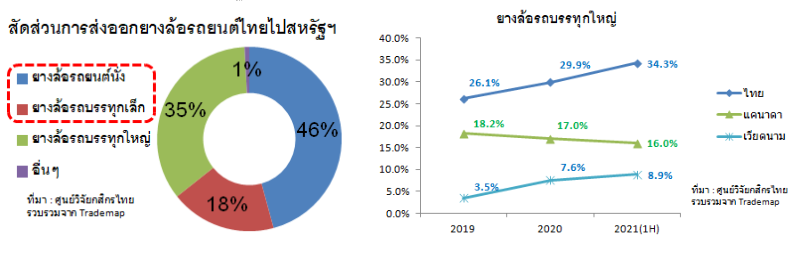
• <\/span><\/strong>After more than a year of deliberation, the United States has ruled that passenger car and light truck tires exported from Thailand will be subject to anti-dumping (AD) duties. This decision is expected to raise the prices of these tires from Thailand in the US market. While this may not significantly impact the overall value of Thailand's tire exports to the US in 2021, Kasikorn Research Center believes that the AD duties imposed could affect future investments in the tire industry and impact exports to the US.<\/span><\/p>
Average Import Prices of Passenger Car Tires Imported by the US in the First Half of 2021 (USD/Unit)<\/p>
• Kasikorn Research Center believes that major Japanese and Western brands may invest in tires to support the REM market in Thailand only to a limited extent, as the domestic market has not expanded significantly, while export prices have become less competitive. This may lead these major brands to choose to invest in the US or increase investments in existing production bases in Mexico and Canada, which are members of the USMCA, and export to the US instead, benefiting from the lack of import duties and lower shipping costs. Meanwhile, Chinese brands already investing in Thailand may have opportunities to increase investments and diversify exports to other markets outside the US to accelerate the creation of Economies of Scale, as Chinese tires focus on price competition, and consumer preferences in the market may not match those of major brands. This makes the distribution of production bases across multiple locations, as seen with major brands, less effective in reducing costs, especially since Thailand still has a significant strength in having a highly efficient labor force in the tire industry and relatively lower production costs compared to other production sources. However, when considering investments from new Chinese tire manufacturers for passenger car and light truck tires, Thailand may become a less attractive option as more competing countries emerge, especially those not subject to AD like Indonesia or those facing lower levels of AD like Vietnam. • In the OEM tire market, which accounts for less than 10% of the total tire production in the country, there are still opportunities for popular tire brands targeting the OEM market in Thailand to invest further to support the increasing production of vehicles in Thailand, especially as Thailand is set to become a regional automotive production hub for exports. Kasikorn Research Center estimates that vehicle production in Thailand could rise to 2.5 million units and 3 million units in 2030 and 2040, respectively, from 1.64 million units this year, as Japanese and Western automakers have adjusted their plans to make Thailand a more significant automotive production hub for exports, as evidenced by the gradual closure of factories abroad and increased production in Thailand, along with increased investment in technology components in Thailand. At the same time, Chinese automakers also plan to gradually invest in vehicle production in Thailand to establish a right-hand drive production base for global exports. However, the direction of investment expansion may be gradual in the short term over the next three years due to the production volume being pressured by economic conditions both in Thailand and globally, which have slowed down due to the impact of COVID-19, particularly for well-known Japanese or Western tire brands. • Looking ahead, to mitigate the impact of AD, focusing on cost reduction through increased automation in the production process may become increasingly necessary. Additionally, targeting new long-term markets such as xEV passenger car tires may help open new markets to create more investment and export opportunities. This research report is prepared by Kasikorn Research Center Co., Ltd. (“KResearch”) for general dissemination, relying on publicly available sources or information deemed reliable at the time of preparation, which may change over time. KResearch does not guarantee the accuracy, reliability, suitability, completeness, or timeliness of such information and does not intend to solicit, recommend, advise, or persuade any decisions to take any actions. Therefore, you should study the information carefully and exercise caution and discretion before making any decisions. KResearch will not be liable for any damages arising from the use of such information. Any information contained in this research report is the property of KResearch and/or third parties (as applicable). The use of such information (in whole or in part) must acknowledge the ownership rights of KResearch and/or third parties (as applicable) or the source of that information. You may not reproduce, modify, adapt, alter, forward, publish, or engage in any such actions for commercial purposes without prior written permission from KResearch and/or third parties (as applicable). <\/p>

Source: Kasikorn Research Center compiled from Trademap
*Average export prices from the US to various countries, **Kasikorn Research Center's preliminary forecast based on the imposed duty rates<\/p>
 <\/p>
<\/p>
 <\/p>
<\/p>