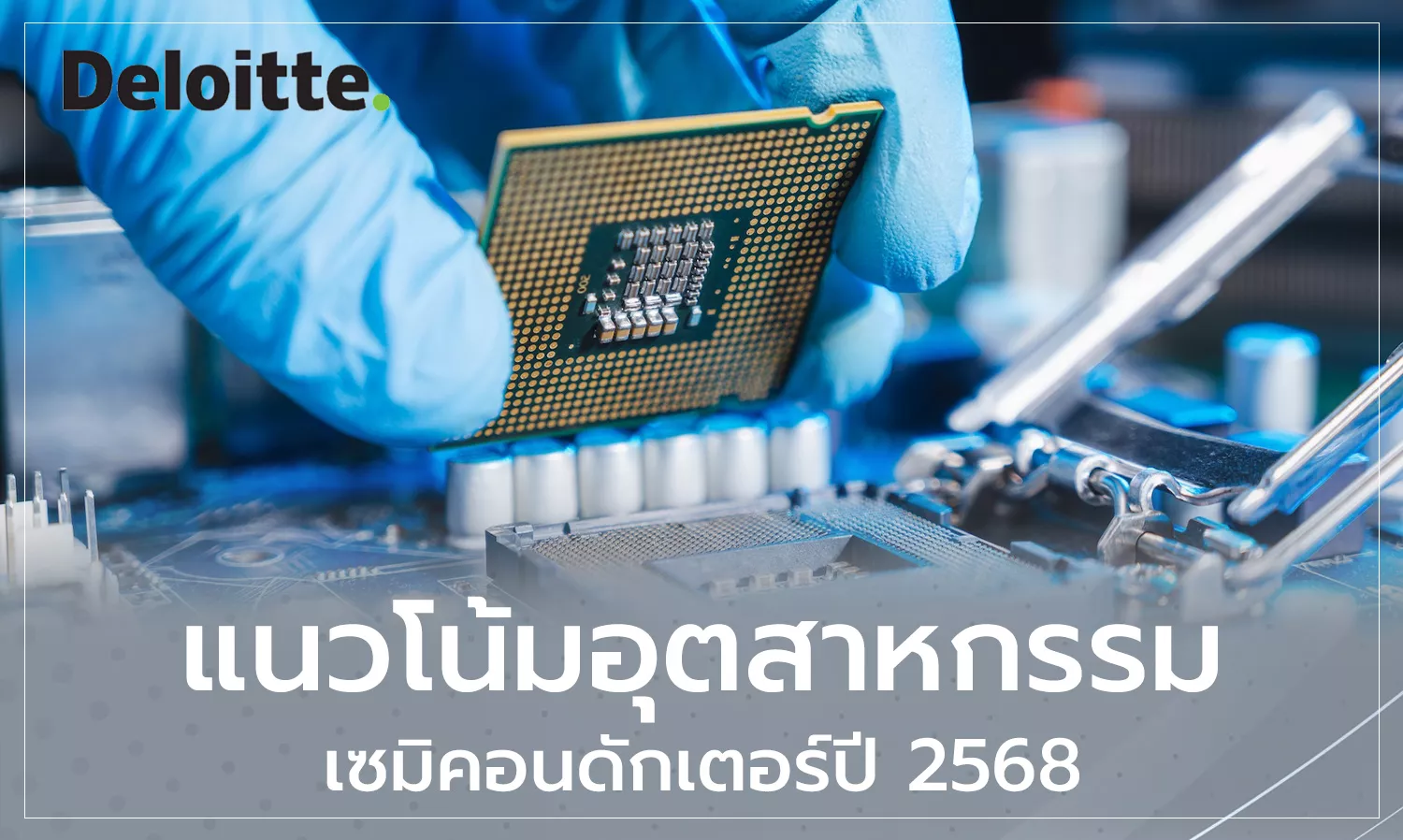
Trends in the Semiconductor Industry for 2025
In 2024, the World Semiconductor Trade Statistics reported that the global semiconductor industry grew by approximately 19%, with sales valued at $627 billion. It is projected that in 2025, sales will reach a record high of $697 billion, with the Americas and Asia-Pacific regions expected to grow by double digits compared to the previous year's growth rates of 15% and 10%, respectively. Additionally, Deloitte's report 2025 Global Semiconductor Industry Outlook forecasts that chip sales could reach $1 trillion by 2030, with a compound annual growth rate (CAGR) of 7.5% from 2025 to 2030.
As of mid-December 2024, the market capitalization of the world's top 10 semiconductor companies reached $6.5 trillion, a 93% increase from $3.4 trillion in mid-December 2023.
Chips are utilized in various sectors, including enterprise edge computing, smartphones, applications, and the Internet of Things (IoT). These chips are often used for GenAI or traditional AI (Machine Learning), or both. A key driver of industry sales is the demand for GenAI chips and the growth of the data center industry, which includes Central Processing Units (CPUs), Graphics Processing Units (GPUs), communication chips for data centers, and power chips. However, demand from the PC and mobile markets has begun to decline, with the International Data Corporation (IDC) forecasting that smartphone sales may grow by only 6% in 2025 compared to the previous year, while personal computer sales may increase by just 4%.
Future Indicators
In 2025, semiconductor industry executives should focus on the following areas:
- A significant disparity between substantial investments in semiconductors for GenAI and companies' ability to effectively monetize GenAI products. Many businesses still hold the belief in 2025 that "the risk of insufficient investment outweighs the risk of over-investment." However, demand for GenAI chips may decline more than anticipated if this perspective changes.
- Increased competition from startups poses challenges for existing players in the semiconductor industry. In the last three quarters of 2024, chip-related startups received approximately $7.6 billion in venture capital, with AI chips accounting for 30%. Many startups can offer specialized solutions, including customizable RISC-V-based applications, chiplets, large language models (LLMs), photonic integrated circuits (ICs), and chip design services.
- Expectations that interest rates in the U.S. and other major markets will gradually decrease, along with a favorable credit environment, may support mergers and acquisitions (M&A) in the chip industry, especially if companies with valuable intellectual property that are lagging behind competitors become acquisition targets. However, stricter regulations and global trade conflicts may hinder deal-making.
Geopolitical Tensions
Geopolitical tensions continue globally, and semiconductor companies must prepare for rapid changes in the future, requiring traditional partnerships and collaborations to adapt. Trends such as reshoring and nearshoring are becoming more popular. The U.S. is attempting to bring the production and supply chain operations of U.S. companies abroad back home. Additionally, China's export controls on essential minerals are impacting the chip industry, as tungsten and tellurium are critical raw materials for semiconductor production. Ongoing conflicts in various regions may adversely affect the supply of necessary materials and inventory, complicating semiconductor demand planning, which will require greater agility to adjust supply chain strategies and pricing agreements.
The Semiconductor Industry Situation in Thailand
The Office of Trade Policy and Strategy has categorized Thailand's semiconductor trade into two groups: Integrated Circuits (IC) and Diodes-Transistors Semiconductor (O-S-D). The Ministry of Commerce's Permanent Secretary reported that Thailand's semiconductor supply has improved after experiencing a chip shortage due to the COVID-19 pandemic since late 2020, with imports of integrated circuits increasing from 680 billion baht in 2023 to 870 billion baht in 2024, a 27% increase compared to the same period last year. In 2024, the majority of imports came from Taiwan at 380 billion baht, followed by China at 90 billion baht and South Korea at 73 billion baht. Japan, which used to be in the top three, is now ranked fourth with a value of about 73 billion baht. The total imports in the first two months of 2025 amounted to approximately 130 billion baht, a decrease of 2.5% compared to the same period last year.
For the Diodes-Transistors Semiconductor (O-S-D) group, imports decreased from about 120 billion baht in 2023 to about 110 billion baht in 2024, a decrease of 13%. Although Thailand imported the most O-S-D from China in 2024, the value of imports saw the largest decline compared to other regions, dropping by 34% to around 42 billion baht, followed by Japan at 15 billion baht and the U.S. at 14 billion baht. Furthermore, total imports in the first two months of 2025 amounted to 17 billion baht, a decrease of 9.6% compared to the same period last year.
Thailand is making significant efforts to become a more prominent player in the global semiconductor supply chain. In December 2024, the Board of Investment (BOI) announced investment privileges worth over 10 billion baht for a Taiwanese subsidiary, the world's largest contract electronics manufacturer, to establish a factory for producing and exporting high-precision machinery and equipment used in the semiconductor industry. Additionally, it is promoting the world's number one Power Electronics semiconductor company to build the third semiconductor manufacturing plant in Samut Prakan province to support the electric vehicle industry and data centers, as well as businesses utilizing clean energy management tools, with operations set to commence in 2026.
Moreover, the National Semiconductor and Advanced Electronics Industry Policy Committee (National Semiconductor Board) has approved a framework for developing the semiconductor and advanced electronics industry strategy, including acknowledging the strategic plan for workforce development to support semiconductor industry investment in Thailand, preparing for a new wave of foreign direct investment (FDI) worth no less than 500 billion baht by 2032.
The semiconductor industry in Thailand is poised for significant growth, driven by strategic investments, government incentives, and future workforce readiness. These factors will position Thailand to become a key player in both upstream and downstream segments of the industry, as well as an important hub in the global semiconductor supply chain.

Ing Hao Tan, Assurance Leader, Deloitte Thailand

Thatsada Saengmanacharoen, Senior Consultant, Growth Department, Deloitte Thailand
Note: This article was written by Ing Hao Tan, Assurance Leader, Deloitte Thailand, and Thatsada Saengmanacharoen, Senior Consultant, Growth Department, Deloitte Thailand.