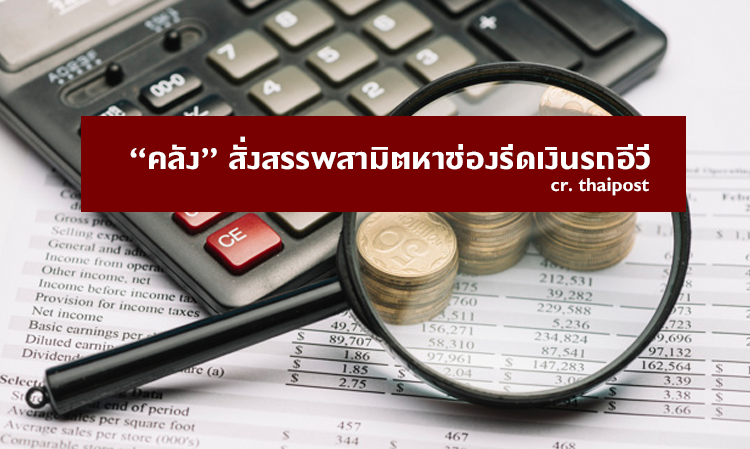
"Finance Ministry" Orders Excise Department to Find Ways to Tax EVs
On September 12, 2019, Mr. Uttama Savanayana, the Minister of Finance, revealed after visiting and providing policy guidance to the Excise Department that he has instructed the department to consider establishing a fund to promote the potential of the electric vehicle (EV) industry and battery management. This initiative aims to support the EV industry, which is a government target, focusing on using relevant taxes to improve the quality of life for citizens and protect the environment. The tax structure should be appropriately organized, and the fund may be established through legislation.
The fund's budget will be considered based on the increasing number of EV imports. The fund will be used to promote innovation, develop personnel, advance technology, and manage expired batteries to ensure the quality of life for citizens. However, the specific tax rate for EV imports has not yet been determined.
Mr. Uttama stated that the Excise Department is also considering introducing new tax rates to collect taxes on innovative beverages, such as vitamin-infused water that is non-carbonated and offers health benefits, or fruit juices containing collagen. This initiative aims to promote innovation, with the tax rate being lower than the general beverage tax, which is currently set at 14% plus a sweetness tax.
Regarding the consideration of extending the tobacco tax increase from 20% to 40%, which is set to end on October 1, 2020, no conclusion has been reached yet. The Excise Department is currently assessing the appropriateness of this measure. As for the tax on cannabis, this matter has not yet been proposed, and it is viewed as too early to consider.
Mr. Santi Prompat, the Deputy Minister of Finance, emphasized the necessity of establishing a fund to promote the potential of the EV industry. Although EVs are beneficial and are expected to see increased usage in the future, there are issues regarding battery management once they reach the end of their life cycle. It is essential to have an agency in place to manage this to avoid environmental impacts. He affirmed that this matter needs immediate action, as delaying it would not be timely for the situation, and retroactive taxation on already imported EVs would not be feasible.
The Deputy Minister of Finance also mentioned that he has assigned the Excise Department to assess the appropriateness of tobacco tax rates to avoid burdening citizens while ensuring compliance with World Trade Organization (WTO) agreements, as the WTO is closely monitoring Thailand. Therefore, careful consideration of this matter is necessary.
Mr. Patchara Anantasit, Director-General of the Excise Department, reported that the overall tax collection of the Excise Department for the first 11 months of the fiscal year 2019 (October 2018 - August 2019) reached 584 billion baht, exceeding the budget target by 2.1 million baht or 0.0004%, and higher than the same period last year by 3.95 billion baht or 0.68%. However, tax collections from oil and tobacco remain below target, while collections from vehicles, beer, and alcohol have exceeded expectations.
Thank you for the information from www.thaipost.net