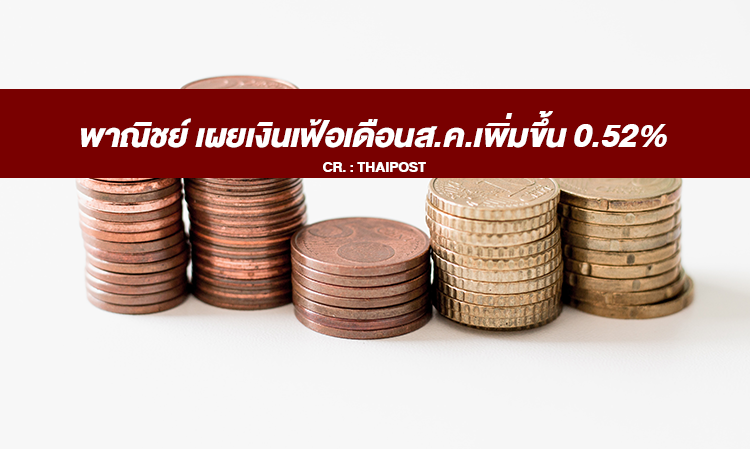
Commerce Reports August Inflation Increased by 0.52%
"Commerce" reports that inflation in August increased by 0.52% despite rising food prices, including sticky rice, jasmine rice, vegetables, fruits, meat, eggs, and milk. The annual forecast remains at 0.8-0.9%, emphasizing that low inflation does not signal deflation.
On September 2, 2019, Ms. Pimchanok Wonkohphorn, Director of the Office of Trade Policy and Strategy (OTPS), revealed that the Consumer Price Index (CPI) for August 2019 stood at 102.27, up 0.52% compared to August 2018, but a slowdown from July 2019, which saw an increase of 0.98%. The primary factor for the rise in August inflation was the increase in food prices, which rose by 5.15%, while energy prices continued to decline for the fourth consecutive month, decreasing by 5.16%. Core inflation, excluding fresh food and energy, increased by 0.49%, and the average inflation for the first eight months of 2019 (January-August) rose by 0.87%.
The inflation increase in August 2019 was driven by a 2.63% rise in food and non-alcoholic beverage prices. Key items that saw price increases included fruits, which rose by 8.69%, and fresh vegetables, which increased by 4.99% due to lower market supply and a relatively low price base from the previous year. Sticky rice and jasmine rice increased by 7.06% due to drought issues leading to reduced supply, while demand remained high. Meat, including duck, chicken, and seafood, rose by 3.63%, eggs and dairy products increased by 1.82%, and food consumed at home rose by 0.97%, while food consumed outside increased by 0.96%. Non-alcoholic beverages rose by 0.52%, but cooking ingredients decreased by 0.90%.
Other non-food and non-beverage items decreased by 0.67%, primarily due to an 8.15% drop in fuel prices. Transportation and communication costs fell by 2.22%, clothing and footwear decreased by 0.09%, and personal care services dropped by 0.03%. However, public transportation fares increased by 6.19%, housing costs, such as electricity and rent, rose by 0.30%, and entertainment, reading, and education costs increased by 0.79%. Tobacco and alcoholic beverages saw a slight increase of 0.02%.
Ms. Pimchanok stated that the inflation trend for the remainder of this year is expected to rise slightly, primarily due to the growth in prices of fresh food items. However, prices of other consumer goods are relatively stable with minimal changes, while energy prices continue to decline, reducing inflationary pressure. It is estimated that the annual inflation rate will remain low at 0.8-0.9%, within the expected range of 0.7-1.3%. This indicates that inflation will grow slowly again, with previous years showing a decrease of 0.9% in 2015, an increase of 0.19% in 2016, 0.66% in 2017, and 1.07% in 2018.
"When comparing Thailand's inflation with other ASEAN countries, Thailand's inflation is relatively low, with other countries experiencing rates of 2-3%, while Thailand remains below 1%. The excessively low inflation reflects that consumers are delaying spending and not purchasing goods, which may affect economic stability. The government's economic stimulus and the increase in funds for the state welfare card are seen as measures to inject money into the system. As agricultural prices rise and capital goods for export increase, this will positively impact the economy in the final quarter of this year. However, it is still confirmed that even with low inflation...
Thank you for the information from www.thaipost.net