Inflation Rate in January 2026 at -0.66%, Thai Inflation Expected to Remain Low Due to Decreased Production Costs from Global Energy Prices and Influx of Cheap Imports
- The general inflation rate for January 2026 is -0.66% YoY, marking a continuous decline for the 10th month due to lower energy prices compared to the previous year. The core inflation rate stands at 0.60% YoY, stable from last month’s 0.59% YoY.
- Krungthai COMPASS predicts that inflation will continue to remain low in the near future due to: 1) Decreased production costs aligned with global energy prices, and 2) An influx of cheap imported goods. However, attention must be paid to the risks from geopolitical uncertainties that could affect oil prices and the Thai baht.
The general inflation rate for January 2026 is -0.66% due to energy prices and a decrease in fresh vegetable prices.
The general inflation rate for January is -0.66% (YoY), a deeper decline from the previous month’s -0.28% and exceeding analysts' expectations of -0.40%[1]. The main factor is a decrease in energy prices by 8.41% due to lower global energy prices compared to last year and government measures to alleviate living costs. Additionally, a significant pressure factor this month is the fresh vegetable and fruit category, which saw a reversal to a decrease of 0.11% from a previous positive figure last month (see Figure 2).
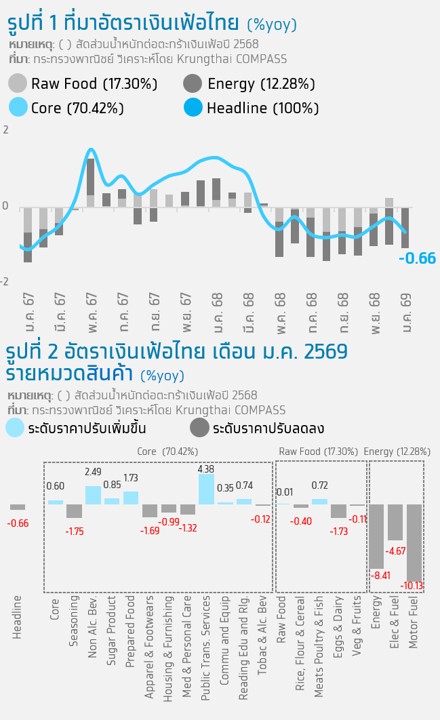
In January 2026, there were 7 groups of products with price increases, down from 9 groups in the previous month (excluding energy). (See Figure 2) Groups with price increases include public transport fares (up 4.38%), while groups with price decreases include housing (down 0.99%).
When considering month-on-month changes, the general consumer price index in January decreased by 0.28% from December, with the food and non-alcoholic beverage category decreasing by 0.42%. The main reason is a decrease in fresh vegetable prices by 8.31%, while other non-food and beverage categories decreased by 0.17% due to a 1.78% drop in fuel prices.
The core inflation rate remains at 0.60%, stable from last month’s 0.59%. Month-on-month changes show that the core consumer price index increased by 0.07%.
Implication:
- Krungthai COMPASS expects that Thailand's inflation will continue to remain low in the near future due to:
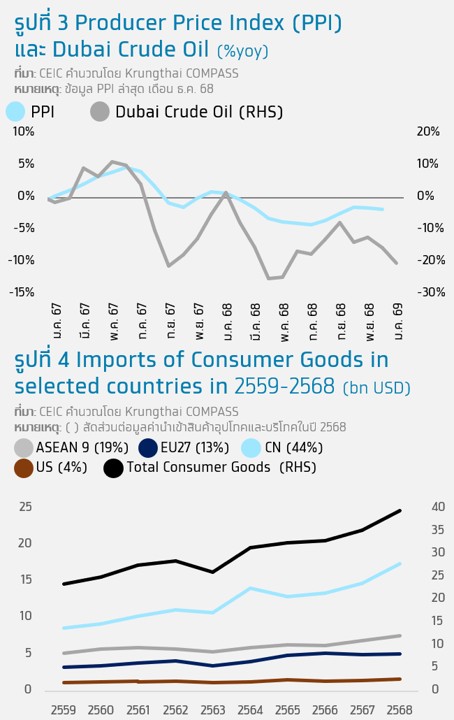
- Decreased production costs aligned with lower energy prices compared to last year. The U.S. Energy Information Administration (EIA) estimates that global oil supply in 2026 will continue to exceed market demand as OPEC+ and other producers are likely to increase oil production beyond demand[2]. The trend of lower energy prices will help reduce production costs, as indicated by the continuously declining Producer Price Index (PPI) from last year (see Figure 3). Additionally, lower oil prices will also reduce transportation costs.
- The influx of cheap consumer goods from abroad is expected to increase, reflected by an 18% growth in consumer goods imports from China in 2025, making Chinese goods account for 44% of the total value of consumer goods imports, up from an average of 37% during 2016-2019 (before COVID-19). Furthermore, the recent strengthening of the Thai baht has also pressured inflation to remain low (see Figure 4).
- Monitor risks to the direction of Thai inflation, including the influx of cheap goods from abroad due to market saturation and weaker-than-expected demand in China, leading producers to offload products to ASEAN and Thailand more. Additionally, geopolitical uncertainties must be monitored, as they will affect global oil prices and the Thai baht, impacting the inflation outlook in the near future.