Summary of Financial Linkages Between Thailand and Cambodia in Three Key Dimensions
In light of the ongoing monitoring and assessment by various government and private agencies regarding the situation between Thailand and Cambodia, Kasikorn Research Center has compiled and evaluated preliminary insights on the financial linkages between Thailand and Cambodia across three dimensions as follows:
- Dimension of Money Transfers and Payments: Money transfers through electronic or digital transfer systems between Thailand and Cambodia continue to operate smoothly. Meanwhile, the risk mitigation from exchange rates for trade transactions between Thailand and Cambodia can be managed through standard instruments, as nearly 100% of international trade transactions between Thailand and Cambodia are conducted in US dollars and Thai baht (not in the Cambodian riel).
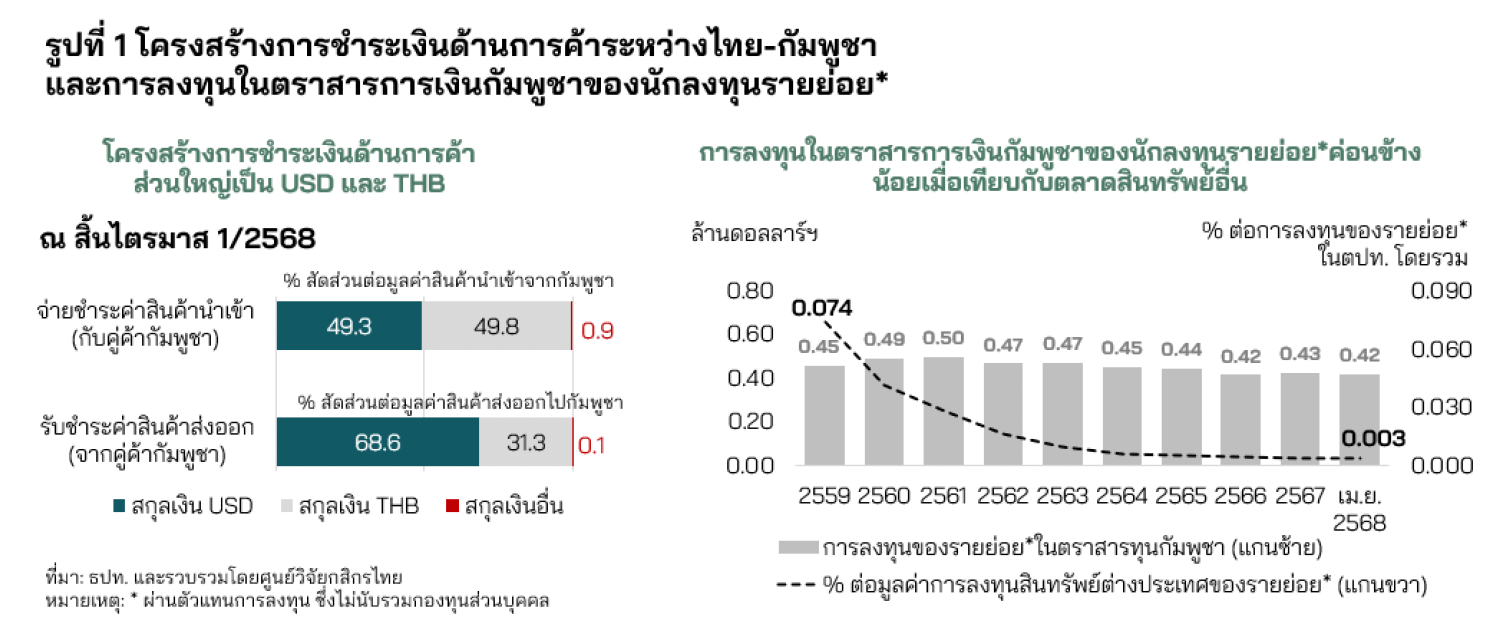
As of Q1 2025, the proportion of export payment transactions from Thailand (from partners in Cambodia) in US dollars and Thai baht is approximately 68.6% and 31.3% of the value of Thai exports to Cambodia, respectively. Meanwhile, the proportion of import payment transactions from Thailand (with partners in Cambodia) in US dollars and Thai baht is 49.3% and 49.8% of the value of goods imported from Cambodia (Figure 1).
However, mitigating FX risks is only a partial solution as it must be acknowledged that there are still other concerns in the business sector that need to be closely monitored in the future, such as the liquidity of cash transactions, as well as the impacts on trade/economic activities in border areas and the risks that may arise from partners and businesses operating in Cambodia.[1]
- Dimension of Investment in Cambodian Assets: Investors (including retail investors investing through investment agents and mutual funds, excluding private funds) currently have only a small number of retail investors investing in Cambodian financial instruments through agents, while the total outstanding investment is in equity instruments, which has gradually decreased over the past few years. As of April 2025, the outstanding amount was $0.42 million, accounting for only 0.003% of the total investment in foreign assets by retail investors (Figure 1).
It is noteworthy that mutual funds in Thailand do not invest in Cambodian financial instruments; thus, based on preliminary data, the direct link of retail investments and mutual funds to Cambodian financial assets is likely quite limited compared to investments in other more popular markets such as the US, Luxembourg, China, Japan, and Singapore, respectively.
- Dimension of the Banking Sector: Currently, Thai commercial banks provide financial services in Cambodia through branches or affiliated finance companies in which they hold shares, such as cross-border digital payment and money transfer services, QR code payment services, deposit services, and loans to support businesses and retail clients.
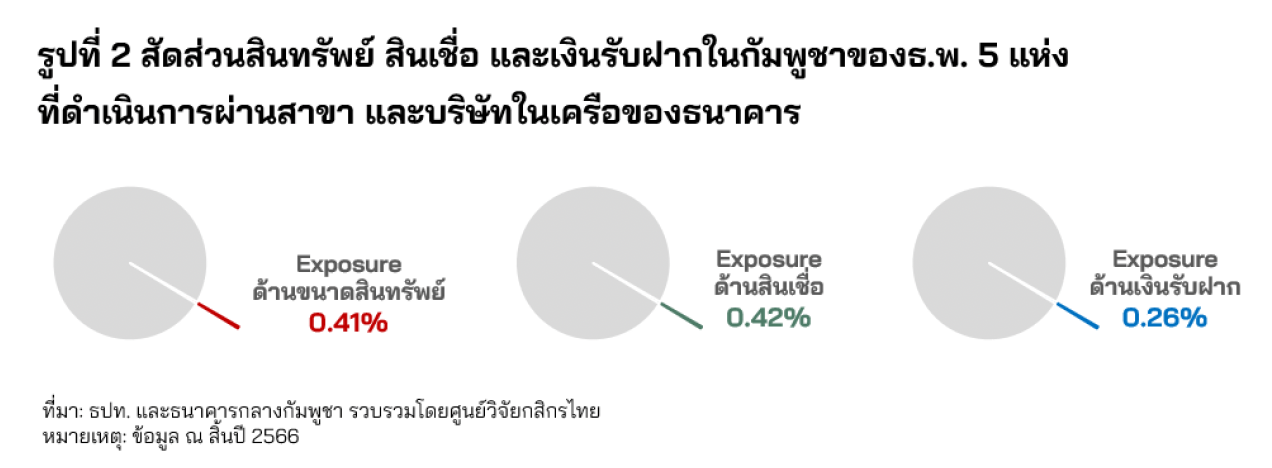
However, when looking at the exposure of five commercial banks in Cambodia, it is found that the proportion is still relatively small compared to their operations in Thailand. The asset size, loans, and deposits in Cambodia account for approximately 0.41%, 0.42%, and 0.26% respectively compared to the total outstanding amounts in the Thai commercial banking system (Figure 2).
Initially, Kasikorn Research Center views that the development of the relationship between Thailand and Cambodia remains a matter that needs continuous monitoring, with most concerns revolving around trade-related transactions and economic activities in border areas. However, the impact on the Thai banking sector will be manageable.
Given that the exposure in various aspects in Cambodia of Thai commercial banks is still not high, this reflects two important points: 1. In providing financial services abroad, commercial banks will adopt a cautious operational strategy, considering the availability of financial resources and defining the scope of financial services only in areas where they have expertise and align with trade, investment, and economic fundamentals. 2. Commercial banks closely monitor and assess situations, as well as manage risks in foreign business continuously. Therefore, it ensures that Thai commercial banks can effectively manage risks that may arise from their operations in Cambodia.
[1] The outstanding amount of direct investment from Thailand was $2,376 million at the end of 2024.