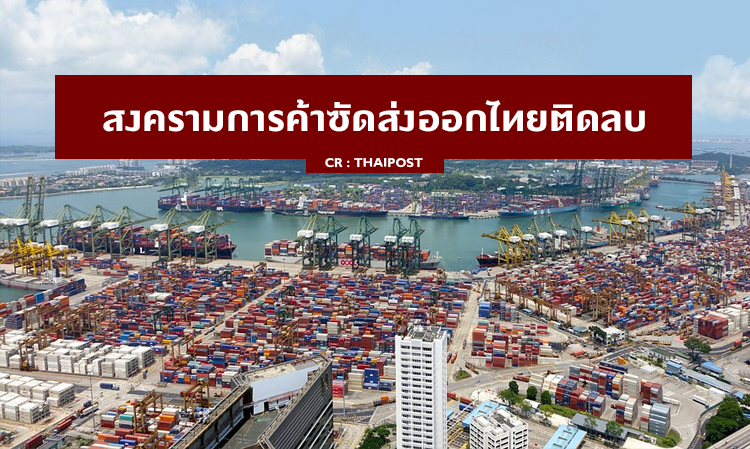
Trade War Hits Thai Exports Negatively
On August 7, 2019, Ms. Kanya Phak Tantipipatanapong, President of the Thai National Shippers' Council (TNSC), revealed the current global economic overview, stating that it remains volatile due to the ongoing trade war between the United States and China. This situation has led to increased foreign investment in ASEAN, with the highest FDI going to Vietnam, the Philippines, Indonesia, Malaysia, Thailand, and Singapore. The main factor driving this is the relocation of production bases as China faces trade restrictions from the U.S., prompting foreign investors who previously invested in China and produced goods for export to the U.S. to shift their production to ASEAN countries.
“On July 31, the U.S. Federal Reserve voted to lower interest rates by 0.25% in a split decision, bringing the current policy rate to 2-2.25%. This decision was made in response to concerns about the global economy and stagnant inflation in the U.S., signaling that further cuts may be necessary. At the same time, it is believed that this rate cut will help push inflation back to the 2% target, as the current inflation rate stands at 1.8%. This could potentially lead to a financial war in the future,” Ms. Kanya stated.
Regarding global currencies, the TNSC views that they remain volatile in line with the global economic conditions affected by the trade war, such as the depreciating currencies of the U.S. and China. In Thailand, the currency has appreciated, with the Thai baht showing a strengthening trend in July, fluctuating between 30.57 and 30.90 baht per U.S. dollar throughout most of the month. This has resulted in increased export costs for Thailand. However, on July 15, the TNSC held discussions with the Bank of Thailand (BoT) to find solutions to the currency crisis affecting the export sector.
In terms of requests, the TNSC has proposed to the BoT to address issues or implement measures for assistance, including: 1. Implementing policies to prevent the inflow of speculative short-term capital; 2. Providing spokespersons and/or information through online channels to offer real-time and accurate exchange rate direction; 3. Reducing the policy interest rate and controlling the interest rate spread of commercial banks; 4. Supporting SMEs in currency hedging; and 5. Disclosing information on forward exchange trading fees.
For Thai exports in June 2019, the export value was recorded at 21,409.3 million U.S. dollars, a decrease of 2.15% or 676,838 million baht, contracting by 2.9%. Meanwhile, imports were valued at 18,197 million U.S. dollars, down 9.4%, equivalent to 583,094 million baht, a contraction of 10.2%. This resulted in exports for the first half of the year (January-June) amounting to 122,971 million U.S. dollars, a contraction of 2.9% or 3,881,308 million baht, while imports totaled 119,027 million U.S. dollars, down 2.4%. Nevertheless, the TNSC forecasts that Thai exports will decline by 1% in 2019.
Thank you for the information from www.thaipost.net