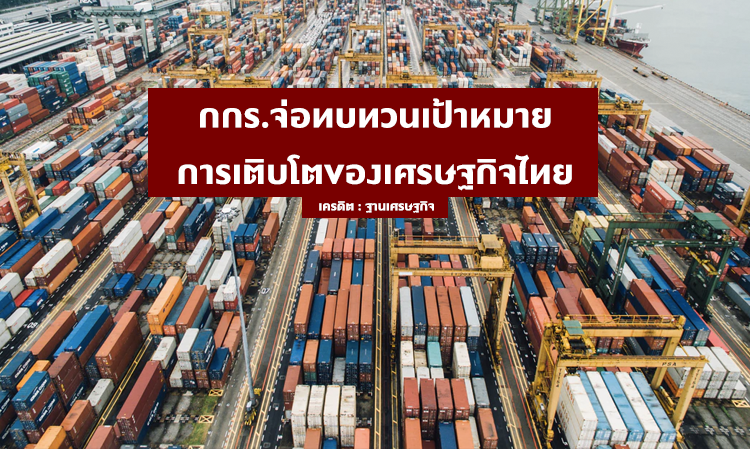
Joint Private Sector Committee to Review Thailand's Economic Growth Targets
On July 10, 2019, Mr. Suphan Mongkolsuthee, Chairman of the Federation of Thai Industries (FTI), revealed that the meeting of the Joint Private Sector Committee from three institutions (JPS) on July 10 will reconsider the estimates for Thailand's Gross Domestic Product (GDP) growth and exports for 2019. Initially, GDP was expected to grow by 3.7-4% and exports by 3-5%, but there is a tendency for these figures to be revised downwards due to various factors, including the US-China trade war and concerns from the private sector regarding the rapidly appreciating Thai baht.
"The extent of the adjustment will need to be reassessed, especially considering the baht's strength at around 30.50-30.80 baht per US dollar. This rapid appreciation significantly impacts Thailand's competitiveness, so we urge the government to implement measures to prevent the baht from strengthening beyond that of our trading competitors, particularly by lowering the policy interest rate," Mr. Suphan stated.
Mr. Kriangkrai Thiennukul, Vice Chairman of the FTI, mentioned that the private sector is currently concerned about the baht's appreciation, which is greater than that of other ASEAN countries, undermining Thailand's competitiveness and exacerbating the export situation, which has seen a 2.7% decline over the past five months. Additionally, this affects the tourism sector, another crucial driver of the economy. Therefore, the JPS will likely need to revise the economic and export figures downwards.
"Many agencies have adjusted their economic and export targets downwards, with the worst-case scenario being a 1% decline in exports. The FTI anticipates that exports this year will be around 0-1%. The JPS will need to discuss further, as if the baht falls below 30 baht per US dollar, the likelihood of negative export growth increases. The Thai baht is currently the strongest in ASEAN and may be one of the strongest currencies in the world, primarily due to Thailand's relatively high foreign reserves," Mr. Kriangkrai added.
The private sector hopes that the new cabinet, particularly the economic team, will work harder to manage the economy in the short term by addressing the baht's strength through lowering the policy interest rate, stimulating domestic spending, negotiating new Free Trade Agreements (FTAs) for new export markets in the medium term, and driving investments according to the Thailand 4.0 roadmap in the long term to build confidence in investments in the Eastern Economic Corridor (EEC), among other measures.
"What is noteworthy at this time is the impact of the trade war, which has led to a significant shift of production bases to Vietnam. In the first five months, Vietnam's exports were only $400 million less than Thailand's, whereas in 2018, Thailand's export value exceeded Vietnam's by over $80 billion. There is a possibility that Vietnam's export value may surpass Thailand's this year," Mr. Kriangkrai concluded.
Thank you for the information from www.thaipost.net