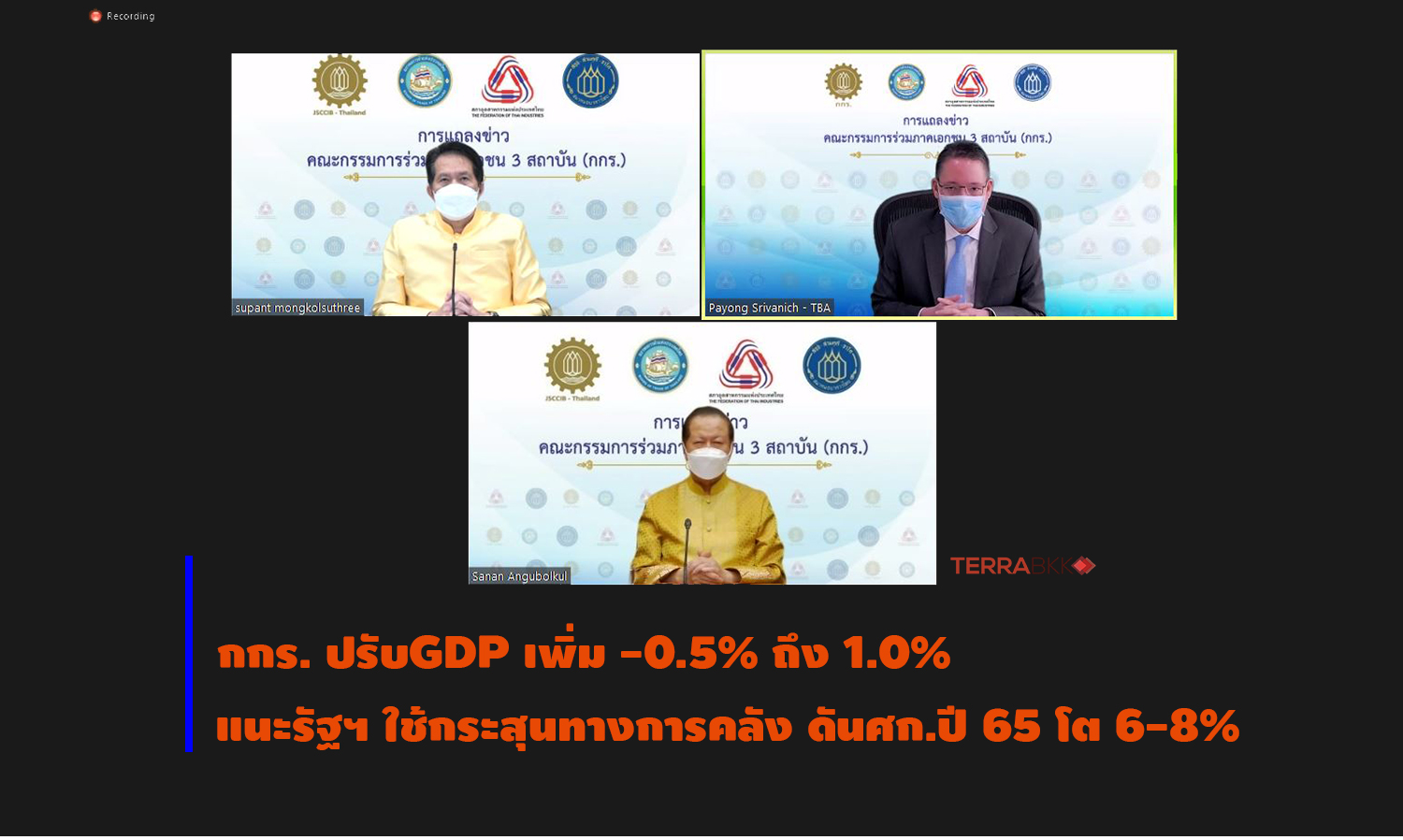
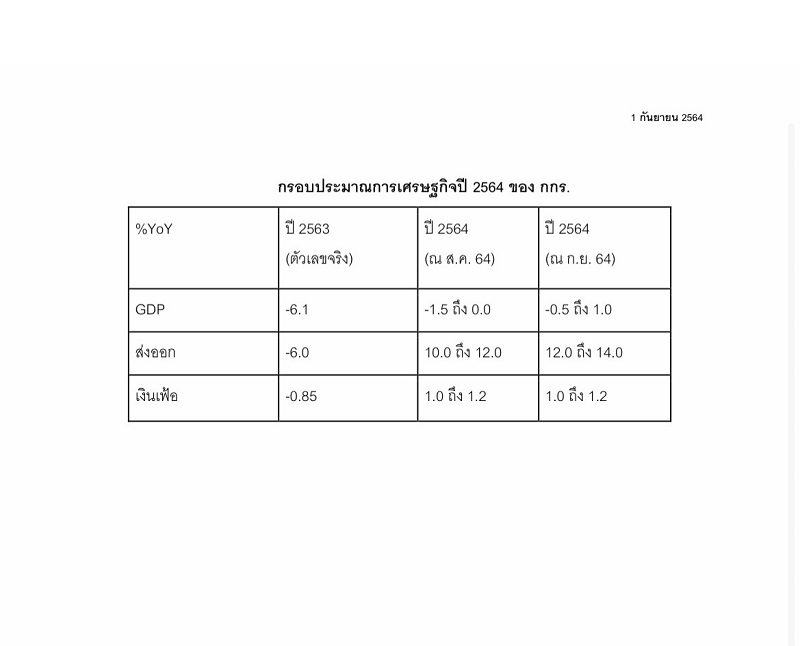
Joint Private Sector Committee Adjusts GDP Forecast to -0.5% to 1.0%, Urges Government to Utilize Fiscal Measures to Boost Economy in 2022 by 6-8%
The Joint Private Sector Committee (JPSC) has revised its economic forecast for Thailand in 2021 from a previous estimate of -1.5% to 0.0% to a new range of -0.5% to 1.0%. Export growth is now projected at 12.0% to 14.0%, up from the earlier estimate of 10% to 12%, due to a strong recovery in the global economy, provided that the government effectively supports the business sector. This includes ensuring widespread access to vaccines for workers and assisting with the costs of various Rapid Tests to control the spread of the virus in a timely manner. The general inflation rate is expected to remain within the range of 1.0% to 1.2%.
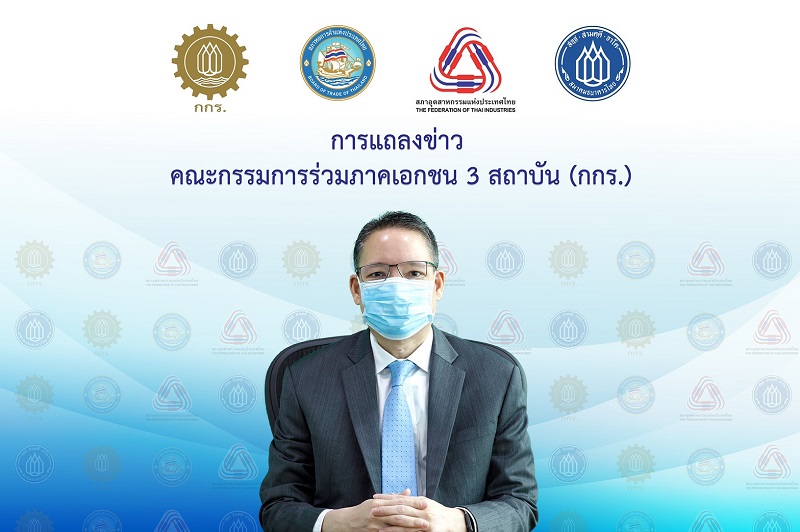
Mr. Payong Srivanit, Chairman of the Thai Bankers' Association and Chair of the Joint Private Sector Committee comprising the Thai Bankers' Association, the Federation of Thai Industries (FTI), and the Thai Chamber of Commerce revealed that the key factor for the adjustment is the improving COVID-19 infection situation in the country, which has led to the easing of lockdown measures in September and an increase in vaccine procurement plans, positively impacting the economy for the remainder of the year.
The effective allocation and administration of the increased vaccine supply will help improve the economic outlook for the rest of the year, depending on two main factors: 1) The supply chain of the manufacturing sector under the Bubble & Seal measures must not be disrupted by outbreaks among workers, and 2) If the spread of the virus is better controlled, the government will be able to accelerate various economic stimulus measures, particularly promoting tourism in time for the high season at the end of the year, which will help boost domestic spending. However, if the outbreak worsens again, the Thai economy remains at risk of entering a recession.
The effective and clear vaccine procurement and administration plan can drive Thailand towards a more ambitious economic recovery target for 2022. The government agencies estimate that the economy can grow by 3-5% in 2022, which the private sector views as too low, leaving economic activity levels below pre-COVID-19 levels in 2019.
This situation leaves many businesses still struggling. Therefore, to encourage businesses to recover quickly, the government should set a more challenging economic growth target of 6-8%, which is feasible given that over 50% of Thais have received two doses of the vaccine.
The government needs to utilize fiscal measures by increasing the public debt ceiling to GDP from 60% to 70-80%, which would bring in an additional 0.7-1.5 trillion baht, focusing on supporting employment and using measures with high economic multipliers, such as co-payment schemes or higher credit guarantees comparable to other countries.
Additionally, support for entrepreneurs, especially SMEs, is crucial for helping them navigate through the crisis. Currently, the Bank of Thailand has adjusted the criteria for recovery loans, incorporating private sector recommendations to enhance access for SMEs to a maximum loan amount of 150 billion baht. The loan limit for new borrowers will be increased from 20 million baht to 50 million baht.
Existing borrowers with previous limits of 30% below 50 million baht can apply for up to 50 million baht to enhance liquidity in response to the prolonged COVID-19 situation. The criteria and conditions for guarantees from the Credit Guarantee Corporation have also been adjusted, including a reduction in guarantee fees for vulnerable borrowers, with fee reductions in the first two years to alleviate burdens during the ongoing economic recovery, expected to start from September 6.
The Thai Bankers' Association has collaborated with the Thai Chamber of Commerce and the Federation of Thai Industries to promote the Digital Supply Chain Platform project and the establishment of E-invoicing standards under the larger "Digital Supply Chain Project," in conjunction with the Smart Financial Infrastructure initiative led by the Bank of Thailand. This aims to create a system that connects the trade and finance sectors using trade activity data from small, medium, and large partners within the supply chain and E-invoicing data to support lending for SMEs, expected to commence in Q4 of this year, with the government able to promote various measures through this platform in the future.
The JPSC has proposed to the government that vaccination efforts must be efficient, clearly communicated, transparent, and verifiable to build public confidence. There should be no further lockdown measures as they significantly impact the economy; instead, the Bubble & Seal measures should be used alongside proactive Antigen Test Kit screenings, fully utilizing the private sector's potential in a complementary manner to ensure effective COVID-19 prevention.
The government should implement more economic stimulus measures, both short-term and long-term. Short-term measures should aim to boost domestic spending, such as the co-payment program of 3,000-6,000 baht, as it is an effective mechanism, along with tax deduction initiatives and tourism promotion.
Long-term measures should focus on strengthening and maintaining production bases to cope with trade wars, promoting new industries (New s-Curve) through continuous public investment, both direct government investment and PPP, while creating an investment-friendly atmosphere and attracting foreign direct investment (FDI) to fully support the recovery of the Thai economy in the future. Additionally, the government should increase the budget for supporting SMEs through higher credit guarantee ratios, as in other countries, where government-supported guarantees can reach 80-100% of loan amounts, while Thailand currently stands at only 40%.
The government is requested to support the costs of Antigen Test Kits for industrial testing, providing assistance with test kits and various expenses, as well as helping with tax measures to reduce the burden on entrepreneurs and addressing high shipping costs, as the private sector seeks measures to reduce additional costs.
Supply chain disruptions in various industries have led to rising raw material and transportation costs. One critical area affected by this issue is semiconductor chips, which cannot be produced quickly enough, resulting in shortages across multiple industries. The government is requested to help resolve the semiconductor chip issue.