How to Turn Crisis into Profit: Lead Your Team Through Hard Times
The COVID-19 situation is rapidly spreading worldwide, causing a chain reaction that affects income, the overall economy, and businesses across all industries. In the topic "Turn Crisis into Profit: Lead Your Team through Hard Times", the leader plays a crucial role in guiding the organization and team through this crisis. The knowledge shared in this article can be applied to create profits or ensure business survival. It is essential to look for opportunities within the crisis to transform the situation into profit.
Step 1: Identify the Challenge The COVID-19 crisis has negatively impacted organizations, resulting in adverse outcomes. However, the challenges that arise from the crisis are crucial for organizations. For example, measures to control the pandemic, such as prohibiting gatherings and dining in restaurants, highlight the challenges faced during this crisis. Therefore, the first duty of the leader is to clearly identify the problems that may arise. For instance, if restaurants are prohibited from serving dine-in customers, they must find ways to sell food through delivery services to address the issue.
Step 2: Assess the Impact Once the problems are identified, it is essential to examine how these challenges affect the organization. Thus, if we are to combat the COVID-19 crisis...
Step 3: Find Solutions Within the Organization To overcome the impact, we must find ways to address the challenges.
Given the current situation, if you do not make any adjustments, your business outcomes are likely to be negative. Therefore, it is necessary to change business operations to continue generating profits.

“VUCA World” is a term that originated from American military operations and has been adapted to apply to the current era. It reflects the interconnectedness of information from around the world, which includes:
- Volatility: This era experiences higher volatility than in the past.
- Uncertainty: For instance, predictions that cannot be anticipated, unlike in the past.
- Complexity: Such as the Phuket boat incident, which impacted the hotel business and had widespread effects on tourism.
- Ambiguity: The difficulty in obtaining complete information.
So, what does “VUCA World” have to do with the crisis? It must be noted that the COVID-19 crisis is occurring in the “VUCA World”, making it highly volatile. This is reflected in the rapid spread of the virus in Europe within a month, resulting in a massive number of infections, creating a situation that cannot be predicted in advance.
As the crisis exists in the “VUCA World”, the overall picture becomes volatile and complex. The difficulty in identifying challenges arises. Besides COVID-19, the world has faced the US-China trade war, domestic politics, and oil prices, all of which impact Thailand's overall situation.
Thus, the role of the leader is to identify challenges within the organization and acknowledge that this crisis exists in a “VUCA World”, a world filled with uncertainty, high volatility, and steep challenges, where complete research data cannot be obtained.
The question is, what should the leader do?
To identify the challenge, you must be decisive enough to confidently predict outcomes even without 100% data, quickly during that time, and set aside accuracy for later.
Once you identify the challenge, the next step is to assess the impact. After recognizing the problem, you must evaluate its effects on your organization. I have categorized this into three groups for further consideration:
1. Perception
When a challenge arises, it affects the perception of people. Team members may have differing opinions, leading to disorganized efforts and potentially preventing the organization from reaching its goals.
2. Direction
When a crisis occurs, it may affect the organization's goals. Therefore, you need to find alternatives or support for the business in areas that must be halted or slowed down to keep the business moving forward.
3. Operation
Changes in work methods, such as working from home.
The key is that the leader must address the impacts occurring within the organization during the crisis. If successful, they can guide the team towards the desired profit. Certainly, the leader must enhance their role in alignment with the three groups of impact mentioned, prioritizing actions based on the opportunities presented by the crisis.
Initially, the leader must focus on managing the perception that is still scattered. The first role is to act as a coach and mentor to help the team align their attitudes in the same direction and foster a correct understanding.
The second role is to address direction. When the organization's direction changes, as a leader, you must be a strategic thinker, selecting the appropriate methods to achieve goals while utilizing limited resources.
Moreover, the controller role is essential for solving operational issues during a crisis. The leader must be “decisive, quick, and clear”. Therefore, once you determine how to proceed and establish a new working method, the leader's role shifts to being decisive and swift. All three roles must be applied appropriately and timely to achieve the desired outcomes.
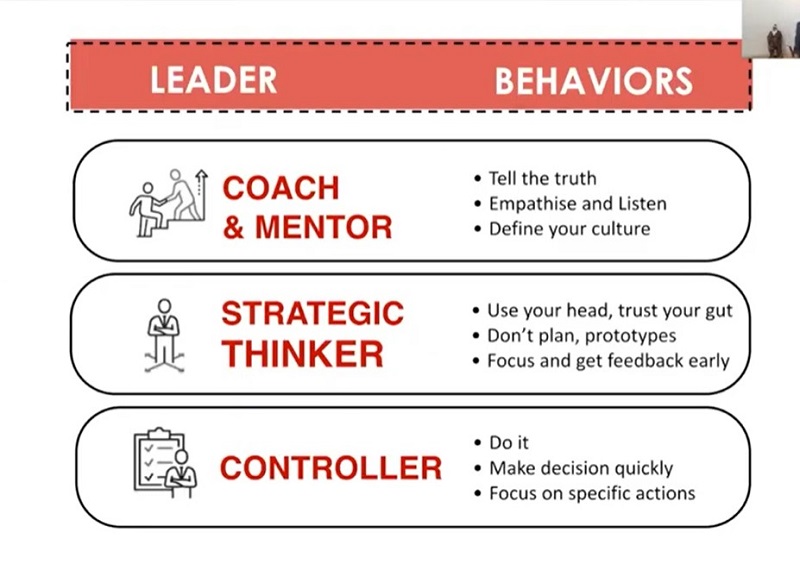
When the crisis exists in a “VUCA World”, characterized by high volatility, the leader must adjust their behaviors to align with the situation. The leader must embody the three roles mentioned through nine behaviors.
As a coach and mentor, you must provide truthful information to create a factual dataset for the team to understand and build confidence. The leader should strive to understand team members and establish an organizational culture that can operate during the crisis, such as flexibility, where everyone can perform various roles or work quickly.
As a strategic thinker, you need to utilize limited available data instinctively and plan quickly, as everything in the “VUCA World” is rapidly changing. Feedback should be swiftly incorporated to align with the organizational culture during the crisis.
For the controller, you must act immediately upon identifying solutions. This differs from the current business climate, where, when problems arise, you must decide quickly without waiting for clear information, embracing risks.
“COVID-19 is a crisis with an unpredictable duration. The key challenge is the adaptability of businesses under these circumstances. I want to be part of helping businesses adjust and operate under these limited conditions, which is why I am sharing this first webinar titled "Turn Crisis into Profit: Lead Your Team through Hard Times." The first step is for all leaders to understand what COVID-19 or any other factor is impacting your business, as this will be crucial for resolving your team's operational challenges.”