Real Estate Stimulus Policies During the Covid-19 Pandemic
Real Estate Stimulus Policies During the Covid-19 Pandemic
By: Tri Rat Jaru Thas, Chulalongkorn University, May 2021
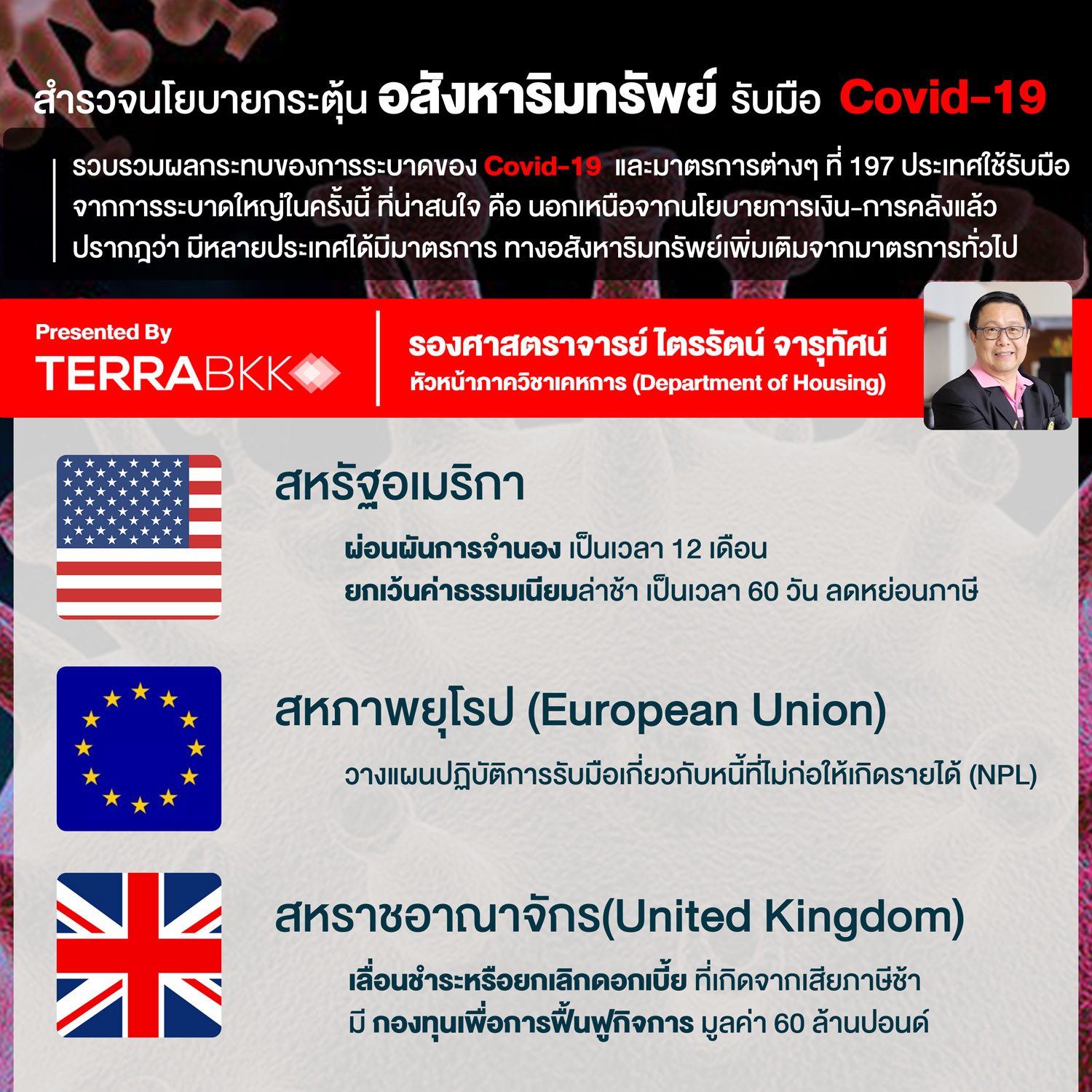
In May 2021, the International Monetary Fund (IMF) compiled the impacts of the Covid-19 pandemic and various measures taken by 197 countries to cope with this major outbreak. Interestingly, in addition to monetary and fiscal policies, many countries implemented additional real estate measures beyond general policies, with the following notable details:

|
1. United States |
Covid-19 Situation
The first confirmed COVID-19 case in the U.S. was reported in January 2020, with new cases rising again in September and continuing to trend upward until early January 2021. The U.S. economy contracted by 31.4% in the second quarter of 2020 but has since recovered strongly, with an unemployment rate of 6.2% in February 2021.
Real Estate Measures
- Fannie Mae and Freddie Mac (agencies that oversee the conversion of residential loans into securities) announced assistance for borrowers, including a 12-month mortgage forbearance and a 60-day suspension of foreclosure and eviction proceedings.
- New policies were enacted to assist those affected by the pandemic (COVID-19 Emergency Eviction and Foreclosure Prevention Act of 2020), which extended the time for paying rent or mortgage payments for residents in New York, with the state covering those costs initially, along with property tax reductions. Additionally, the state attracted major companies like Facebook, TikTok, Home Depot, and many others to invest in commercial real estate, research centers, and large offices to draw labor into the city.
|
2. European Union |
Covid-19 Situation
Since the first case was reported on January 24, 2020, COVID-19 has spread throughout the European Union (EU) and had a severe impact, peaking in April 2020. The European Commission concluded advance purchase agreements allowing countries to buy up to 2.8 billion doses (approximately 5.5 times the population of 513 million). By May 5, 2021, 26.3% of the EU population had received at least one vaccine dose.
Real Estate Measures
In November 2020, the Eurogroup agreed to implement support measures by early 2022, pending ratification of a treaty on non-performing loans (NPLs) on December 16, amid fears of rising NPLs due to COVID. This plan would allow member states to extend state aid to banks and national asset management companies.

|
3. United Kingdom |
Covid-19 Situation
The first confirmed case was reported on January 31, 2020, with cases peaking in April/May. After a decline, the second and third waves hit with higher case numbers than initially seen. In response to the first outbreak on March 23, the government implemented several measures.
These included travel restrictions, social distancing measures, closing entertainment venues, non-essential retail, and indoor spaces. The largest economic impact occurred in Q2 2020 when GDP fell by 19.5% quarter-on-quarter, reflecting a severe contraction in April. Overall, the UK economy contracted by 9.8% in 2020.
Real Estate Measures
In May 2020, Prime Minister Boris Johnson announced policies to stimulate the real estate sector, starting with easing some restrictions to allow the housing market to conduct in-person viewings. The government also amended regulations to empower local authorities to relax payment deadlines or waive interest on late tax payments for small to medium-sized enterprises (with annual income not exceeding £45 million or approximately 1.9 billion baht).
Market Financial Solutions (MFS) launched a £60 million fund (approximately 2.6 billion baht) to provide loans for real estate investors and businesses needing transactions related to residential and commercial properties. The Bank of England (BOE) and the government announced relief and recovery measures to mitigate the impact of the COVID-19 pandemic, with a total value of approximately £483.2 billion (around 220 billion baht), representing about 22% of GDP. Support was provided to residential tenants through Housing Benefit and Universal Credit (government agency), allowing for a minimum rent payment of 30% of the rent in each district. The government also allowed households to apply for a three-month mortgage payment holiday.
Note: The UK government provides financial support to the Bank of England, focusing on supporting residential tenants and mortgage borrowers.

|
4. Spain |
Covid-19 Situation
Spain was heavily impacted by the COVID-19 outbreak, with the first case detected on February 25, 2020. During the first wave, a state of emergency was declared from March 14 to June 21, 2020, with restrictions on commercial, cultural, recreational activities, hotels, and restaurants, and reduced public transport services from March 30 to April 9, 2020. All non-essential activities were halted.
Real Estate Measures
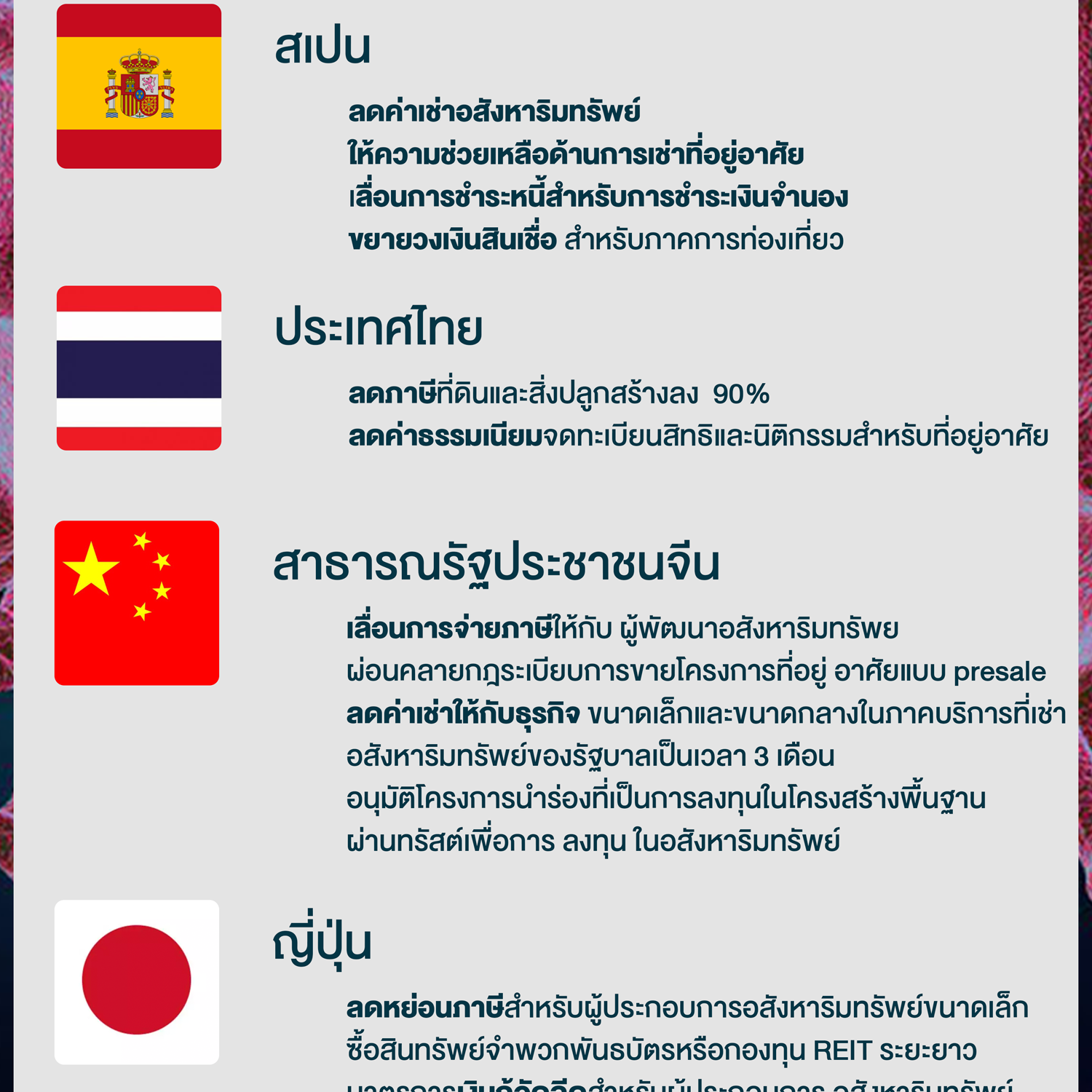
- Tax incentives for certain homeowners who reduced rental prices for properties used for activities related to the hotel, restaurant, and tourism industries (€324 million). Tax payment deferrals for small and medium-sized enterprises and self-employed individuals were granted with interest exemptions for the first three to four months.
- Increased flexibility for workers to access savings from their pension plans, allowing transfers between budgets, and local governments could use surplus budgets from previous years to support housing development.
- New rental assistance programs for tenants in distress and additional state support in the state housing plan for 2018-21 (€800 million or approximately 30 billion baht).
- Loans through the state financial fund for competitiveness in tourism (€515 million or approximately 20 billion baht) to promote sustainability in the tourism sector.
- Investment in digital and innovation in the tourism sector (€220 million or approximately 800 million baht).
- Increased credit limits for the tourism sector (€200 million or approximately 7.5 billion baht) and loans for the industry to promote digital transformation (€123.5 million or approximately 4.6 billion baht).
- Debt deferrals for mortgage payments for the most at-risk individuals, including households, self-employed individuals, and homeowners renting mortgaged properties, deferrals or reductions in rent for tenants, and deferrals for non-residential loans, including consumer loans for those at risk, suspension of interest and repayment of loans received from the state tourism office for one year without prior application, and acceptance of mechanisms for negotiating and deferring business rental payments.
Note: The Spanish government supports small and medium-sized enterprises and self-employed individuals with specific measures focused on enhancing the competitiveness of tourism in digital and innovative forms for environmental sustainability.

|
5. People's Republic of China |
Covid-19 Situation
In early January 2020, Chinese authorities identified the pneumonia outbreak in Wuhan as caused by a new strain of coronavirus. The government implemented strict quarantine measures, including extending the New Year holiday, closing Hubei province, restricting large-scale movements nationwide, social distancing, and a 14-day quarantine period for returning workers. Due to these quarantine measures, the economy contracted by 6.8% in 2020.
Real Estate Measures
The government and the People's Bank of China (PBOC) have continuously implemented measures, such as increasing flexibility in asset management reforms and relaxing housing policies by local governments, including additional measures issued by provincial governments. Some of the relief measures include:
1) Jiangsu province announced measures to support the real estate sector, such as deferring tax payments for property developers and transaction taxes, as well as relaxing regulations on the presale of residential projects.
2) The China Security Regulatory Commission and National Development and Reform Commission approved pilot projects for infrastructure investment to raise funds through Real Estate Investment Trusts (REITs). Additionally, the Chinese government reduced rents for small and medium-sized businesses in the service sector renting government properties for three months. In Lanzhou city (Gansu province), the down payment rate for purchasing commercial properties was reduced from 70% to 50%.
Note: The Chinese government allows local governments to relax housing policies and supports raising funds through Real Estate Investment Trusts (REITs).

|
6. Japan |
Covid-19 Situation
The first confirmed COVID-19 case in Japan was reported on January 16, 2020. The government implemented various measures aimed at health efforts and quarantining. The state of emergency was lifted for 39 out of 47 prefectures on May 14 and for Osaka, Kyoto, and Hyogo on May 21. On May 25, the state of emergency was lifted for all prefectures.
Real Estate Measures
- The government introduced policies to reduce taxes for small real estate operators (with total capital of less than 50 million yen or approximately 14 million baht) or companies with fewer than 100 employees. There are also measures for subsidized loans for real estate operators based on monthly income reductions, with no principal payments required for the first three years.
- The government also injected money into the system by purchasing long-term assets such as bonds or REITs to increase liquidity and improve returns. Lower interest rates enable investors to reduce investments in real estate assets, leading to increased demand and supply, and facilitating a rapid economic recovery.
Note: The Japanese government announced additional budgets for the fiscal year 2020-2021 three times, totaling 308.4 trillion yen (54.9% of GDP in 2019), directly supporting household businesses and local governments and banks (decentralization is very effective).

|
7. Australia |
Covid-19 Situation
The first confirmed COVID-19 case in Australia was reported on January 25, 2020. Social distancing measures were tightened in late March/early April, including a ban on public gatherings of more than two people and the closure of non-essential businesses. After the National Cabinet announced a three-step plan on May 8 to ease COVID-19 restrictions, states and territories relaxed quarantine measures regionally. The economy continued to recover, with real GDP increasing by 3.1% in Q4 2020, following a 3.4% increase in Q3. However, from July to November 2020, a regional COVID-19 outbreak led to new lockdowns in Melbourne. On May 6, strict COVID-19 measures were announced until May 9 for Greater Sydney.
Real Estate Measures
- A funding allocation of up to A$15 billion (approximately 300 million baht) was made to invest in mortgage-backed securities to assist small banks and non-bank financial institutions in raising funds. The government also renamed the program to SME Recovery Loan Scheme, covering loans for small and medium-sized enterprises (SMEs).
- The government announced an extension until the end of December 2021. Starting in April, the government will guarantee 80% of new SME loans (up from 50%), with a maximum loan size of A$5 million and a maximum term extended to ten years. This program also offers repayment holidays of up to 24 months.
- Support for the housing market through adjustments to lower interest rates, mortgage relief, and support for first-time homebuyers to alleviate negative impacts on homeowners' wealth in Australia. The Home Builder program was introduced to support employment in the residential construction sector, with the government providing A$25,000 (approximately 600,000 baht) to households building new homes or renovating existing ones.
Note: The Australian government has various real estate measures to assist consumers, including support for residential mortgages, lowering interest rates, mortgage relief, and support for first-time homebuyers, as well as employment support in the residential construction sector (indicating the government's emphasis on real estate).

|
8. Singapore |
Covid-19 Situation
Singapore managed to control the spread of COVID-19 infections by the end of 2020 after a lockdown in April 2020 when cases surged. Singapore entered the third phase of the outbreak on December 28, 2020. The recent increase in infections since April 28, 2021, has led to stricter lockdown measures.
The national COVID-19 vaccination program began on December 30, 2020, aiming to vaccinate all Singaporeans and long-term residents by the end of 2021.
Real Estate Measures
- Major banks in Singapore can offer housing loans eligible for collateral for a period where pricing is set higher than prevailing market rates, aligning with liquidity support objectives.
- On October 5, the Monetary Authority of Singapore (MAS) and the financial industry announced an extension of support for individuals and SMEs needing more time to repay loans. Individuals with commercial housing loans who cannot fully resume repayments can request reduced payments fixed at 60% of the monthly installment, and eligible SMEs may choose to defer 80% of principal payments for secured loans. These measures will expire in 2021.
Note: The Singapore government emphasizes strengthening the financial system and developing human resources, with economic resilience measures aimed at sustainable development.

|
9. Thailand |
Covid-19 Situation
The first confirmed COVID-19 case was reported on January 13, 2020. By mid-December 2020, Thailand had 4,246 cases in a population of nearly 70 million. However, there was a surge in cases in a second wave from December to mid-April. As of May 6, there were 76,811 cases and 336 deaths, with approximately 2,000 new cases reported daily.
- Property Tax Reduction to alleviate the impact of the COVID-19 outbreak in 2021, with a 90% reduction in property tax rates for the 2021 tax year.
- Reduced Registration Fees for residential property transactions, with transfer fees reduced from 2% to 0.01% and mortgage fees from 1% to 0.01% (only for transfers and mortgages).
Note: The policy focuses on property owners (who have enough to be taxed) and new buyers, not addressing existing small residential loans.
Summary
1. The real estate business accounts for 8% of GDP, playing a significant role in driving the economy by circulating substantial funds, creating jobs, and increasing income, while linking with other industries such as construction, building materials, financial institutions, electrical appliances, and furniture and decoration businesses. If the real estate sector is affected, it will certainly impact related businesses and the overall economy.4
2. The real estate and housing business has slowed down due to the economic crisis, significantly impacting the real estate business in Thailand. New housing sales decreased from 120,673 units in 2019 to 90,267 units (-25.2%) in 2020, with a projected growth of about 4.2% in 2021. Unsold units increased from 301,098 units in 2019 to 319,528 units (+6.1%) in 2020, with a forecasted increase of about 6.2% in 2021.5
Note: Real estate will be immediately impacted by the crisis, but recovery will take longer.
Lessons from Abroad
1. Real Estate Business
- Many countries emphasize individual housing loans, with measures for repayment holidays (suspending principal and interest payments) for up to 24 months, with the government providing direct support to financial institutions or through central banks.
- There are programs for low-income individuals providing new rental assistance for tenants in distress.
- Stimulating the economy by boosting real estate, whether it be first-time homes, first condos, or allowing foreigners to purchase condos in projects like the Thailand Elite Card to stimulate the real estate business through membership programs like "Elite Flexible One," requiring members to invest in purchasing new condominiums completed and ready for occupancy in Thailand, with a total value of no less than 10 million baht, with a two-year implementation period starting from January 1, 2021, and ending on December 31, 2022.
2. Other Interesting Proposals
- The Australian government's Home Builder program provides A$25,000 (approximately 602,500 baht) to households building new homes or renovating existing ones. This not only helps families secure suitable housing but also supports the construction industry and the sale of building materials, as well as home appliances after renovations (COVID-19 has increased work-from-home arrangements or people staying home due to unemployment).
- Promoting sustainable tourism development, as reported by UNCTAD in July 2020, estimating that the contraction of tourism due to COVID-19 impacted Thailand's GDP by 9%. Spain has projects to enhance tourism competitiveness by increasing investments in digital and innovative forms in the tourism sector.
- Restructuring businesses, whether in finance, industry, or agriculture, must focus on Digital Transformation (as seen in the cases of Singapore and China).
In Conclusion: Developed countries will have policies to address both short-term (such as limiting outbreaks, vaccination) and long-term issues to establish economic and social structures in the post-COVID era. If Thailand continues to focus on short-term problems (distributing money, finding vaccines) while also using future funds, we may not have to wait 20 years (for the national strategy plan)... What will the future look like in the next 2-5 years? Can anyone answer that?
References
1International Monetary Fund, Policy responses to COVID-19,
https://www.imf.org/en/Topics/imf-and-covid19/Policy-Responses-to-COVID-19, May 2021
2Thanaporn Suchatpatmakul, Fannie Mae and Freddie Mac, Research and Development Department, Thai Bond Market Association
https://www.thaibma.or.th/pdf/Article/Fannie%20Mae%20and%20Freddie%20Mac.pdf
3Office of the Economic Policy and Planning, Ministry of Finance News, January 26, 2021
The same applies to new housing priced below 3 million baht per unit, covering single houses, twin houses, townhouses, commercial buildings, and condominiums purchased from developers from December 31, 2021.
4Krungsri Research, Business/Industry Outlook 2021-2023: Upcountry Housing Business (6 Main Provinces) https://www.krungsri.com/th/research/industry/industry-outlook/Real-Estate/housing-in-upcountry/IO/io Housing-in-Upcountry-21
5Real Estate Information Center, Government Housing Bank and Bank of Thailand, 2021