Vibrant Secondary Cities, Yet Revenue Challenges Persist
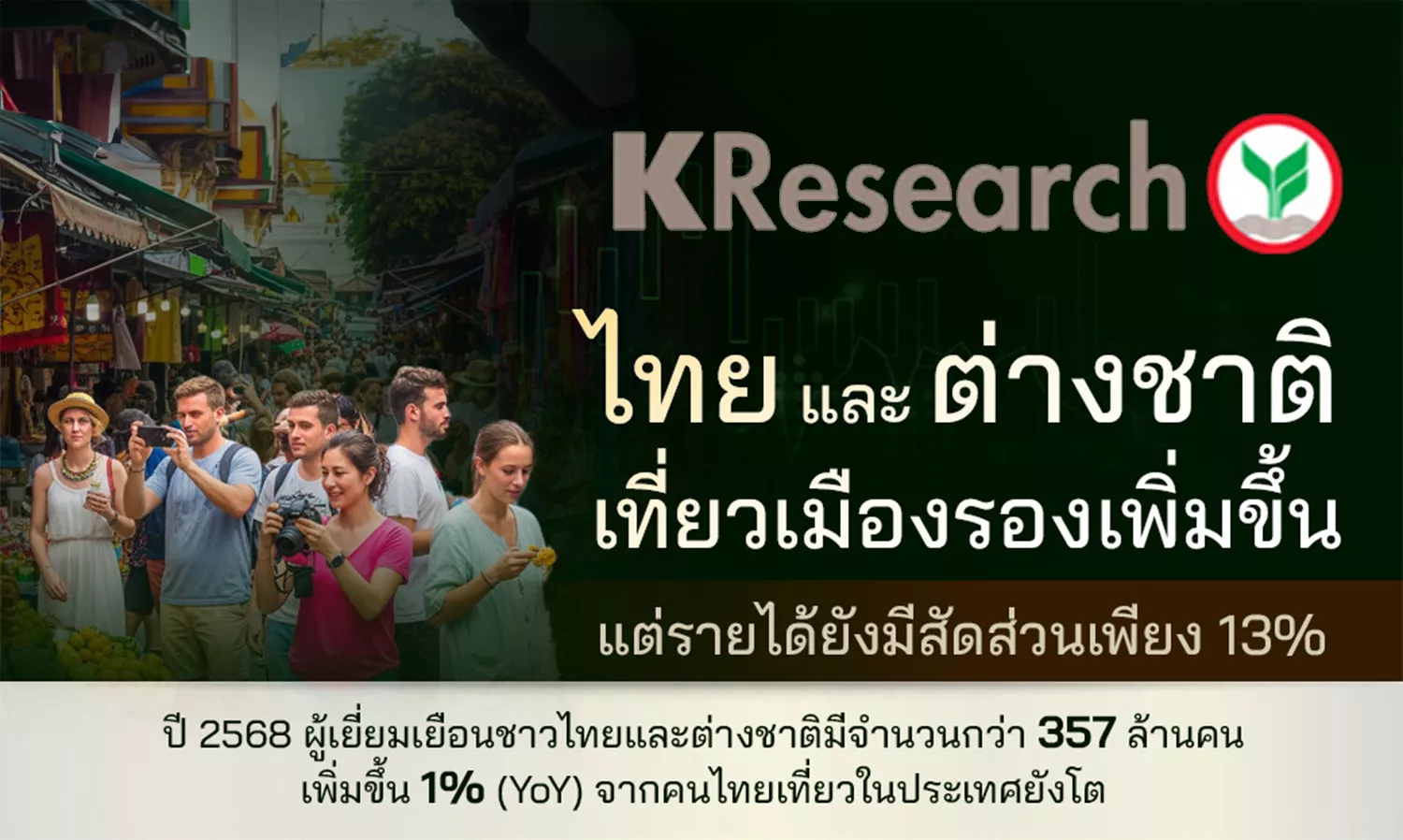
Tourism in Thailand in 2025 reflects a recovery that is "more dispersed" rather than concentrated in major tourist cities as in the past. Data from Kasikorn Research Center indicates that both domestic and international tourists number over 357 million, an increase of 1% compared to the previous year (YoY). The main driving force continues to be domestic tourism among Thais, which has been steadily growing, although the expansion varies unevenly across provinces.
When considering the structural aspects, interesting changes emerge. The number of visitors to major tourist cities has actually decreased slightly by 0.05% (YoY), while secondary cities or attractive destinations have seen a visitor growth rate of 3.2% (YoY). This reflects a shift in travel behavior towards seeking new experiences, tranquility, and local identity rather than the congestion typical of traditional tourist cities.
However, the growth in "visitor numbers" has not fully translated into "revenue". Despite the increasing proportion of visitors to secondary cities, revenue from tourism in these areas accounts for only 13% of total tourism revenue. This highlights a structural challenge that needs urgent addressing; it’s not just about attracting visitors, but also about increasing "spending per trip" and "length of stay".
This issue indicates that the development of secondary cities in the future must shift from merely promoting destinations to designing in-depth experiences. This includes organizing tourism activities that connect with local culture, food, crafts, or specific regional festivals, as well as developing infrastructure and services that facilitate longer stays, such as quality accommodations, local transportation systems, and activities that encourage tourists to "stay longer, not just pass through".
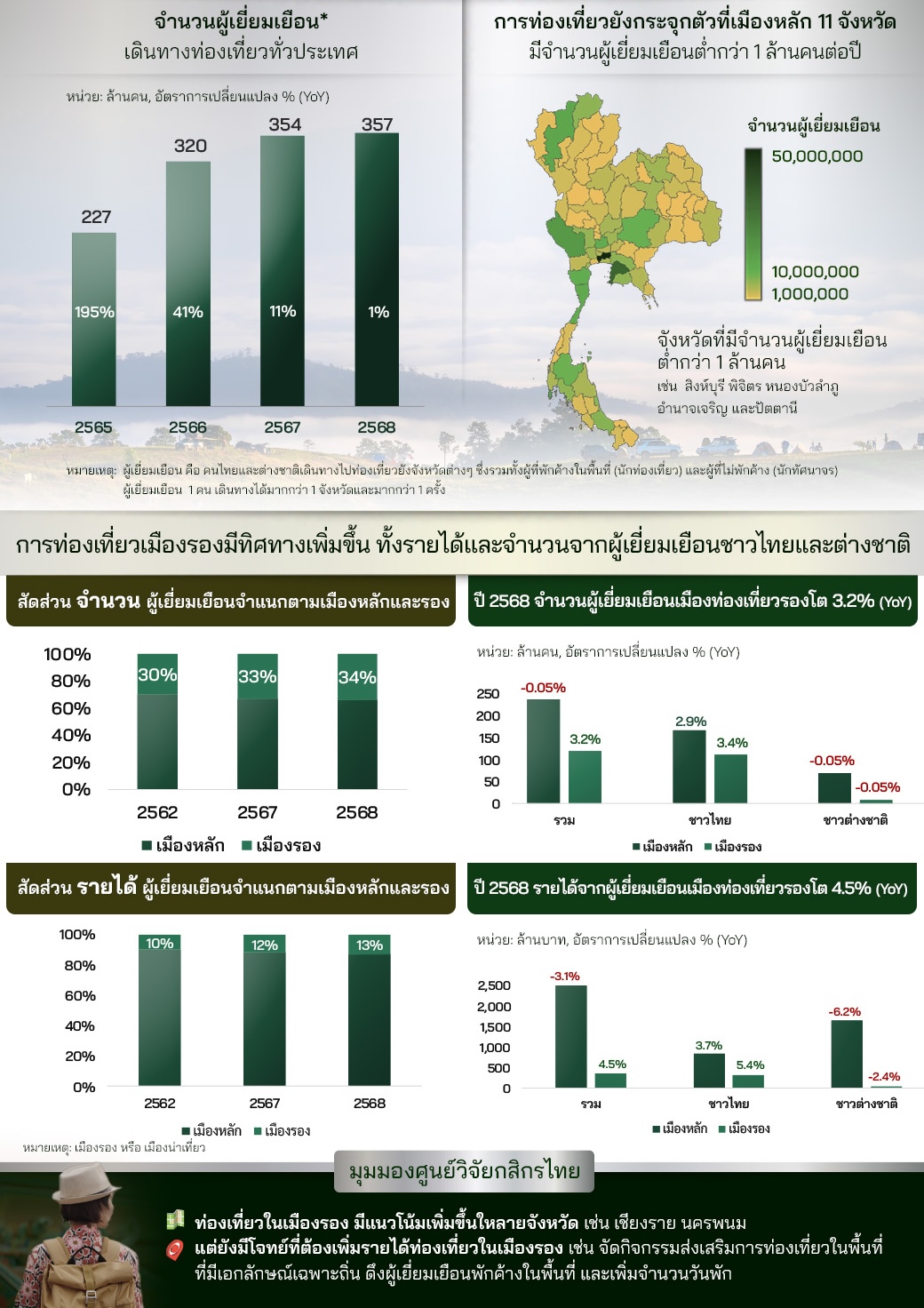
From a policy perspective, secondary cities should not be viewed merely as overflow areas for excess demand from major cities, but should be elevated to become "economic tourism destinations" that generate sustainable income for communities. If the growth in visitor numbers can be transformed into real economic value, secondary cities will become a crucial mechanism for income distribution, reducing inequality, and strengthening the structure of Thai tourism in the long term.
Source and Data Reference
Kasikorn Research Center, Infographic: Thai and foreign tourists are increasing in secondary cities, but revenue still accounts for only 13%