
In the First 8 Months of 2025, Foreign Tourist Arrivals in Thailand Decline, Impacting Tourism Revenue (Kasikorn Research Center)
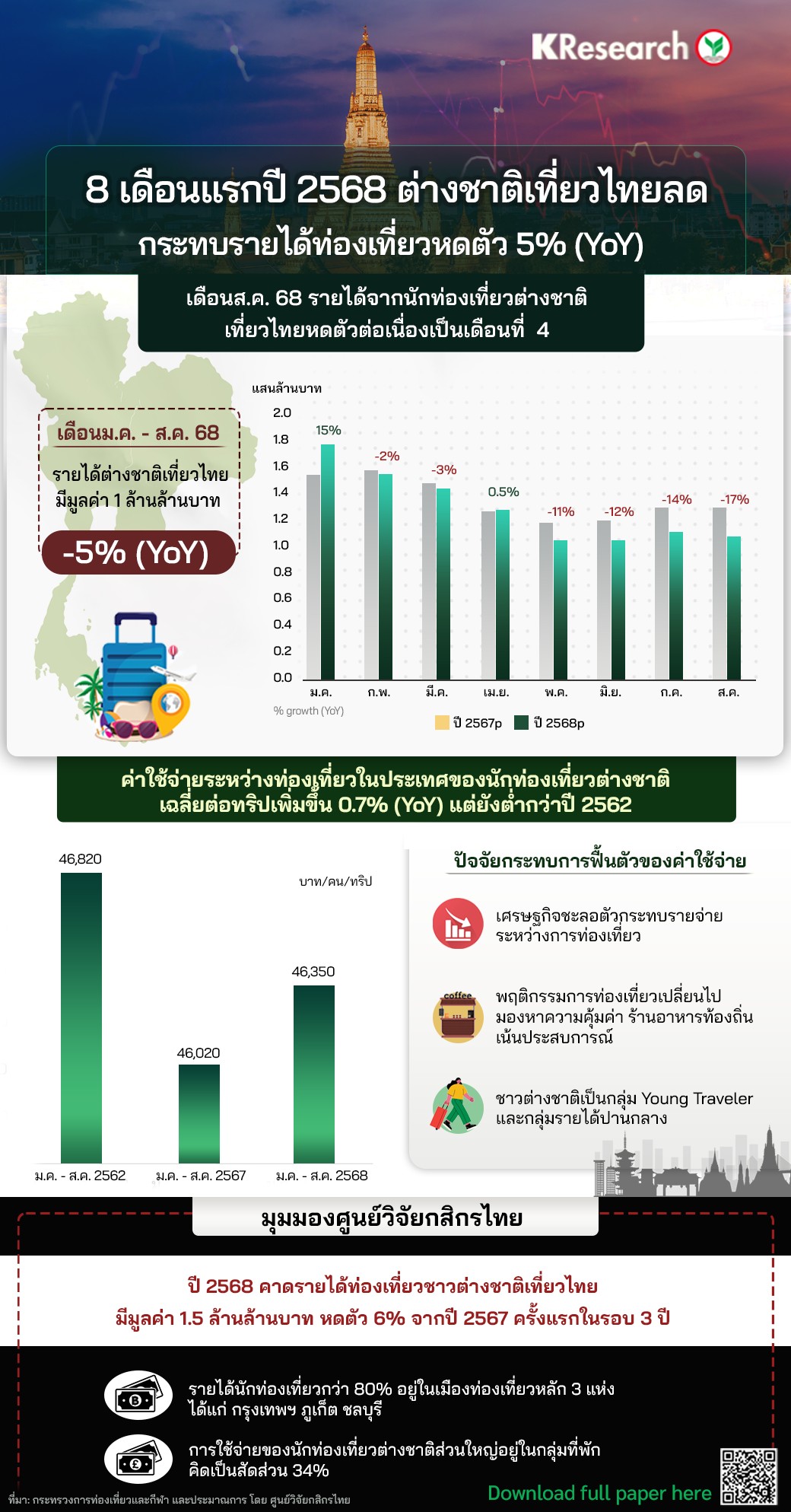
Throughout the period from January to August 2025, Thailand's tourism sector faced significant pressure. Revenue from foreign tourists was 1 trillion baht, a decrease of 5% compared to the previous year (YoY), marking a continuous decline for four consecutive months, with August experiencing the highest drop of -17% YoY.
Annual Tourism Revenue Outlook for 2025
Although there was some recovery in the first half of the year, various negative factors are putting pressure on the tourism atmosphere for the remainder of the year. The Kasikorn Research Center predicts that:
-
Revenue from foreign tourists for the entire year of 2025 is expected to be 1.5 trillion baht.
-
It will decrease by 6% YoY compared to 2024.
-
This will mark the first decline in three years.
Per Capita Tourist Spending
-
The average spending per trip in the first 8 months of 2025 was 46,350 baht/person/trip, an increase of only 0.7% YoY.
-
However, this is still lower than the pre-COVID level in 2019, which was 46,820 baht/person/trip.
-
This reflects that the recovery is not yet complete.
Pressures and Trends
-
Economic slowdown is affecting tourists' spending.
-
Changing behaviors show that tourists are seeking value, local dining, and cultural experiences more.
-
The main tourist demographic consists of Young Travelers and middle-income tourists, resulting in lower overall spending.
Tourism Revenue Structure
-
Over 80% of revenue comes from 3 main cities: Bangkok, Phuket, and Chonburi.
-
Chinese tourists remain the largest group, accounting for 34% of total revenue.
Conclusion
2025 is a challenging year for Thailand's tourism sector. Although the number and behavior of foreign tourists still generate significant revenue, pressures from the global economy and purchasing power have led to a decline in overall revenue after just two years of recovery. Thailand needs to adjust its strategies to attract quality tourists and distribute revenue more widely to secondary tourist cities to reduce the long-term vulnerability of the tourism economy.