Thai Exports in September 2025 Surpass Expectations with 19.0% YoY Growth; Full-Year 2025 Export Forecast Adjusted to 11.0% from 5.7%
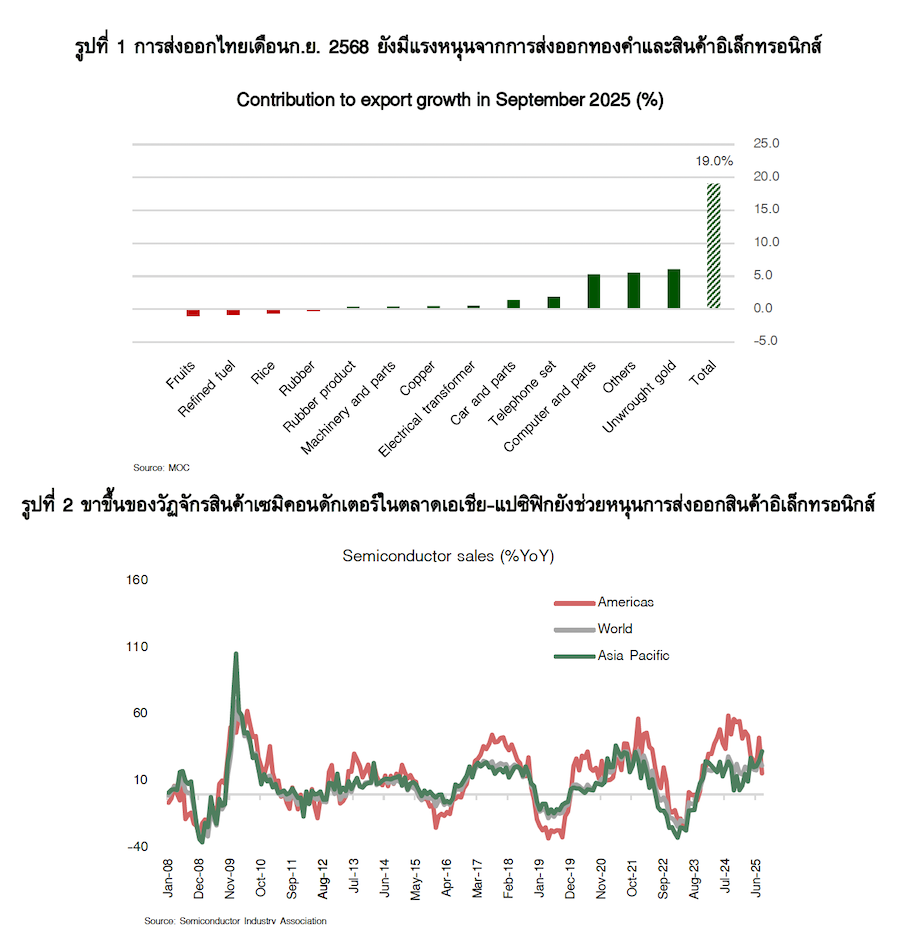
- Thai exports in September 2025 grew beyond expectations at 19.0% YoY, marking the highest growth in 42 months. This growth was primarily driven by exports of electronics and gold. Excluding these two categories, Thai exports in September would have expanded by 4.9% YoY (Figure 1)
- The acceleration in electronics exports saw a growth of 42.6% YoY (contribution to growth 8%) in September, up from the previous month, led by exports of computers, phones, and components. Exports of electronics to the U.S. grew significantly at 67.1% YoY, as most items were not yet subject to import duties. Additionally, exports were supported by the upward cycle of the semiconductor industry related to demand for artificial intelligence (AI), particularly in the Asia-Pacific market, which helped boost exports across several regional markets including ASEAN, China, Taiwan, and South Korea (Figure 2).
- Gold exports surged due to increased global demand, with gold exports in September growing by 212.6% YoY (contribution to growth 6%), pushing gold prices to record highs during the month, with 80% of exports going to Switzerland. Although gold prices began to slow down in October, they are still considered high due to ongoing geopolitical issues and uncertain U.S. trade policies, leading to expectations that gold exports will continue to significantly support overall Thai exports for the remainder of the year.
- Exports of goods subject to reciprocal tariffs did not slow down as anticipated, with key exports to the U.S. such as air conditioners and pet food continuing to grow in September. Thailand has gained a competitive pricing advantage after the U.S. raised import tariffs on Thailand lower than on major competitors like China and similar to other ASEAN competitors.
- Kasikorn Research Center has revised its forecast for Thai export growth to 11.0% from the previous estimate of 5.7% for 2025, as Thai exports in September grew contrary to expectations of contraction, resulting in a growth of 13.9% YoY in the first three quarters of the year. The final quarter is expected to grow by 2.6% YoY, up from previous contraction forecasts, due to anticipated continued acceleration in electronics exports before the U.S. raises tariffs on semiconductors under Section 232, along with the upward cycle of the industry.
- Meanwhile, the Kasikorn Research Center has also adjusted its forecast for Thai imports to grow by 10.3% from the previous estimate of 5.0% for 2025, driven by expected growth in electronics imports. Imports of electrical and electronic components, such as printed circuit boards and semiconductor devices, grew by 93.5% in September 2025, primarily from Asian markets like Taiwan, China, Malaysia, and Japan. However, the adjustments in export and import forecasts are not expected to significantly alter the trade balance and payment balance, while the Thai economic forecast for 2025 remains at 1.8%.
- Regarding the impact of the joint reciprocal trade agreement between Thailand and the U.S., signed on October 26, 2025, it is expected to take effect in 2026. However, the agreement is not yet legally binding and serves as a framework for further negotiations, aiming for a joint conclusion by the end of this year. Key points include:
- Thailand must increase market access for U.S. goods by eliminating import tariffs on approximately 99% of agricultural, food, and industrial products, as well as addressing non-tariff barriers. Meanwhile, the U.S. will maintain import tariffs on Thai goods at 19% and will consider exemptions for certain items.
- Thailand must increase purchases of U.S. goods, including agricultural products (e.g., animal feed corn, soybean meal) valued at $2.6 billion per year, energy products (e.g., LNG, crude oil, ethane) valued at $5.4 billion per year, and 80 U.S. aircraft valued at $18.8 billion.
It is important to monitor details regarding transshipped goods, or goods not originating from Thailand, which may be subject to U.S. import tariffs as high as 40%.
Discussion
Follow breaking news Investment property articles on Facebook, click here.