Forecast for the Thai Baht in 2025: Expected to Fluctuate in a Weak Range... Additional Pressure from Trump's Policies
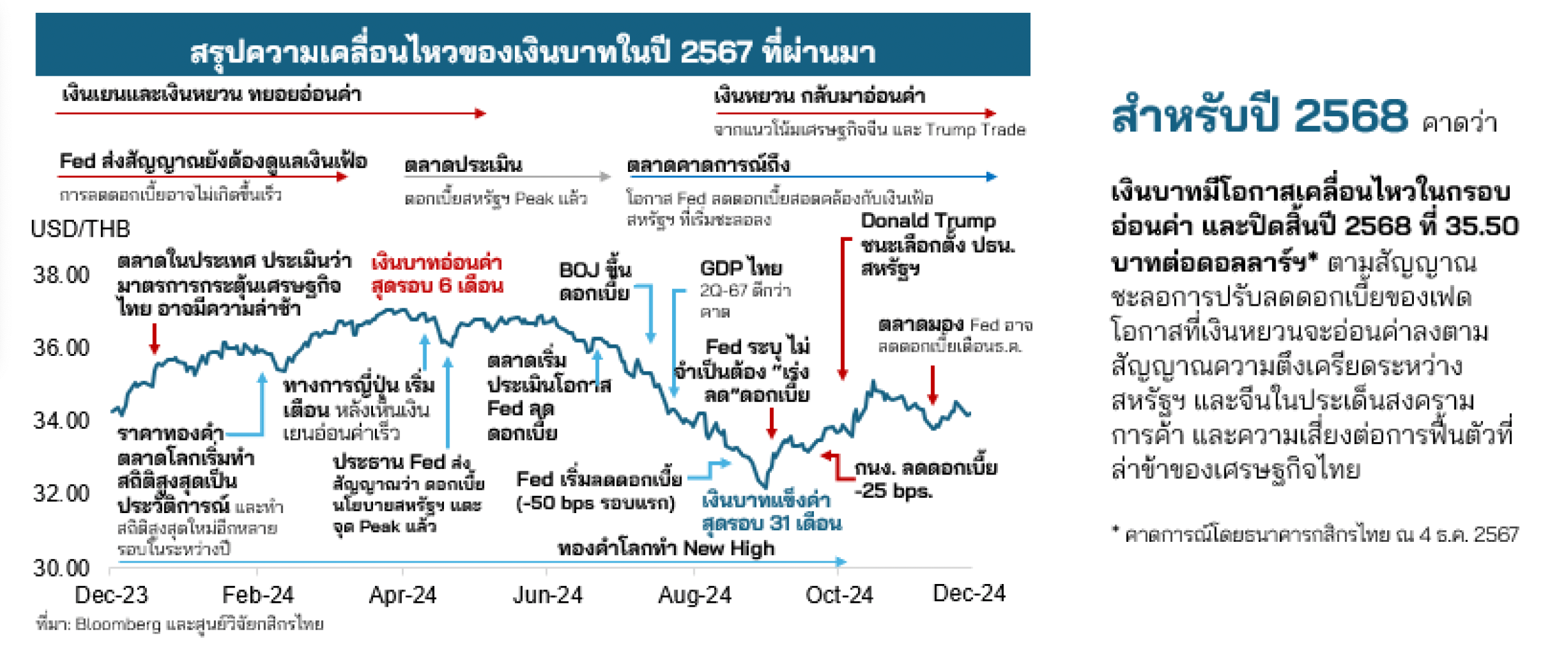
- The Thai Baht closed the market at the end of 2024 at 34.11 Baht per US Dollar. While this level may seem close to the closing level at the end of 2023, it is important to acknowledge that the movement throughout the year was quite wide and difficult to predict.
- For 2025, Kasikorn Research Center believes that three key factors need to be monitored: 1) Factors from the US, including the direction of the Fed's interest rates and the impact of Donald Trump's policies; 2) The trend of China's economic slowdown; and 3) The weak fundamentals and risks of a slow recovery of the Thai economy, which may lead to the Baht depreciating.
- The trend of the Baht's depreciation may become clearer in the second half of 2025, especially as the Fed approaches the end of its interest rate reduction cycle. The Baht may close the year 2025 at around 35.50 Baht per US Dollar (forecasted by Kasikorn Bank).
Looking back at the Baht in 2024, although the closing level at the end of the year was similar to that of 2023, the range of movement throughout the year was wider, reflecting volatility and a challenging direction to assess.
- The wider range of the Baht in 2024 reflects increased volatility. The Baht closed the market at the end of 2024 at 34.11 Baht per US Dollar, close to the closing level of 2023 at 34.14 Baht per US Dollar. While it may seem that the Baht did not change much in terms of the closing level, it is important to recognize that the Baht in 2024 fluctuated within a wider range than in 2023. Daily exchange rate statistics show that the difference between the strongest point of 2024 (32.15 Baht per US Dollar) and the weakest point (37.18 Baht per US Dollar) was about 5.03 Baht, greater than the 4.67 Baht difference in 2023, indicating increased currency volatility.
- The Baht changed direction during 2024 in response to the Fed's interest rate signals. Despite various factors affecting the Baht in 2024, one significant factor was the outlook on the US Federal Reserve's policy interest rate trends. The Fed shifted from signals indicating a prolonged high interest rate to acknowledging that US interest rates had passed their peak, signaling a move towards interest rate cuts by late Q3 2024. This factor was reflected in the Baht's depreciation in the first half of the year, followed by a recovery in Q3 2024, before depreciating again, especially after Donald Trump's victory in the US presidential election.
In 2025, monitor three key factors that may lead to a depreciating Baht.
1) The impact of Donald Trump's policies may lead to higher inflation rates in the US, which will affect the Fed's outlook and timing for interest rate cuts. The greater the risk of US inflation, the more cautious the Fed will be in considering the timing of interest rate reductions. Additionally, the trend of increasing tariffs on imports from China (and other countries) may pressure the Yuan to depreciate, similar to what was seen during the initial tariff increases when Trump first took office.
2) The trend of China's economic slowdown. Beyond the impact of US tariff policies under Trump's leadership, it must be acknowledged that there are several factors contributing to the fragile recovery of the Chinese economy, which may be delayed. This includes risks from the fragility of the real estate sector and weak domestic spending signals. These factors lead the market to assess that the People's Bank of China may need to further cut interest rates (as evidenced by the 10-year bond yield in China dropping to a record low in early 2025), and there is a possibility of further depreciation of the Yuan during the year, which may increase depreciation pressure on the Baht (notably, the correlation between USD/THB and USD/CNY has been around 0.70 over the past 12 months, indicating that the Baht and Yuan tend to move in the same direction).
3) The weak fundamentals of the Thai economy. The Kasikorn Research Center estimates that the Thai economy may grow by 2.4% in 2025, slightly slower than in 2024. The risks of a delayed recovery in economic activities across various sectors, potentially impacted by foreign economic policies, suggest that there remains a possibility for the Monetary Policy Committee (MPC) to further cut Thailand's policy interest rate after the reduction in the October 2024 meeting.
Pressure for the Baht to depreciate may gradually increase, especially in the second half of 2025.
It must be acknowledged that the uncertainty of US economic policies is one of the key variables for 2025, including details, the intensity of measures, and the timing of their effects. However, it is expected that the situation will gradually become clearer after the first 100 days, as Trump's economic team begins negotiations with trading partners, which may lead to heightened tensions in trade disputes, particularly between the US and China. This factor will not only affect the Yuan and other currencies in Asia but is also likely to impact Thailand's export trends and economic recovery timing, especially in the second half of the year.
In this uncertain environment, the Kasikorn Research Center believes that the Baht may fluctuate within a volatile range and is likely to depreciate to around 35.50 Baht per US Dollar by the end of 2025 (forecasted by Kasikorn Bank).
However, it is important to monitor Trump's stance on wanting the Dollar to depreciate, which may create confusion, pressure the Dollar, and increase market volatility as well.