A New Financial Direction for 2025: Gold and the Promotion of Economic Growth and Wealth for All Thais
The role of gold in promoting access to diverse and equitable financial services in Thailand
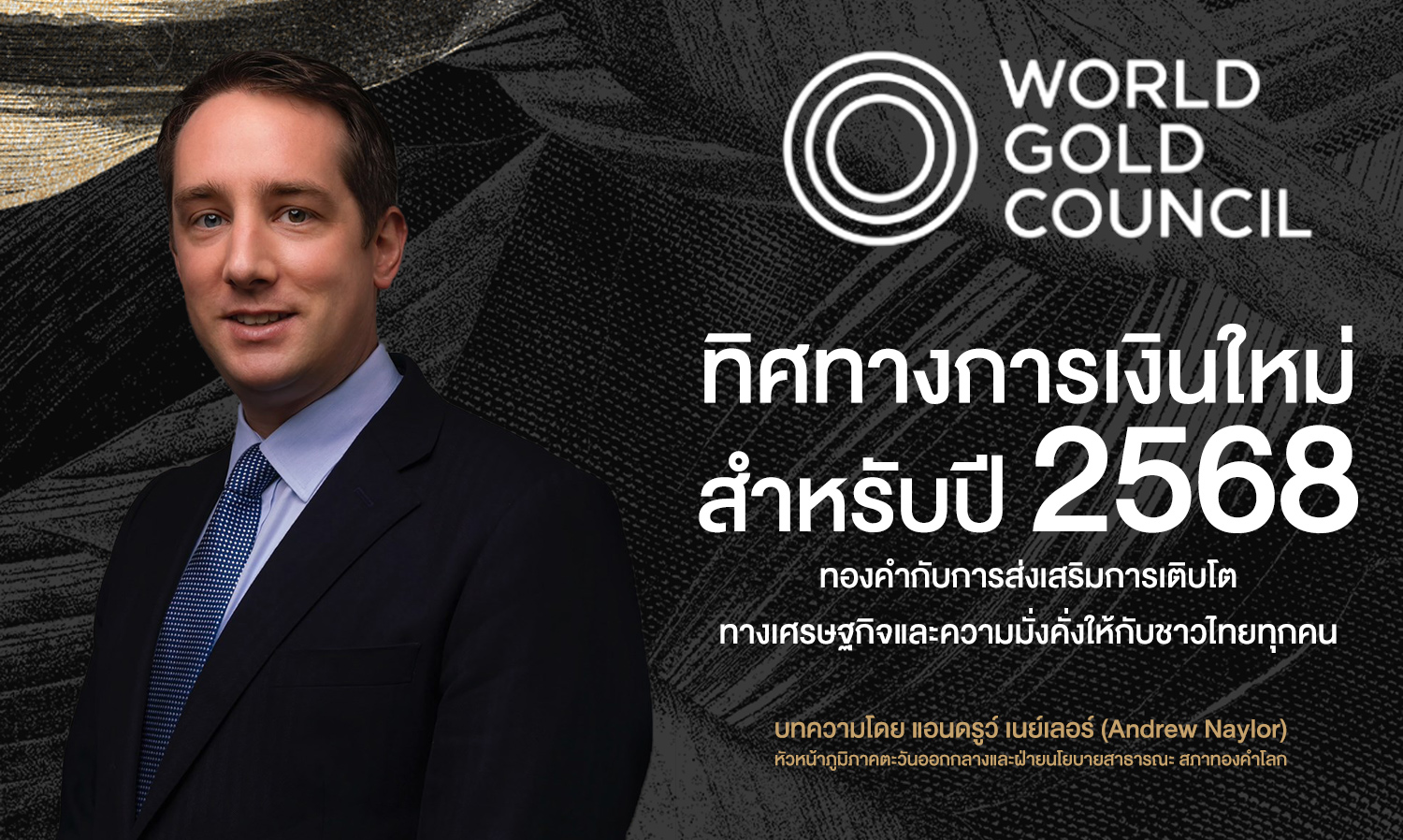
Article by Andrew Naylor, Head of Middle East and Public Policy at the World Gold Council
As we step into 2025, gold presents a remarkable opportunity for financial stability amidst the current geopolitical uncertainties. Gold has long been a symbol of wealth and prosperity in Thai culture and is often used to celebrate significant occasions such as weddings, birthdays, and welcoming new family members. Despite the evolving Thai society, gold remains deeply embedded in the lifestyle of the Thai people, driving strong demand in the consumer gold market, which has maintained its position as the fastest-growing market among ASEAN countries for two consecutive quarters in 2024.
Moreover, gold can promote Financial Inclusion, a key objective for governments, NGOs, and international organizations worldwide. Access to financial services means that individuals can reach savings products, loans, insurance, and payment systems comprehensively, which is crucial for fostering economic growth. When individuals and households achieve financial stability, they are more likely to invest or start businesses, thus supporting the country's economic development.
Access to Financial Services in Thailand
The latest Global Findex Report by the World Bank in 2021 indicated that the average access rate to bank accounts in emerging markets is 71%, while the global average is 77%. This reflects significant improvement from 51% in 2011. Thailand has made continuous progress in this area; since 2017, 82% of Thais have bank accounts, and by 2021, this figure rose to 95.6%, with 67.1% of Thais saving money in banks and 92% making payments through digital systems, surpassing the APEC average of 82.1%, 61.4%, and 78.1%, respectively.
Although bank account access is high, Thailand still has opportunities to develop other financial services. For instance, access to loans remains low at 30.4%, below the APEC average of 38.2%, due to limited understanding of loan products and fear of rejection. Surveys show that in 2024, borrowing from informal sources increased to 30%, raising concerns as borrowers often face interest rates exceeding the legal limit of 15%.
Enhancing Access to Financial Services through Innovation
Currently, there is a rapid acceptance of innovations and new initiatives worldwide to promote access to financial services. For example, commercial banks in China, Singapore, the UAE, and Malaysia have introduced gold investment accounts, while banks in Turkey offer services such as gold buyback, gold bonds, and checks.
The Thai government has also demonstrated progressive ideas by promoting gold in the digital system, allowing gold traders to offer gold savings and online trading services through the "Pao Tang" application in collaboration with Krung Thai Bank. This enables Thais to trade 99.99% pure gold at real-time global market prices. In the first quarter of 2023, the value of online gold savings in the country increased by 60-70% compared to the same period the previous year. Notably, a major Thai gold trader, YLG Bullion International, reported a 70% increase in new online gold trading accounts through the Pao Tang app during this period. These applications demonstrate how commercial banks can enhance new service models for traditional gold traders by expanding networks and increasing access to gold-related products.
Using Gold to Reduce Barriers to Accessing Financial Services
Gold can help fill gaps and support financial services, especially in remote rural areas that lack comprehensive coverage. Gold has assisted rural Thais who often use pawn shops to access loans for agricultural expenses and respond to unforeseen funding needs. In 2023, the State Pawnshop Office (SPC), a government pawn shop, received pledges worth over 20 billion baht, with gold accounting for 88% of the total assets pledged, totaling 1.1 million items.
Additionally, gold serves as a crucial guarantee for Thais. In 2020, during the COVID-19 pandemic, Thailand's gold market recorded a net sale of 81.5 tons as households needed to sell their gold holdings for essential funding.
Thus, gold meets both financial and cultural needs, serving as a capital accumulation that retains value over the long term, is highly liquid, easily tradable, and helps protect capital from risks amid uncertainties. Furthermore, it can assist the government both directly and indirectly in achieving public policy goals regarding improved access to financial services.
The Role of Gold in Achieving Financial Service Access Goals
|
Indicators of Access to Financial Services |
Role of Gold |
|
Access to savings products |
Serves as a capital accumulation that retains value over the long term, helps protect wealth, and is easily tradable. |
|
Access to credit |
Used as collateral for personal or business loans. |
|
Access to payment systems |
Used for person-to-person (P2P) payments, especially in digital forms. |
|
Access to insurance |
A strategic component in investment portfolios, enhancing returns (adjusted for investment risk) for pension and insurance funds. |
Strengthening the Banking System
In-depth research on the global retail market by the World Gold Council found that 61% of consumers in the studied countries have more confidence in gold than in various currencies. Additionally, 65% believe that gold will never lose value in the long term, and 67% view gold as a good hedge against inflation and currency volatility. These insights suggest that commercial banks can offer gold-related products to enhance appeal and strengthen relationships with consumers. Central banks have long recognized gold as a crucial factor in strengthening their balance sheets, attracting investors, and boosting overall confidence in the banking system.
Driving Access to Services and Strengthening Financial Stability in 2025
The ongoing appeal and clear returns of gold will be particularly prominent during the New Year festival. Data from 1971 to 2023 shows that in January alone, gold provided returns of up to 1.79%, nearly three times the long-term monthly average.
As we enter 2025, a year expected to be filled with uncertainties, gold can serve as a tool for providing security in volatile conditions and as a potential investment return for both the government and individuals, while also supporting the country's economy and ensuring that all Thais have equitable access to financial services.