Thai Export Growth Expected at 1-2% in 2024 Amid Strong Baht Impacting Trade Deficit
Dr. Chaiyan Charoensuk, President of the Thai National Shippers' Council (TNSC) stated that Thailand's international trade situation in August 2024 compared to the same month last year (YoY) showed that exports were valued at $26,182.3 million, growing by 7.0%, and valued in Thai Baht at 939,521 million Baht, an increase of 13.0% (excluding gold, oil, and military equipment, exports in August grew by 6.6%). Meanwhile, imports were valued at $25,917.4 million, growing by 8.9%, and valued in Thai Baht at 941,019 million Baht, an increase of 15.0%. This resulted in Thailand's trade balance in August 2024 showing a surplus of $264.9 million and a deficit in Baht of 1,497 million.

In the overall international trade of Thailand from January to August 2024 compared to the same period last year (YoY), total exports were valued at $197,192.8 million, growing by 4.2%, and valued in Thai Baht at 7,068,821 million Baht, an increase of 9.9% (excluding gold, oil, and military equipment, exports from January to August grew by 4.3%).
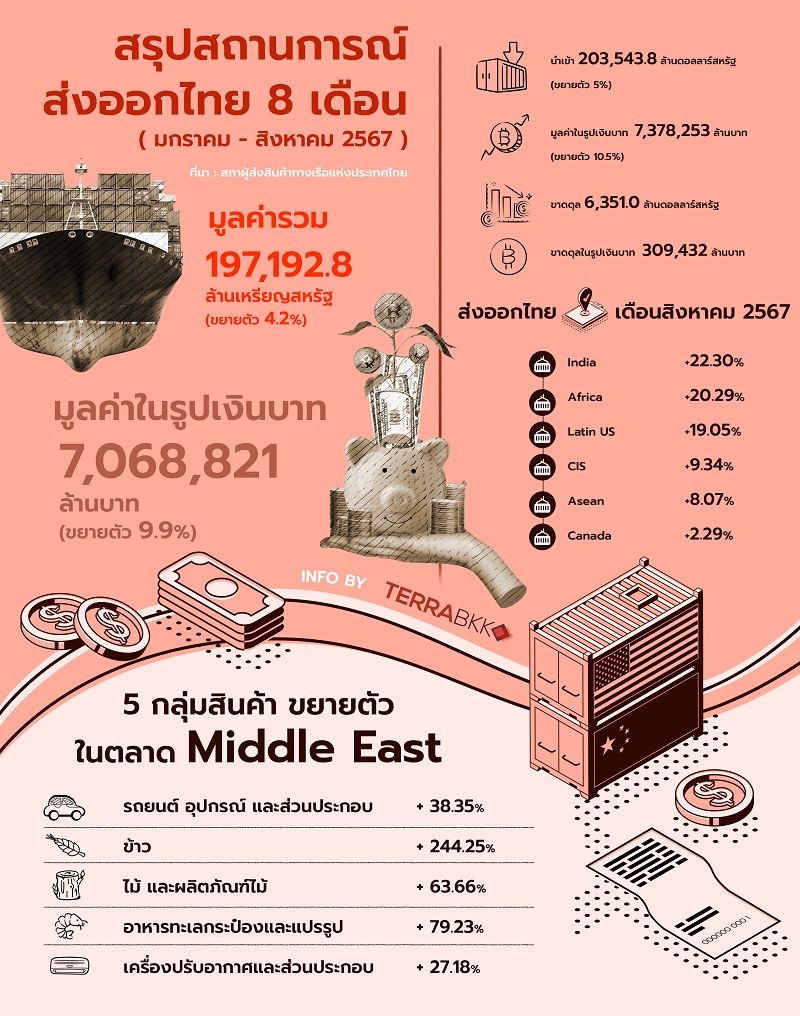
Meanwhile, imports were valued at $203,543.8 million, growing by 5.0%, and valued in Thai Baht at 7,378,253 million Baht, an increase of 10.5%. This resulted in Thailand's trade balance from January to August 2024 showing a deficit of $6,351.0 million, equivalent to a deficit of 309,432 million Baht.
For the export forecast in 2024, growth is expected to be no less than 1-2% (as of October 2024). However, the outlook for exports in the last four months of 2024 is overshadowed by negative factors, particularly the rapid appreciation of the Baht by 12% over the past three months, which has reduced Thailand's competitiveness while businesses struggle to access credit.
The issue of the rapidly appreciating and volatile Baht is partly due to continued capital inflows into the Thai capital market. Therefore, it is requested that the central bank intervene by possibly implementing measures to monitor investors entering into transactions in Thailand, including retail investors, which may require registration for identity verification. Additionally, the government may need to adopt other measures, such as using local currencies in the region for trade instead of the dollar.
The rapid and strong appreciation of the Baht could increase the likelihood of Thailand facing a trade deficit, as there will be more imports of cheaper industrial goods from China. Furthermore, the industry importing components for producing export goods in Thailand is also affected, receiving less revenue, which may lead industries to relocate production bases from Thailand to nearby regions such as Indonesia and Vietnam, particularly in the electrical appliance and garment industries.
Nevertheless, the Thai National Shippers' Council has recommendations for the government, particularly to maintain the stability of the Baht to prevent it from appreciating too quickly, while also supporting tools and fees to hedge against exchange rate risks to assist businesses. Additionally, it suggests considering reducing the policy interest rate to a suitable level, reviewing the adjustment of the minimum wage according to the current economic situation to avoid overburdening businesses, especially SMEs, and accelerating trade negotiations and new trade cooperation both at the national level and with key economic partners.