Thailand's Real Estate Market Index (Residential Sector) for Q1 2024
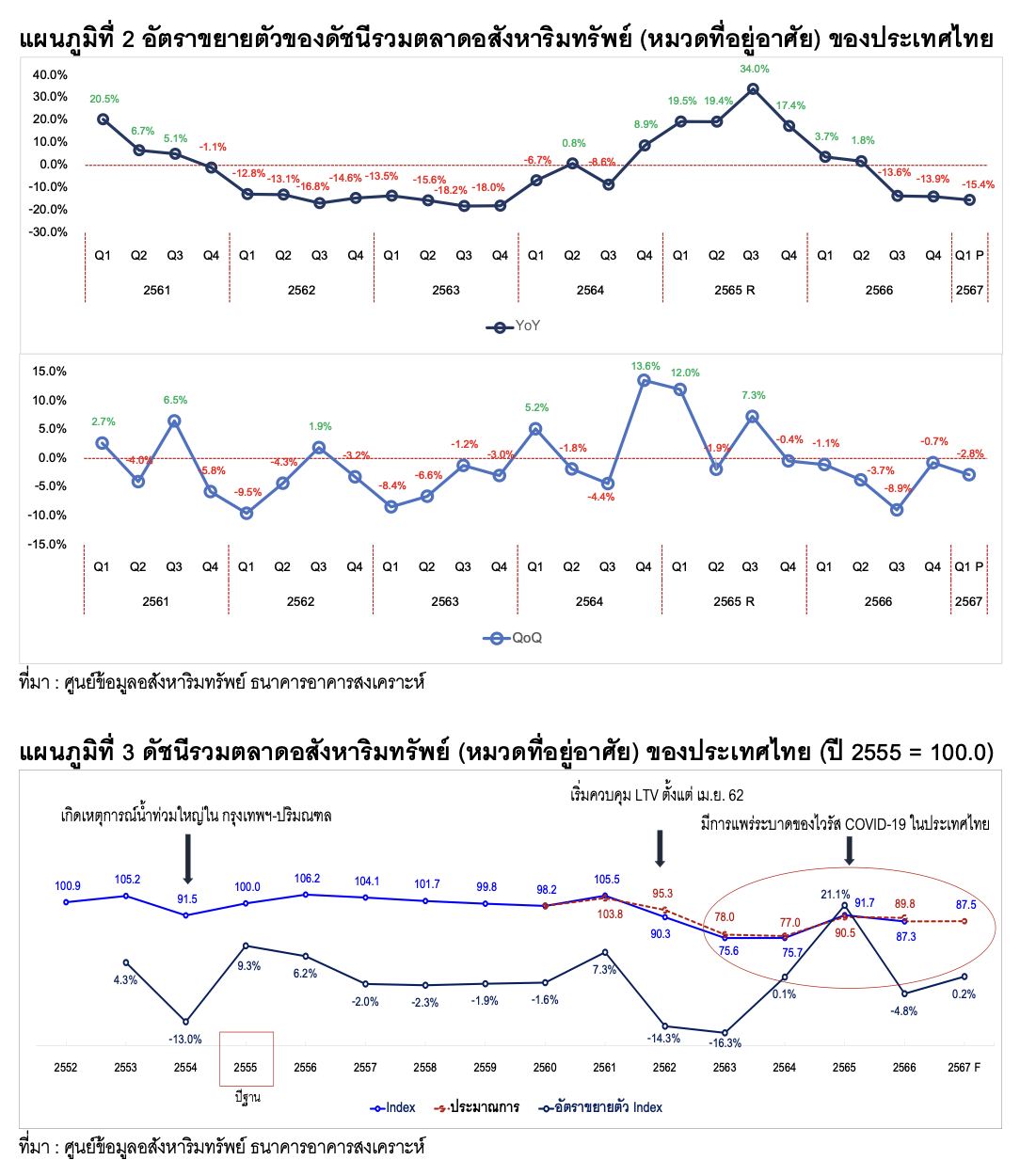
The Real Estate Information Center of the Government Housing Bank, or <\/strong>REIC <\/strong> has reported the overall Real Estate Market Index (Residential Sector) for Thailand in Q1 <\/strong>2024, which stands at <\/strong>79.6<\/strong>. This reflects a decrease compared to the previous quarter (<\/strong>QoQ<\/strong>) of <\/strong>-2.8<\/strong> and a year-on-year (YoY) decline of <\/strong>-15.4<\/strong>.
The decline in Thailand's Gross Domestic Product (GDP) in Q1 2024, which grew by only 1.5%, is expected to be a result of a downturn in the agricultural and industrial sectors, coupled with reduced government spending, private sector investment, and continuous declines in exports. Additionally, private final consumption has also slowed down, with only the tourism-related service sector showing growth.
Dr. Vichai Viratthakhan, Inspector of the Government Housing Bank and Acting Director of the Real Estate Information Center, stated that the economic slowdown has impacted the housing market, with the overall Real Estate Market Index (Residential Sector) in Q1 2024 decreasing by -15.4% compared to the previous year (YoY). This decline is evident in both demand and supply. In terms of demand, the transfer of residential ownership has decreased in both units and value by -12.4% and -13.4%, respectively, while the absorption rate for new condominiums has dropped by -1.9% and for new single-family homes by -0.8%. On the supply side, completed residential units registered an increase of 16.5%, while the area permitted for residential construction decreased by -25.3%. This may be due to several negative factors, such as (1) the cancellation of the relaxation of LTV measures by the Bank of Thailand, (2) the household debt ratio remaining above 90% of GDP, which poses a risk that financial institutions must tighten their lending criteria, leading to a higher rate of loan rejections, particularly among low- to middle-income groups, (3) the policy interest rate remaining high at 2.50%, directly affecting housing affordability, and (4) the slow recovery of the Thai economy. These factors contribute to a situation where potential homebuyers experience limited income growth while the cost of living continues to rise, increasing their financial burden while reducing their purchasing power and ability to repay loans, which directly impacts housing sales.
Regarding the overall direction of the Real Estate Market Index (Residential Sector) in 2024, despite positive factors from measures reducing transfer fees and mortgage fees for properties valued at up to 7.00 million baht, which apply to both new and second-hand homes until December 31, 2024, the ongoing economic slowdown and continuous negative factors are expected to limit growth. The Real Estate Information Center anticipates that the overall Real Estate Market Index (Residential Sector) for 2024 will see only a slight increase of 0.2%, reaching a level of 87.5 in the base case scenario, driven by improved demand for property transfers.
Supply in terms of permitted construction area and registered completed residential units may see slight improvements from 2023 (see Table 1, Chart 1, and Chart 2).
However, if both demand and supply factors perform better than expected in the base case scenario, the index could rise to 96.3, representing a growth of up to 10.3% in the best-case scenario. Conversely, if these factors turn negative more severely than anticipated, the index could drop to 78.8, reflecting a decrease of up to -9.7% in the worst-case scenario (see Table 1 and Chart 3).
 <\/p>
<\/p>
Methodology for Data Compilation<\/strong>
The Real Estate Information Center of the Government Housing Bank has developed the "Overall Real Estate Market Index (Residential Sector) for Thailand" using a quantitative index (Quantity index) based on the geometric mean of average data and employing a forecasting model through multiple linear regression analysis.
This analysis utilizes both demand and supply data from the Bangkok Metropolitan Region, comprising the following variables:
- A set of 6 independent variables
- Data on residential ownership transfers, representing demand variables.
- The absorption rate of housing developments, representing demand variables. <\/ol> <\/li>
-
- The absorption rate of condominiums, representing demand variables.
- Data on completed residential units registered, representing supply variables.
- The number of areas permitted for residential construction, representing supply variables.
- The business confidence index, representing both supply and demand variables. <\/ol> <\/li>
- A dependent variable set consisting of 1 variable, namely the "Overall Real Estate Market Index (Residential Sector)" that has been developed.
The Overall Real Estate Market Index (Residential Sector) for Thailand has been developed quarterly since Q4 2021, using demand and supply data from 2009 to 2017 to create the index, with 2012 as the base year.