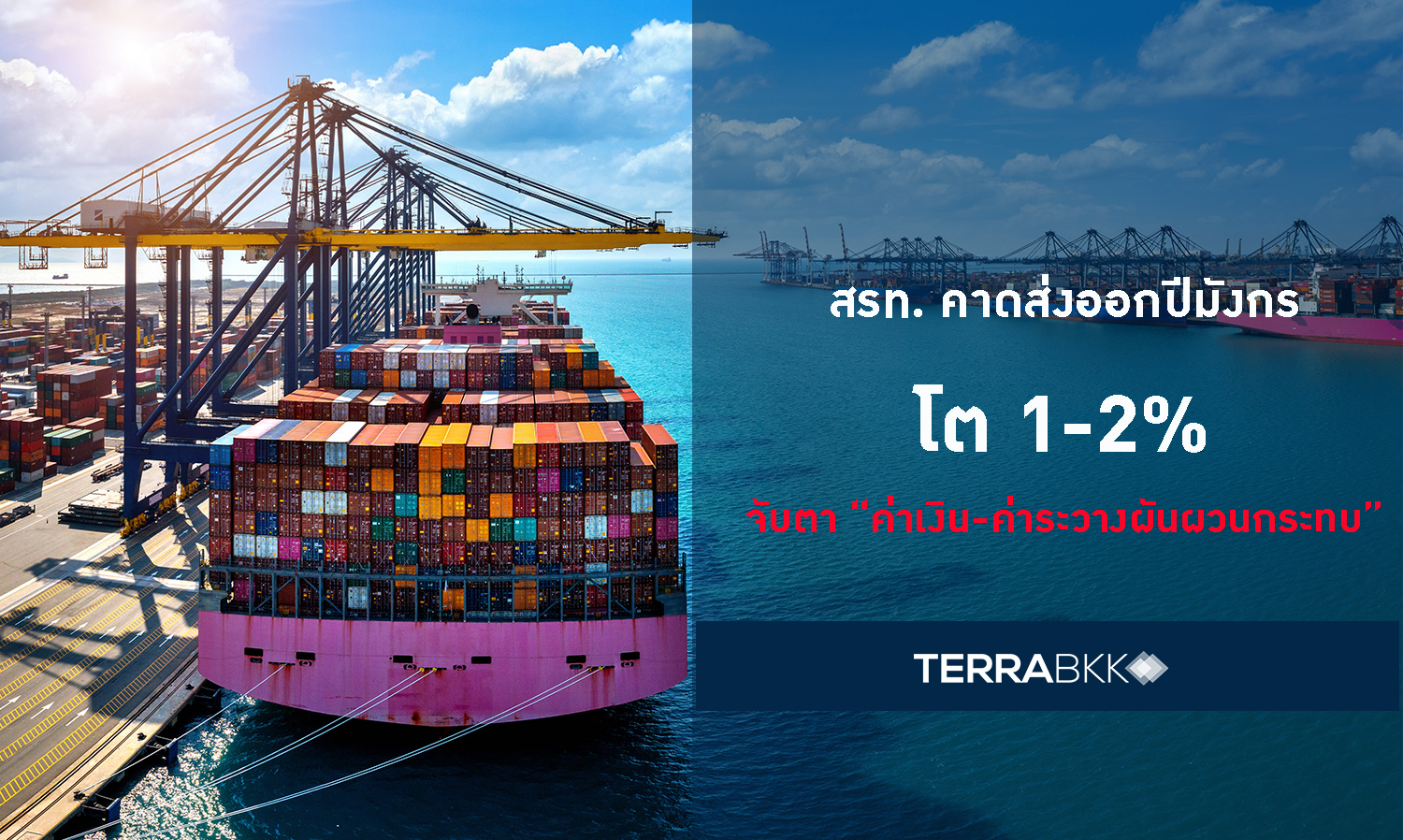
Thai Export Growth Expected at 1-2% in 2024 Amid Currency and Freight Rate Fluctuations
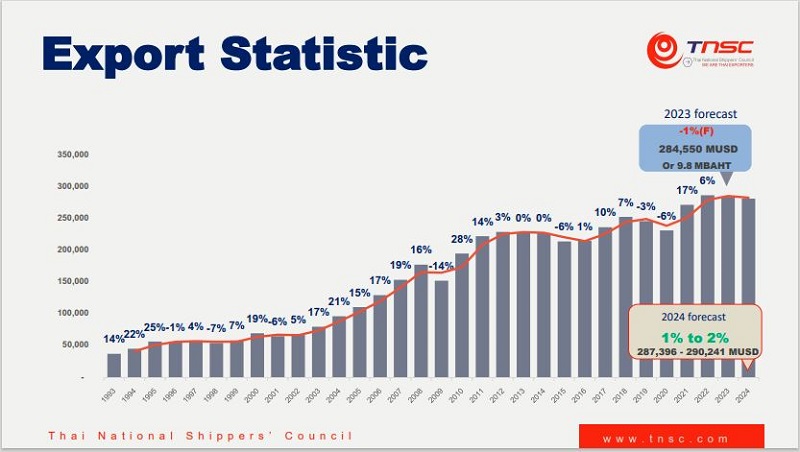
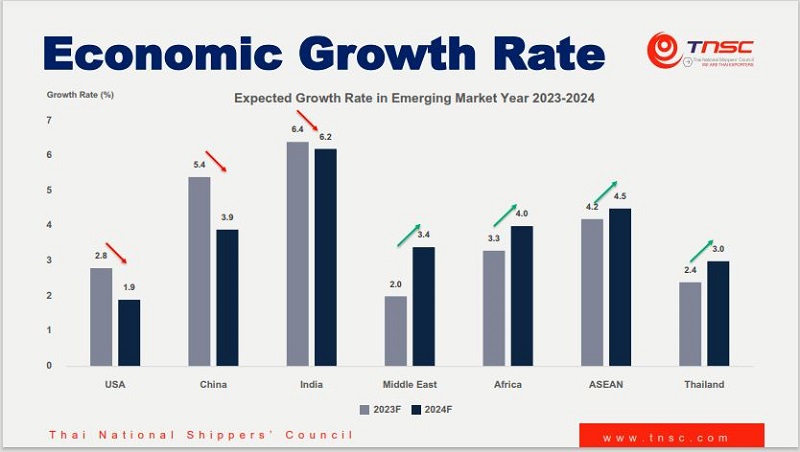
Mr. Chaiyacharn Jaroensuk, President of the Thai National Shippers' Council (TNSC) <\/strong><\/span>, stated that for 2024, the TNSC forecasts Thai exports to grow by 1-2% (as of January 2024). Key factors to monitor include the volatility of the Thai baht and the ongoing decline in inflation in the United States, following predictions that the Federal Reserve may lower interest rates in the first quarter of 2024, while policy interest rates in several countries remain high.<\/p>
Additionally, the prolonged geopolitical conflicts are impacting trade and the overall economy, particularly the crisis in the Red Sea near the Bab el-Mandeb Strait, a major shipping route to Europe and the Middle East. This has led to increased freight rates and longer shipping times. For European routes, freight rates have surged by 80-90%, doubling from $2,000 to $5,000 per container. On January 11, the TNSC, shipping lines, and the Ministry of Commerce will hold a meeting to address these issues.<\/p>
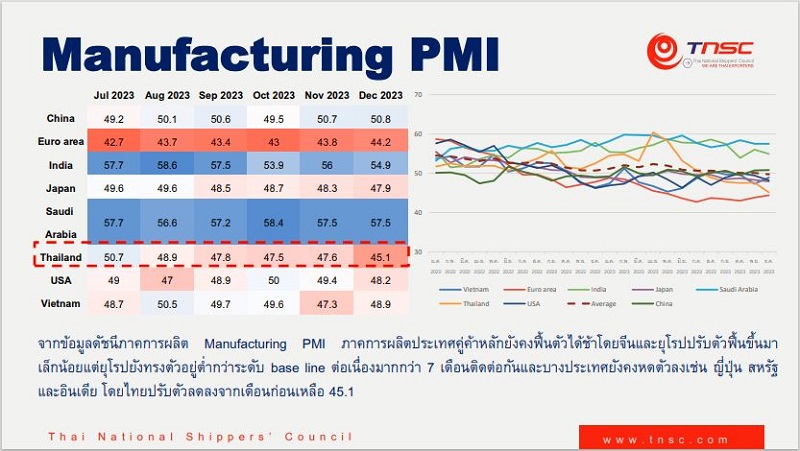
Meanwhile, the Manufacturing Purchasing Managers' Index (PMI) <\/strong><\/span>remains low, with the U.S., Europe, and Japan at 47.9, 44.4, and 47.9, respectively. Concerns about production costs remain uncertain, such as electricity prices (December 2023 at 3.99 baht, new range 4.68 baht) and the minimum wage (which the cabinet has increased by 2-16 baht). Freight rates for European routes are also beginning to rise.<\/p>
Therefore, the TNSC has made several important recommendations: <\/strong><\/span>These include:<\/p>
1) In response to the Red Sea crisis, both the government and private sector must collaboratively manage international maritime transport by increasing the use of larger vessels for cargo handling in Thailand, supporting transshipment activities, and enhancing the Songkhla port by dredging the deep-water channel to reduce indirect costs and facilitate operators.<\/p>
2) To ensure that exports in 2024 can grow, relevant agencies must manage risk factors that directly impact operators' costs, such as energy costs, electricity prices, and minimum wages, keeping them at appropriate levels. At the same time, soft loan measures should be implemented to enhance liquidity, especially for SMEs facing unpredictable fluctuations. <\/p>
3) Support budget allocations for exploring new market potentials in 2024, including promoting cross-border trade and transit activities in Thailand.<\/p>
<\/p> 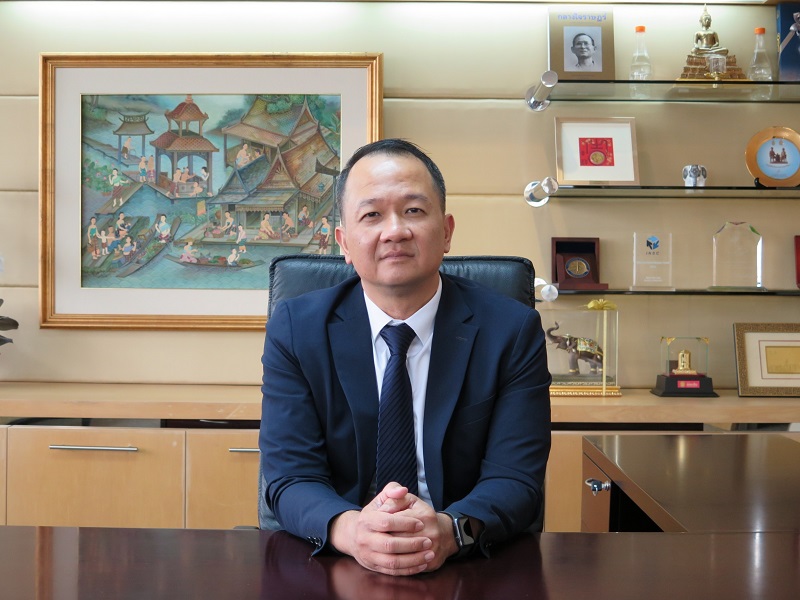 <\/p>
<\/p>
 <\/p>
<\/p>
 <\/p>
<\/p>
 <\/p>
<\/p>