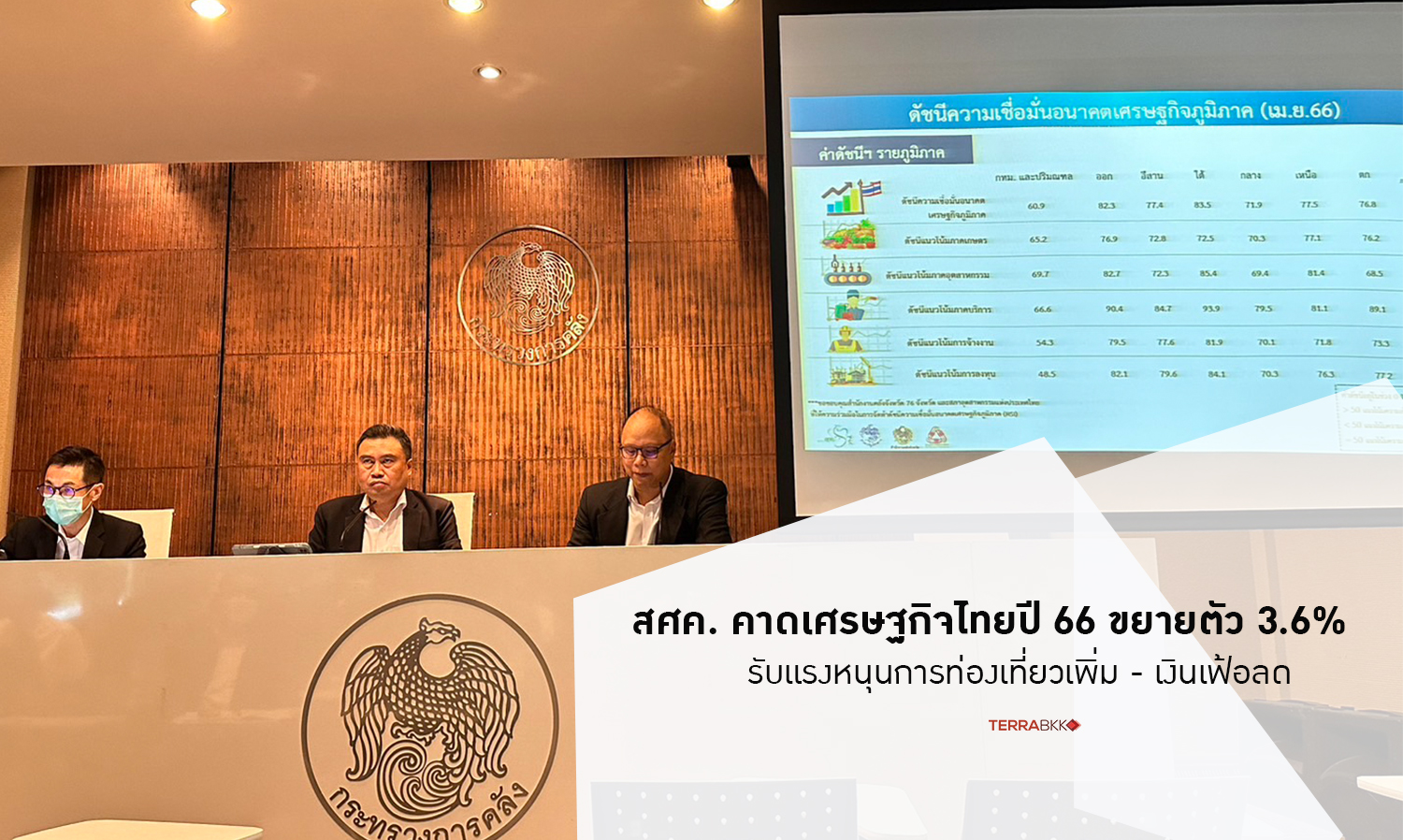
The Fiscal Policy Office Projects Thai Economy to Grow by 3.6% in 2023, Boosted by Increased Tourism and Lower Inflation
The Fiscal Policy Office <\/span><\/strong>has released its economic forecast for Thailand in 2023, predicting a growth rate of 3.6% driven by improved consumption, a continuously expanding tourism sector, and decreasing inflation. However, close attention must be paid to monetary policy and financial institution issues in major economies.<\/span><\/p>
Mr. Pornchai Thirawetch, Director of the Fiscal Policy Office and spokesperson for the Ministry of Finance,<\/strong><\/span> stated that the Thai economy is expected to grow by 3.6% (with a forecast range of 3.1% to 4.1%), continuing the recovery from 2022, which saw a growth of 2.6% per year. This growth is supported by improved consumption and a continuously expanding tourism sector, particularly from tourists in Asia and the European Union. It is anticipated that in 2023, Thailand will welcome 29.5 million international tourists, representing a growth of 164.6% year-on-year, with tourism revenue from foreign visitors expected to reach 1.3 trillion baht, equivalent to a 255.9% increase year-on-year.<\/p>
As for private consumption, it is expected to grow by 4.1%<\/span><\/strong> (forecast range of 3.6% to 4.6%), driven by the recovery of household income in line with domestic economic conditions and decreasing inflation, which supports increased consumption. Meanwhile, private investment is projected to grow by 2.3%<\/span><\/strong> (forecast range of 1.8% to 2.8%) due to improving domestic economic confidence in line with overall economic trends.<\/p>
In terms of exports, the value of exports in US dollars is expected to slightly contract by -0.5%<\/span><\/strong> (forecast range of -1.0% to 0.0%), attributed to persistently high inflation, stringent monetary policy, and financial institution issues in major economies, which are expected to slow down the global economy in early 2023.<\/p>
Regarding government consumption, a contraction of -2.1% is anticipated<\/span><\/strong> (forecast range of -2.6% to -1.6%), while government investment is expected to grow by 2.6% (forecast range of 2.1% to 3.1%) due to delays in the preparation of the annual budget for 2024 compared to the previous year. In terms of domestic stability, general inflation is expected to be at 2.6% (forecast range of 2.1% to 3.1%), aligning with the inflation target range of 1.0% to 3.0%, as global energy prices decrease, alleviating supply-side pressures from energy costs and oil prices.<\/p>
For external stability, the services balance is expected to return to surplus due to the increase in the number of foreign tourists, leading to a projected current account surplus of 4.2 billion USD in 2023, or 0.8% of GDP. However, it is essential to monitor risk factors that may impact the Thai economy,<\/span><\/strong> particularly the uncertainties of the global economy, fluctuations in global financial markets due to the stringent monetary policies of major trading partners, and financial institution issues abroad, especially in the United States and the European Union, as well as geopolitical risks in various regions that may affect international stability and production factors.<\/p> 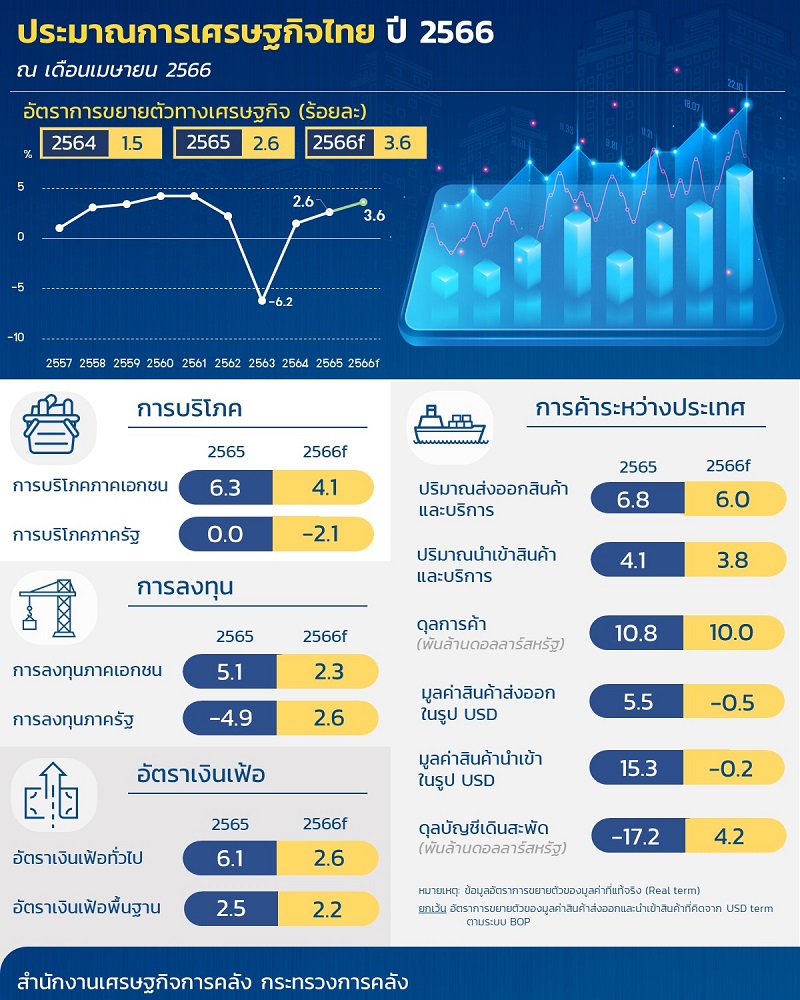 <\/p>
<\/p>
 <\/p>
<\/p>