
Thai Business in 2022 Faces Heavy Costs as Raw Material Prices Surge, Expected to Increase Cost Burden by 416 Billion Baht
Since the last quarter of 2021 and continuing to the present, the Thai business sector has been grappling with rising costs. Data from TTB Economic Analysis Center or TTB Analytics indicates that in 2022, operators will bear an additional cost burden of 416 billion baht due to a 5.7% increase in production costs.
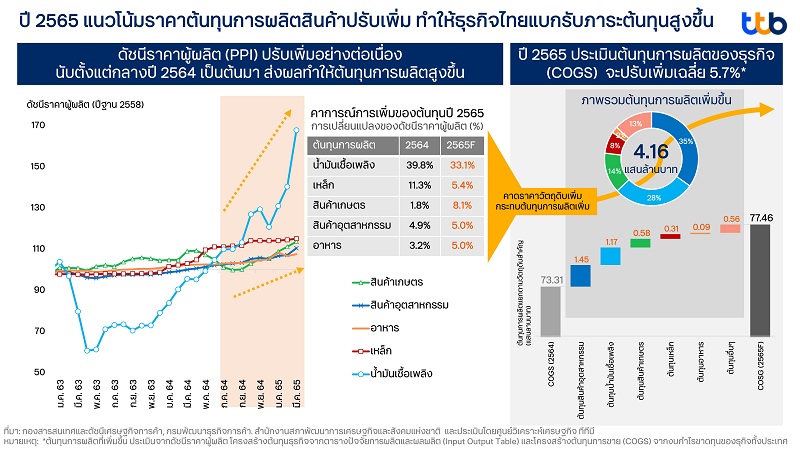
This is a result of five factors: the rising crude oil prices due to supply concerns from the Russia-Ukraine war, increased steel prices driven by higher raw material and transportation costs also stemming from the Russia-Ukraine conflict, rising agricultural product prices in response to recovering demand following the easing of COVID-19 restrictions in many countries, increased industrial product prices due to rising transportation and raw material costs, and higher food prices from increased agricultural product costs.
As a result of these impacts, which are passed through from the production costs of domestic operators, the Producer Price Index (PPI) in 2022 for fuel products is expected to rise by 33.1%, steel by 5.4%, agriculture by 8.1%, industry by 5%, and food by 5%.
The upward trend in raw material production costs in 2022 will lead to an overall increase in production costs for Thai businesses by 5.7%, or over 416 billion baht, with industrial goods accounting for 35%, followed by fuel at 28%, agricultural products at 14%, steel at 8%, and food at 2%.
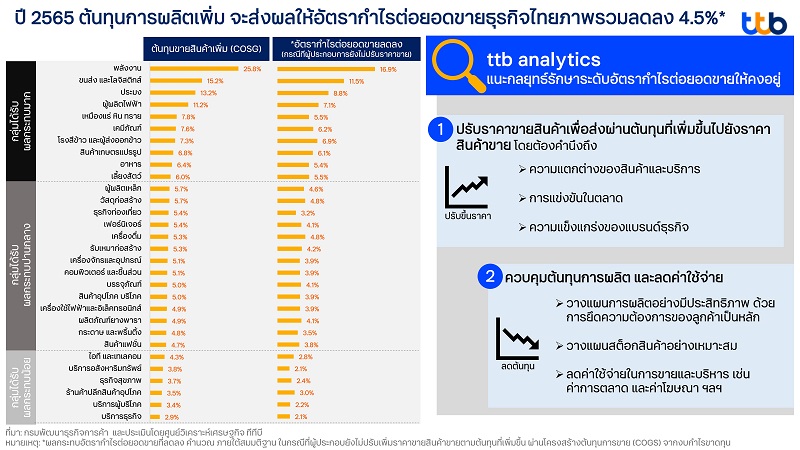
Rising costs indicate a potential decrease in overall business profit margins by 4.5%
Regarding the impact of rising costs on business profit margins, analysis of the profit and loss structure of businesses in Thailand shows that if operators do not raise product prices, a 5.7% increase in the cost of goods sold (COGS) in 2022 will result in a 4.5% decrease in the overall gross profit margin of Thai businesses. The impact of rising costs on business profits can be categorized into three groups:
Group 1 (severe impact with costs rising by 6.0% - 25.8%): includes energy, transportation and logistics, fisheries, electricity producers, mining, chemicals, rice milling and export, processed agricultural products, food, and livestock. This group is heavily reliant on rising raw material costs for fuel and agricultural products, leading to significantly increased production costs and a gross profit margin reduction of between 5.4% - 16.9%.
Group 2 (moderate impact with costs rising by 4.7% - 5.7%): includes steel, construction materials, tourism, furniture, beverages, construction contracting, machinery and equipment, computers and components, packaging, and consumer goods. This group mainly relies on industrial raw materials, steel, and food, resulting in a gross profit margin reduction of between 3.2% - 4.8%.
Group 3 (minimal impact with costs rising by 2.9% - 4.3%): includes IT and telecom, real estate services, health businesses, retail consumer goods, personal services, and business services. This group has relatively low production costs as they operate in the service sector; however, they still face indirect impacts from rising costs.