Monitoring China's Slowing Economy – Strengthening Baht May Impact Thai Agricultural Exports in 2022
Krungthai Compass has released an analysis of Thai agricultural exports for 2021, indicating that cassava, fresh and frozen fruits, rubber, and rice are the product groups that have shown good growth. However, in 2022, attention must be paid to the slowing Chinese economy, the potential strengthening of the baht in the second half of the year, and rising operational costs, which may affect the growth rate of Thai agricultural and agro-industrial exports.
Krungthai Compass from Krung Thai Bank revealed that agricultural and agro-industrial exports in the fourth quarter of 2021 continued to grow, supported by the easing of the COVID-19 pandemic and the festive season, which boosted economic activities among trading partners. The weakening baht also contributed to a 19.3% growth in exports in Q4/2021 compared to the same period last year.
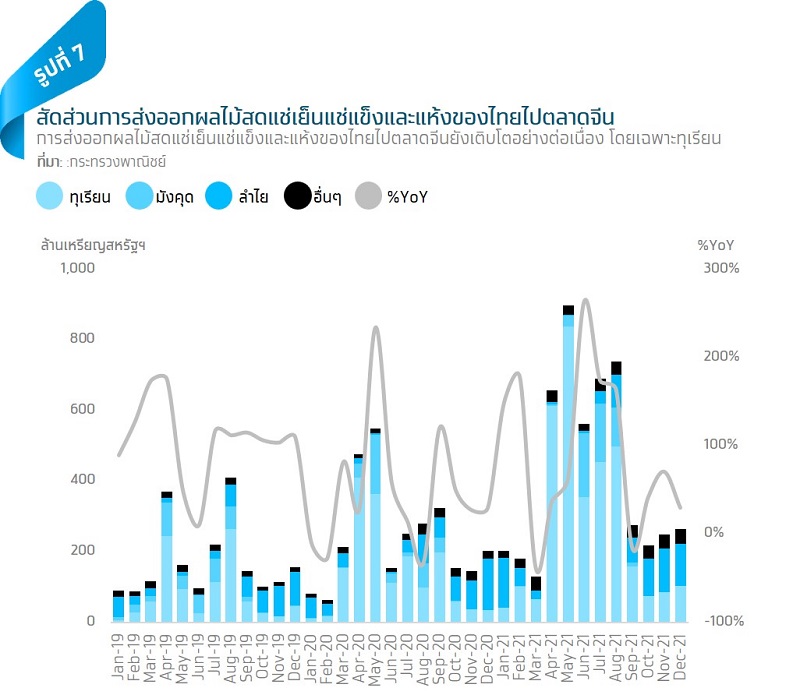
The agricultural product category grew by 19.2% for the fourth consecutive quarter, with strong export growth in all major markets, particularly China, which accounts for 27% of the total value of agricultural and agro-industrial exports. The products that showed good growth include cassava, fresh and frozen fruits, rubber, and rice.
The agro-industrial product category grew by 19.4% for the third consecutive quarter, with exports of seasonings and pet food continuing to perform well, benefiting from the COVID-19 pandemic as more people worked from home, leading to increased pet ownership and care. Additionally, sugar saw benefits from improved export prices, while canned and processed seafood continued to decline, particularly canned tuna, which has contracted for four consecutive quarters due to foreign partners slowing down their stockpiling of these products.
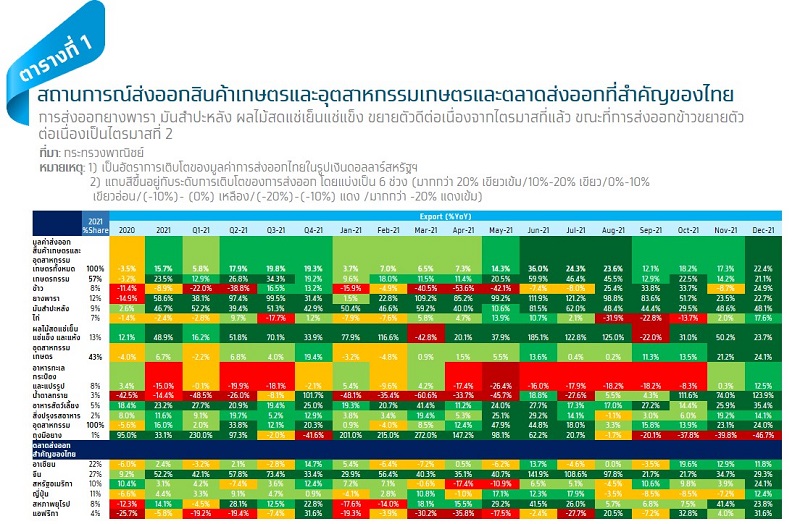
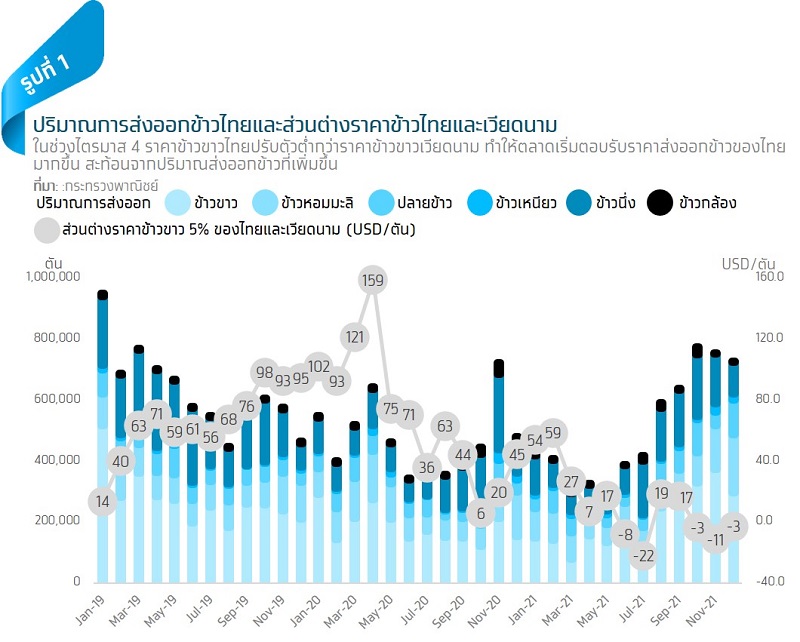
The value of rice exports in Q4 2021 grew for the second consecutive quarter by 13.2% compared to the same period last year, after several quarters of negative growth. The value of white rice exports grew by 71.8% due to a 104.5% increase in export volume, aided by a weakening baht, which allowed white rice prices to become more competitive with those of rivals like Vietnam and India. The value of jasmine rice exports grew by 4.4%.
Although the value of rice exports in the last two quarters has grown, the overall value of rice exports for the year still contracted by 8.9% YoY due to intense price competition and a strengthening baht at the beginning of the year, making it difficult to compete.
For 2022-2023, the direction of agricultural exports is expected to continue to grow but at a slower rate, partly due to a high base. It is anticipated that the export value of fresh, chilled, frozen, and dried fruits will be 223,120 and 261,051 million baht, representing growth of 17.3% YoY and 17.0% YoY, respectively, particularly in the Chinese market, which is Thailand's main export market, accounting for 53%. Additionally, Thailand has a free trade agreement (FTA) with China, allowing for exemptions from import duties on fresh, chilled, and frozen vegetables and fruits. Furthermore, it is expected that in the near future, Thai vegetable and fruit exports to China will benefit from the opening of the China-Laos railway, which will increase export channels and reduce transportation costs and time to just 15 hours, compared to two days by road.
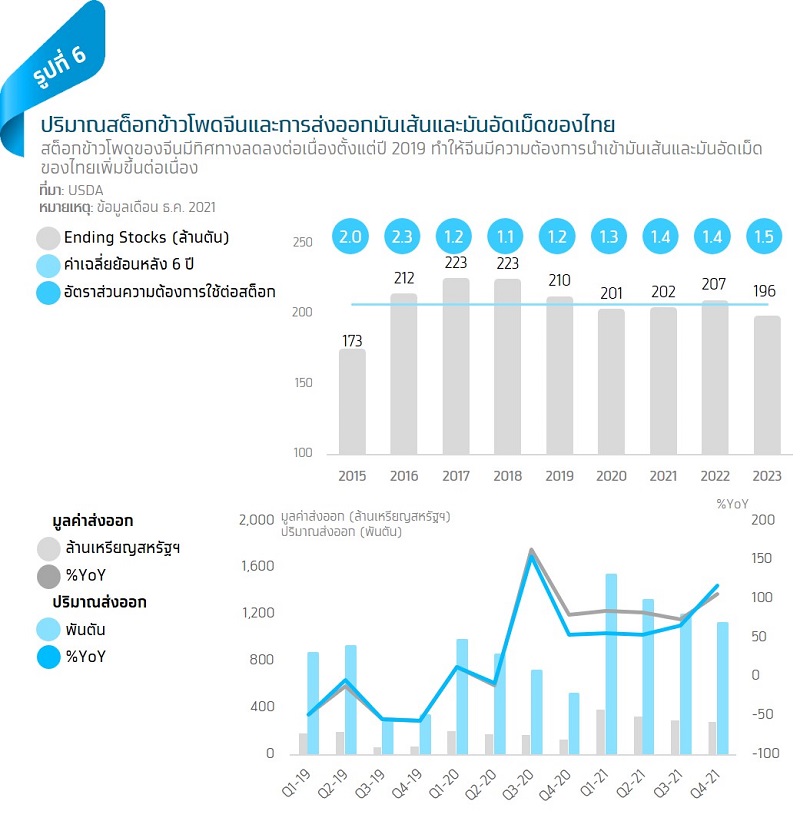
The export volumes of Thai starch and pelletized cassava are expected to be 5.5 and 5.7 million tons, respectively, growing at 5% per year, while the export volume of cassava flour is expected to be 5.1 and 5.5 million tons, respectively, growing at 6% per year, due to declining stocks of Chinese corn (a substitute product), leading to increased demand from Chinese producers for cassava products from Thailand.
However, it is essential to closely monitor challenging factors, such as the slowing Chinese economy, which is Thailand's main agricultural trading partner, showing signs of weaker growth due to the worsening real estate crisis and the impact of energy management policies, which may affect the purchasing power of Chinese consumers and subsequently impact Thai agricultural exports that heavily rely on the Chinese market.
Additionally, the rising production costs from agricultural raw materials, packaging, and transportation will pressure the profit margins of food exporters, such as seasonings and canned foods, as these costs account for 80-90% of total costs.
Furthermore, China's strict hygiene measures, such as increased compliance with inspection measures and COVID-19 prevention protocols, require Thai producers of fresh, chilled, and frozen fruits and vegetables to prioritize safety and quality standards set by trading partners. Initially, this may increase management costs for producers, but in the long run, it will create opportunities for expanding export markets and build consumer confidence.
Meanwhile, the baht is expected to strengthen in 2022, which may impact the export prices of agricultural products with low value-added (such as rice, rubber, and cassava), potentially leading to thinner margins for exporters of these products.
Lastly, high shipping costs remain a risk factor for the transportation costs of Thai agricultural exports, with the most affected products being jasmine rice, seafood, fresh and frozen chicken, cassava, and rubber products. Additionally, the global economic recovery, particularly in the U.S. and China, is expected to increase the demand for shipping containers, putting pressure on shipping rates to remain high throughout 2022-2023.
Thank you for the information from Krungthai Compass