Fiscal Policy Office Weekly Economic Report as of November 5, 2021
The Fiscal Policy Office (FPO) reports the weekly economic situation as of November 5, 2021, as follows:
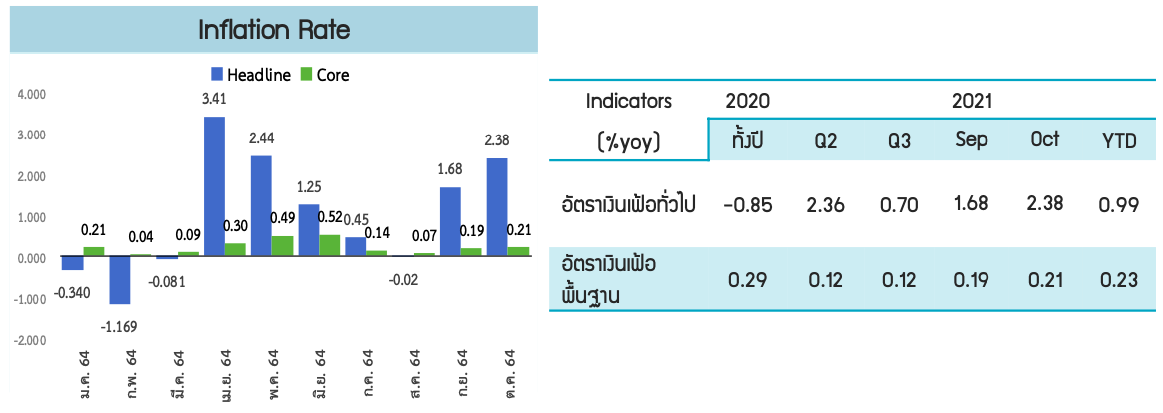
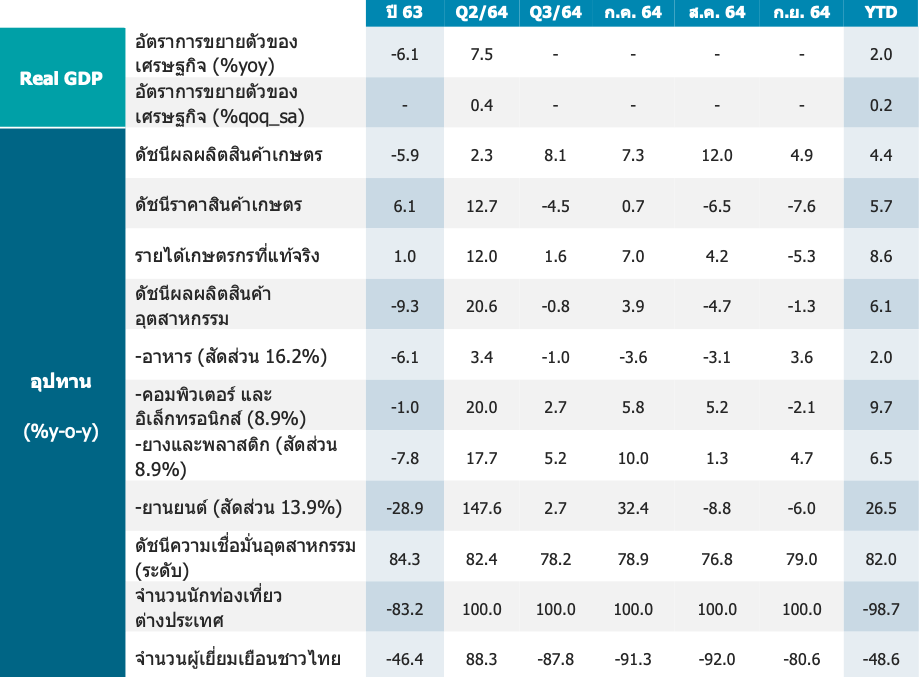
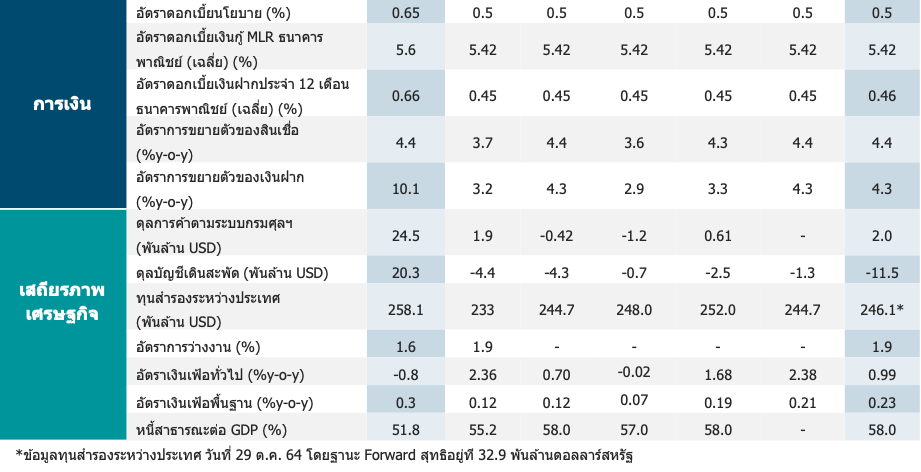
1. The general inflation rate for October 2021 grew by 2.38% year-on-year, while the core inflation rate increased by 0.21% year-on-year.
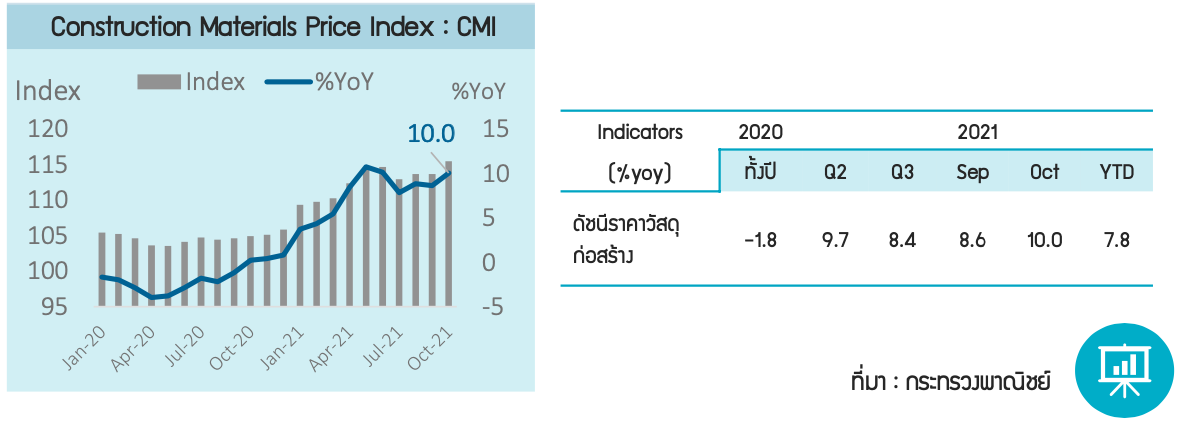
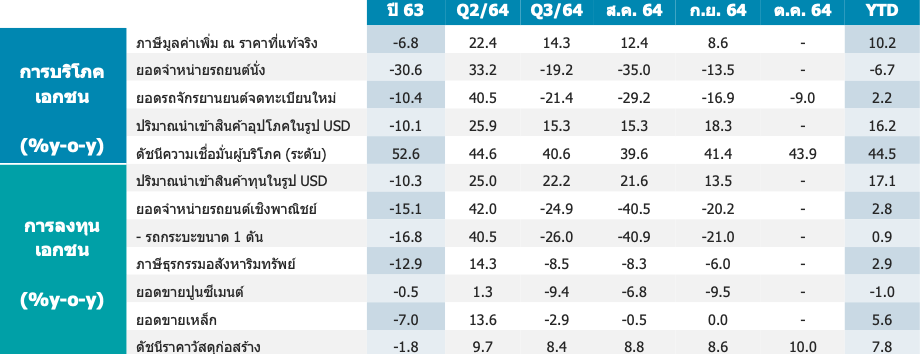
2. The construction material price index in October 2021 rose by 10.0% compared to the same period last year.
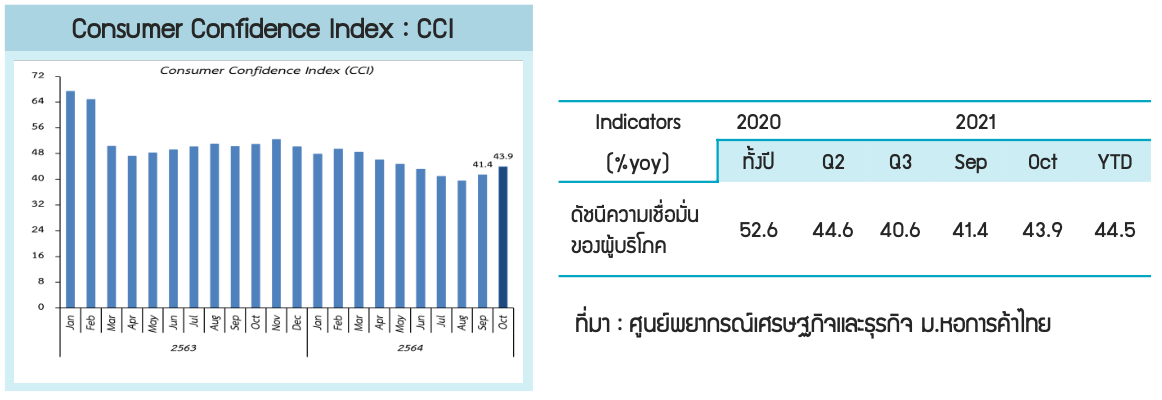
3. The consumer confidence index in October 2021 increased to 43.9 from 41.4 in the previous month.
4. The number of newly registered motorcycles in October 2021 decreased by -9.0% compared to the same period last year.
5. The current account balance for September 2021 recorded a deficit of -1,345.6 million USD.
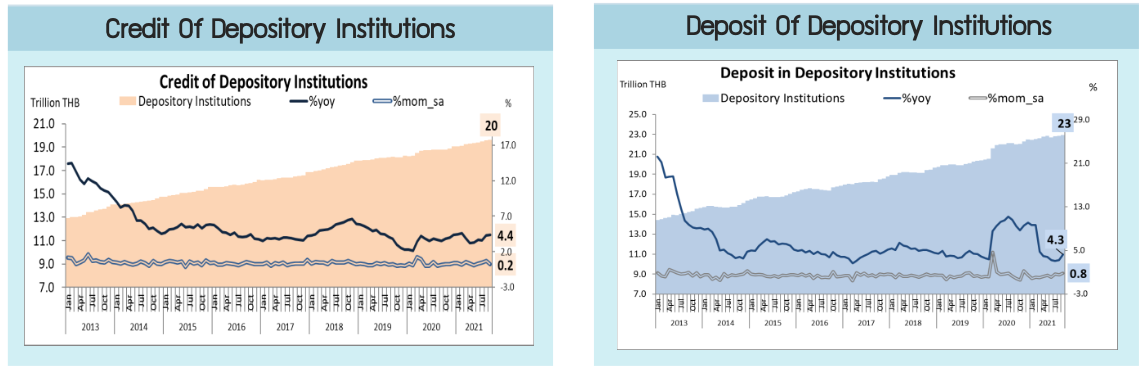
6. Loans in financial institutions in September 2021 grew by 4.4% year-on-year, while deposits in financial institutions grew by 4.3% year-on-year.
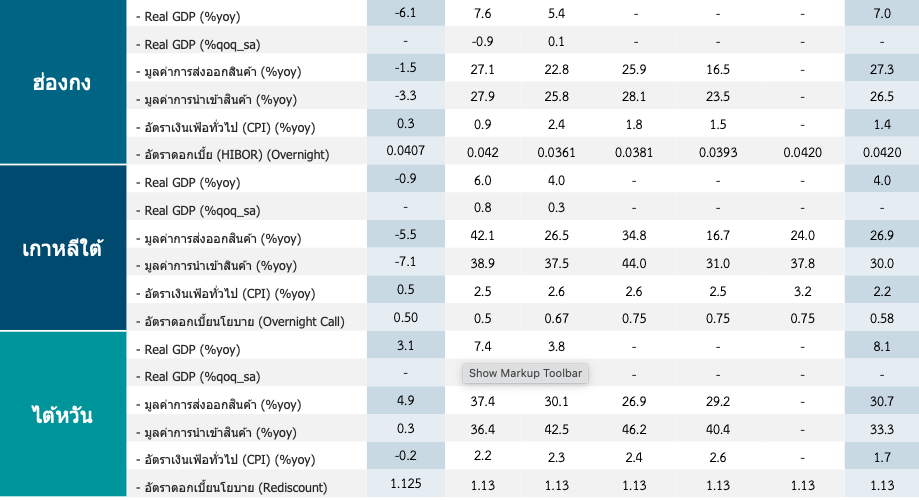
7. Hong Kong's GDP in Q3 2021 grew by 5.4% year-on-year.
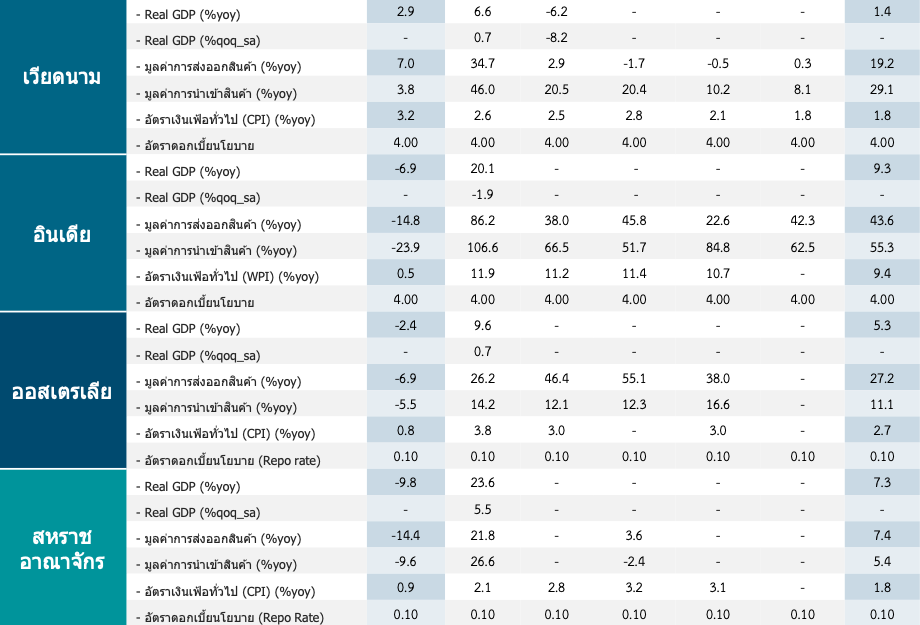
8. Indonesia's GDP in Q3 2021 grew by 3.5% year-on-year.
Thai Economic Indicators
The general inflation rate for October 2021 grew by 2.38% year-on-year, mainly due to the increase in fuel prices following global energy price trends, along with rising prices of fresh vegetables due to crop areas affected by flooding in several regions, resulting in lower market supply. Additionally, there was increased consumption demand during the vegetarian festival.
However, prices of several key commodities decreased compared to last year, such as jasmine rice, sticky rice, pork, fresh chicken, and fresh fruits. For other goods and services, prices continued to move normally according to market mechanisms, and when excluding fresh food and energy, core inflation grew by 0.21%.
The construction material price index in October 2021 grew by 10.0% compared to the same period last year, marking the 13th consecutive month of growth due to rising prices across nearly all categories (especially steel and concrete products, which grew by 39.4% and 5.3% year-on-year, respectively). This was driven by increased raw material costs in the global market, such as steel, aluminum, coal, and oil, leading to higher production costs for construction materials. In the near future, the relaxation of the LTV measures by the Bank of Thailand is expected to stimulate the real estate sector and related businesses, increasing domestic demand for construction materials. However, there are still risk factors, including the ongoing COVID-19 pandemic and the strengthening Thai baht, which may impact the index.
The consumer confidence index in October 2021 increased to 43.9 from 41.4 in the previous month, marking the second consecutive month of improvement and the highest level in five months since June 2021.
This improvement resulted from the relaxation of lockdown measures in 29 additional high-control provinces, the announcement of reduced curfew hours in October 2021, allowing foreign tourists to travel to the country, and the capping of diesel prices at no more than 30 baht per liter, which positively influenced consumer confidence. It is expected that this will lead to increased consumer spending and tourism, as well as higher expenses from foreign tourists towards the end of the year. Additionally, government economic stimulus measures amounting to over 100 billion baht will further circulate in the economy, contributing to improvements in the Thai economy and employment towards the end of 2021, which is a significant reason for the substantial increase in both current and future consumer confidence indices.
The number of newly registered motorcycles in October 2021 decreased by -9.0% compared to the same period last year, but when compared to the previous month, after seasonal adjustments, it grew by 1.4%.
This marks the fourth consecutive month of decline, as consumer concerns about the COVID-19 outbreak and the impact of flooding in several areas have caused economic damage, leading consumers to remain cautious in their spending during this period.
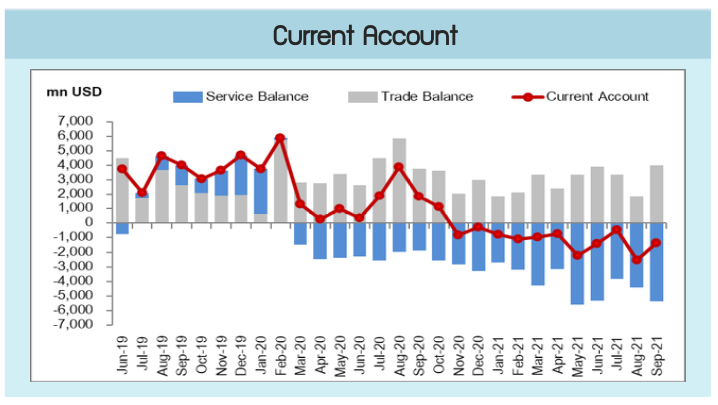
The current account balance for September 2021 recorded a deficit of -1,345.6 million USD, a decrease from the previous month's deficit of -2,536.3 million USD. The services, income, and transfer balance recorded a deficit of -5,353.0 million USD, which increased from the previous month, while the trade balance (BOP system) recorded a surplus of 4,007.4 million USD, resulting in a total current account deficit of -11,513.5 million USD for 2021, which represents a slowdown of 0.2% from the previous month (after seasonal adjustments). When analyzing loan types, business loans grew at a faster rate of 5.2%, while consumer loans slowed to a growth rate of 3.9% year-on-year.
Deposits in financial institutions in September 2021 totaled 22.9 trillion baht, reflecting a growth rate of 4.3% year-on-year. After seasonal adjustments, the growth rate accelerated to 0.8% from the previous month, with deposits from commercial banks and specialized financial institutions growing at rates of 5.0% and 2.6% year-on-year, respectively.
Source: Bank of Thailand
International Economic Indicators
United States
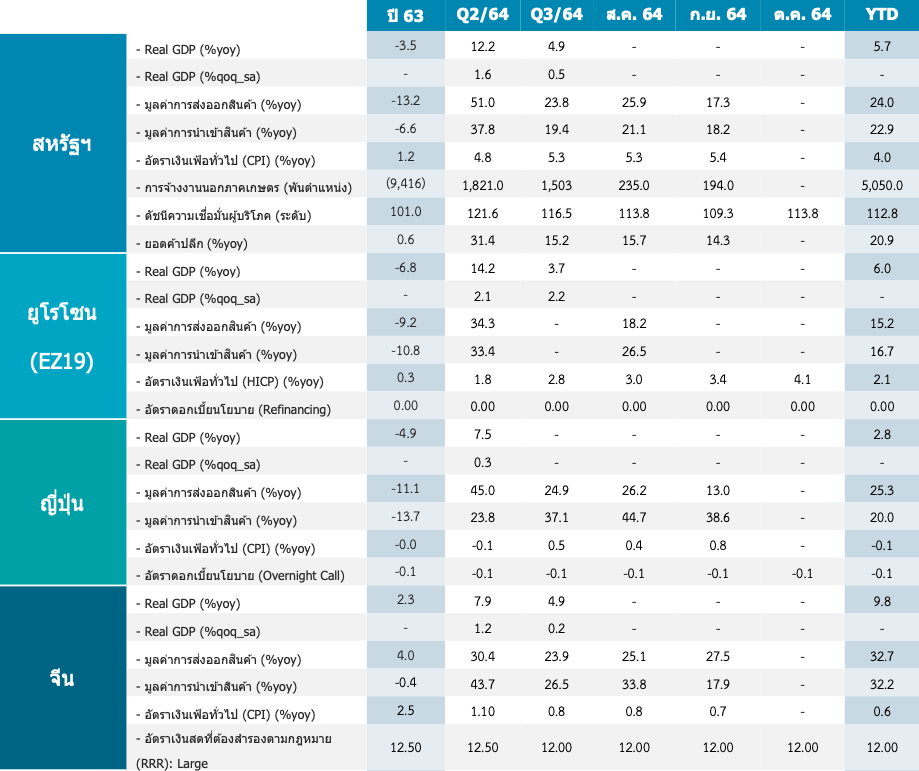
- The PMI index for the manufacturing sector (ISM) in October 2021 was at 60.8, down from 61.1 in the previous month but higher than market expectations, amid supply chain issues and rising product prices.
- The PMI index for the non-manufacturing sector (ISM) in October 2021 was at 66.7, up from 61.9 in the previous month, marking the highest level since data collection began, supported by strong ongoing demand.
- Export value in September 2021 grew by 17.3% year-on-year, slowing from 25.9% growth in the previous month.
- Import value in September 2021 grew by 18.2% year-on-year, accelerating from 21.1% growth in the previous month.
- The trade balance in September 2021 recorded a deficit of 80.9 billion USD, increasing from a deficit of 72.8 billion USD in the previous month.
- The number of first-time unemployment claims for the week of October 24-30, 2021, continued to decline for the fifth consecutive week, reaching 269,000, down from 283,000 in the previous week, below market expectations of 275,000, and the lowest level since the pandemic began in March 2020, reflecting the recovery of the U.S. labor market.
China
- The PMI index for the manufacturing sector (Caixin) in October 2021 was at 50.6, up from 50.0 in the previous month, due to a recovery in domestic demand leading to increased order volumes, while energy shortages and rising costs continued to impact production.
- The PMI index for the non-manufacturing sector (Caixin) in October 2021 was at 53.8, up from 53.4 in the previous month, as the easing of the pandemic situation led to significant increases in new order, export, and employment indices.
Japan
- The PMI index for the manufacturing sector in October 2021 was at 53.2, up from 51.5 in the previous month, marking the highest level since May 2021.
- The PMI index for the services sector in October 2021 was at 50.7, up from 47.8 in the previous month, marking the first increase above 50.0 since February 2020, reflecting growth in the services sector.
European Union
- The PMI index for the manufacturing sector in October 2021 was at 58.3, slightly down from 58.6 in the previous month due to manufacturing facing supply shortages.
- The PMI index for the services sector in October 2021 was at 54.6, down from 56.4 in the previous month; however, the index remains above 50, indicating continued growth in the services sector.
- The unemployment rate in September 2021 was at 7.4% of the total labor force, down from 7.5% in August 2021, due to increased labor demand following the easing of COVID-19 control measures.
Hong Kong
- GDP in Q3 2021 grew by 5.4% year-on-year, slowing from 7.6% growth in the previous quarter, or a growth of 0.1% from the previous month (after seasonal adjustments), due to significant slowdowns in domestic consumption and inventory investment amid an easing pandemic situation.
- Retail sales in September 2021 grew by 4.7% year-on-year, slowing from 10.0% growth in the previous month.
Australia
- The PMI index for the manufacturing sector in October 2021 was at 58.2, up from 56.8 in September 2021, marking the strongest growth in four months due to the Australian government's further easing of COVID-19 control measures.
- The PMI index for the services sector in October 2021 was at 51.8, up from 45.5 in September 2021, reflecting a return to growth in the services sector as the index remains above 50.
Vietnam
- The PMI index for the manufacturing sector in October 2021 was at 52.1, improving from 40.2 in the previous month.
Singapore
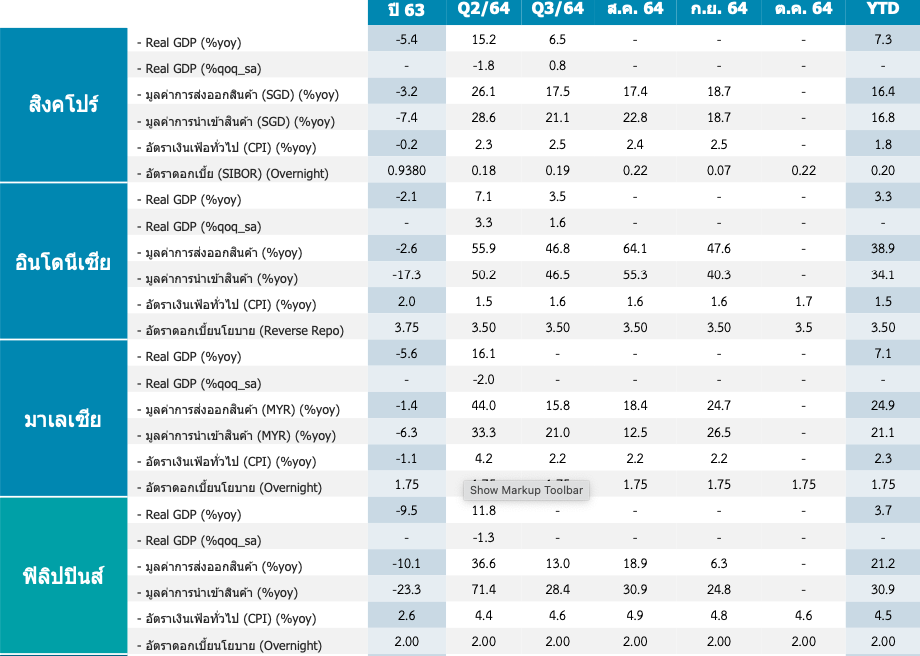
- The PMI index for the manufacturing sector in October 2021 was at 52.3, down from 53.8 in the previous month.
- Retail sales in September 2021 grew by 6.6% year-on-year, improving from a contraction of -2.8% in the previous month.
Indonesia
- GDP in Q3 2021 grew by 3.5% year-on-year, slowing from 7.1% growth in the previous quarter, or a growth of 1.6% compared to the previous quarter (after seasonal adjustments).
- The PMI index for the manufacturing sector in October 2021 was at 57.2, improving from 52.2 in the previous month.
- The inflation rate in October 2021 was at 1.7% year-on-year, up from 1.6% in the previous month, primarily due to transportation costs.
Philippines
- Export value in September 2021 grew by 6.3% year-on-year, slowing from 18.9% growth in the previous month.
- Import value in September 2021 grew by 24.8% year-on-year, slowing from 30.9% growth in the previous month.
- The trade balance in September 2021 recorded a deficit of 4 billion USD, increasing from a deficit of 3.5 billion USD in the previous month.
- The PMI index for the manufacturing sector in October 2021 was at 51.0, improving from 50.9 in the previous month.
- The inflation rate in October 2021 was at 4.6% year-on-year, down from 4.8% in the previous month, primarily due to prices of food and non-alcoholic beverages.
India
- The PMI index for the manufacturing sector in October 2021 was at 55.9, up from 53.7 in the previous month.
Malaysia
- The PMI index for the manufacturing sector in October 2021 was at 52.2, improving from 48.1 in the previous month. The Bank Negara Malaysia announced that the policy interest rate remains at 1.75% per annum.
Taiwan
- The PMI index for the manufacturing sector in October 2021 was at 55.2, up from 54.7 in the previous month, reflecting growth in the manufacturing sector supported by increases in new orders, exports, and employment.
South Korea
- Export value in October 2021 grew by 24.0% year-on-year, accelerating from 16.7% growth in the previous month, driven by increased foreign demand as the pandemic began to ease.
- Import value in October 2021 grew by 37.8% year-on-year, accelerating from 31.0% growth in the previous month, driven by domestic demand following increased vaccination rates.
- The trade balance in October 2021 recorded a surplus of 1.69 billion USD, down from a surplus of 4.21 billion USD in the previous month.
- The PMI index for the manufacturing sector in October 2021 was at 50.2, down from 52.4 in the previous month, marking the lowest level in 13 months due to significant declines in the production index.
- The inflation rate in October 2021 was at 3.2% year-on-year, up from 2.5% in the previous month.
United Kingdom
- The PMI index for the manufacturing sector in October 2021 was at 57.8, up from 57.1 in September 2021, indicating continued growth in the manufacturing sector, although it still faces challenges with raw material and labor shortages.
- The PMI index for the services sector in October 2021 was at 59.1, up from 55.4 in September 2021, as the UK reopened and eased measures for foreign tourists, stimulating domestic demand.
- The Bank of England decided to maintain the policy interest rate at 0.1% per annum during the November 2021 meeting; however, it indicated that there may be a rate hike in the coming months to bring inflation back to the target level of 2%.
Money Market and Exchange Rate Indicators
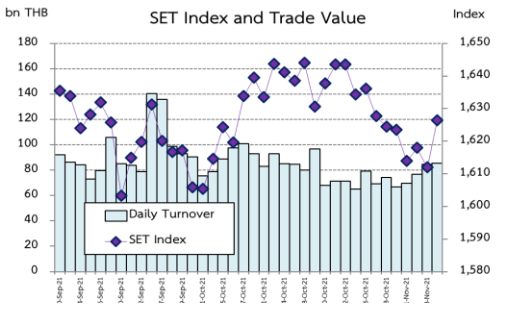
The SET index slightly decreased from the previous week, in line with other regional stock markets that also declined, such as CSI300 (Shanghai), HSI (Hong Kong), and S&P/ASX 200 (Australia). On November 4, 2021, the index closed at 1,626.27 points, with an average trading value between November 1-4, 2021, of 79,271.15 million baht per day. Foreign investors and domestic institutional investors were net buyers, while domestic retail investors and brokerage accounts were net sellers. During November 1-4, 2021, foreign investors net bought securities worth 498.03 million baht.
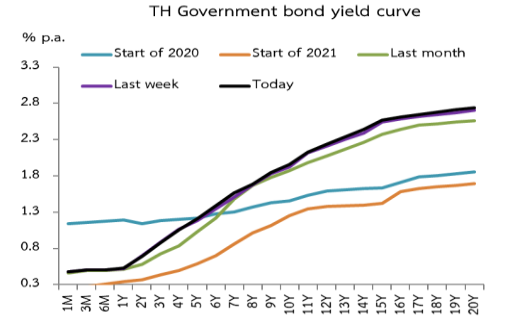
The overall yield on government bonds increased by 1 to 6 bps. This week, there were no government bond auctions. During November 1-4, 2021, foreign investor capital inflows into the bond market totaled 5,818.73 million baht, and from the beginning of the year until November 4, 2021, foreign investor capital inflows into the bond market totaled 79,490.23 million baht.
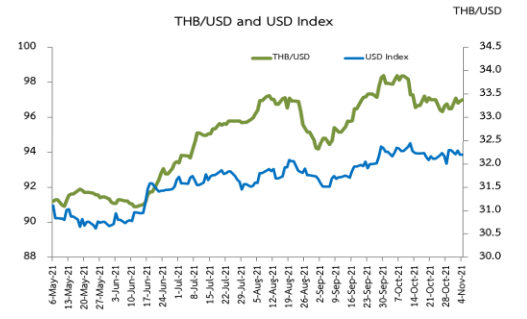
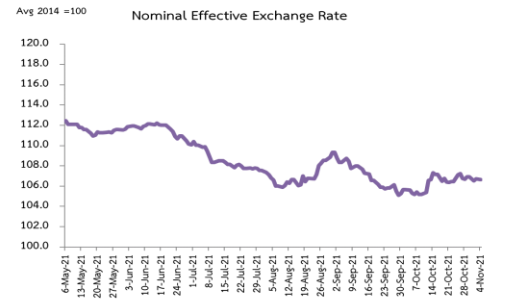
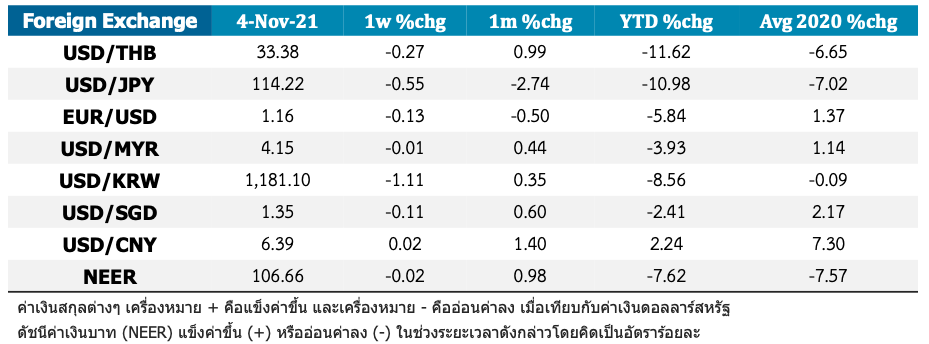
The Thai baht weakened against the previous week, closing at 33.38 baht per USD on November 4, 2021, a depreciation of -0.27% from the previous week, in line with the euro, yen, ringgit, won, and Singapore dollar, which also depreciated against the USD. Meanwhile, the yuan appreciated against the USD compared to the previous week. The Thai baht's depreciation was greater than that of other major currencies in the region, resulting in the NEER index weakening by -0.02% from the previous week.
Economic Indicators
Global Economic Indicators
Thank you for the information from the Macroeconomic Policy Bureau, Fiscal Policy Office, Ministry of Finance 02-273-9020 Ext. 3259