Thai Commercial Bank Shares Success Strategies from Popular Restaurants Honmono Sushi and Kapong Delivery to Help Food Business Adapt
In the midst of the COVID-19 pandemic, operators have inevitably faced significant impacts, particularly in the restaurant sector, which has been directly affected by customers' inability to dine in as they would under normal circumstances. This contradicts the nature of the business, which not only sells the taste and quality of food but also provides an atmosphere for customers. In such a situation, restaurant operators must quickly find solutions and adapt to create a path for survival.

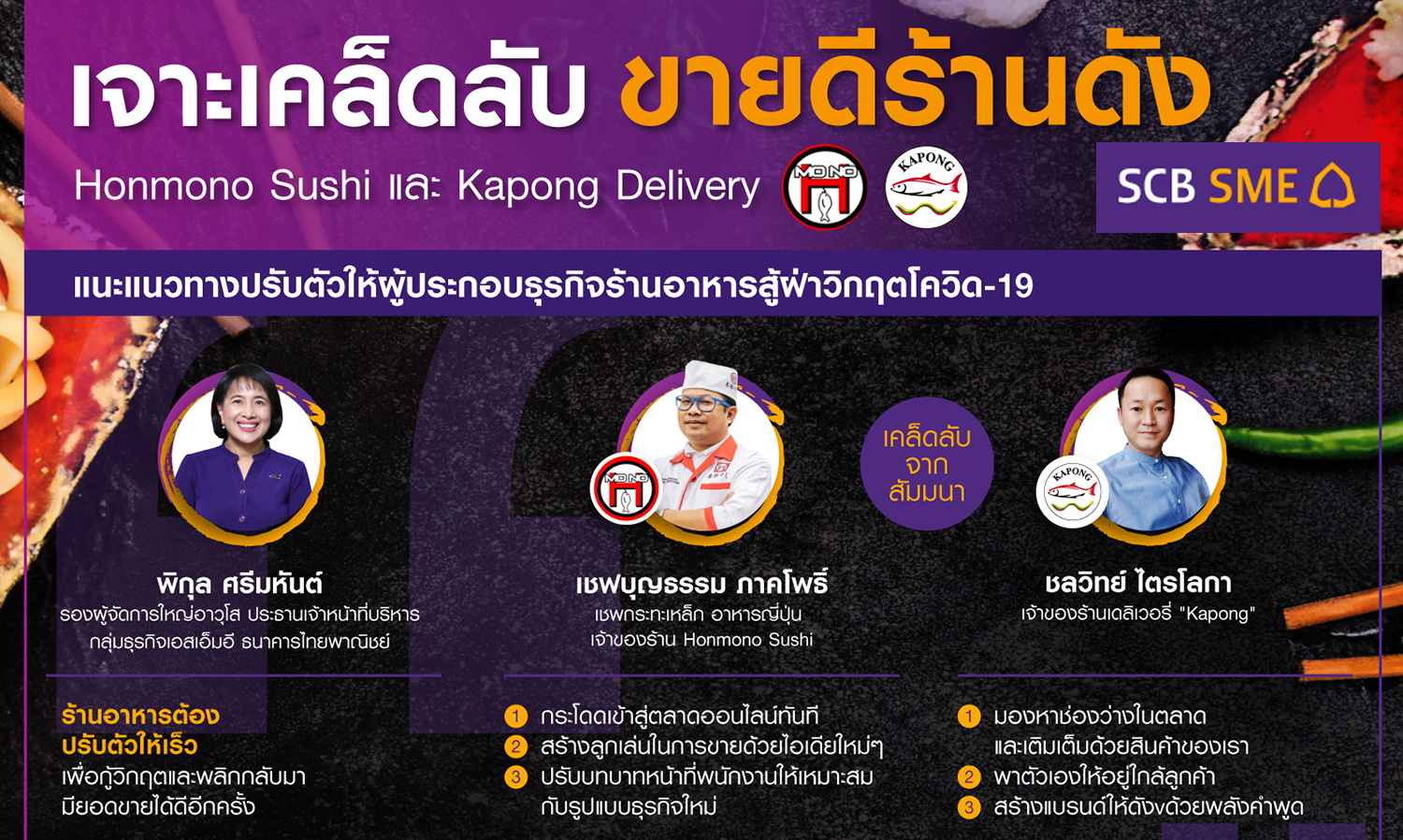
Ms. Pikul Srimahan, Senior Executive Vice President and CEO of the SME Business Group at Siam Commercial Bank, stated that although restaurant operators managed to survive the first wave of the COVID-19 pandemic last year, it does not guarantee that their adaptations will be sufficient to navigate the more challenging circumstances this year. The severe and widespread outbreak has led to stricter control measures that vary according to the severity of the outbreak in different areas, making it difficult to predict when the situation will return to normal. This has significantly altered consumer behavior, as customers can no longer visit restaurants as before and must increasingly rely on delivery or online orders. Restaurants need to adapt heavily to reach their target customers in a new market where many are still unfamiliar or lack sufficient knowledge to compete for survival. Therefore, the bank focuses on providing knowledge to support operators in overcoming the crisis and regaining strong sales through increased online and delivery sales. They invited Chef Boontham Pakphoh, champion of Iron Chef Thailand and owner of Honmono Sushi, and Mr. Chonwit Trailoka, owner of Kapong Delivery, to share their adaptation techniques during the COVID-19 situation at a recent seminar titled “Unlocking Secrets: Strategies for Food Businesses to Survive,” organized by Siam Commercial Bank. Both operators serve as examples of businesses that successfully adapted to overcome the crisis.

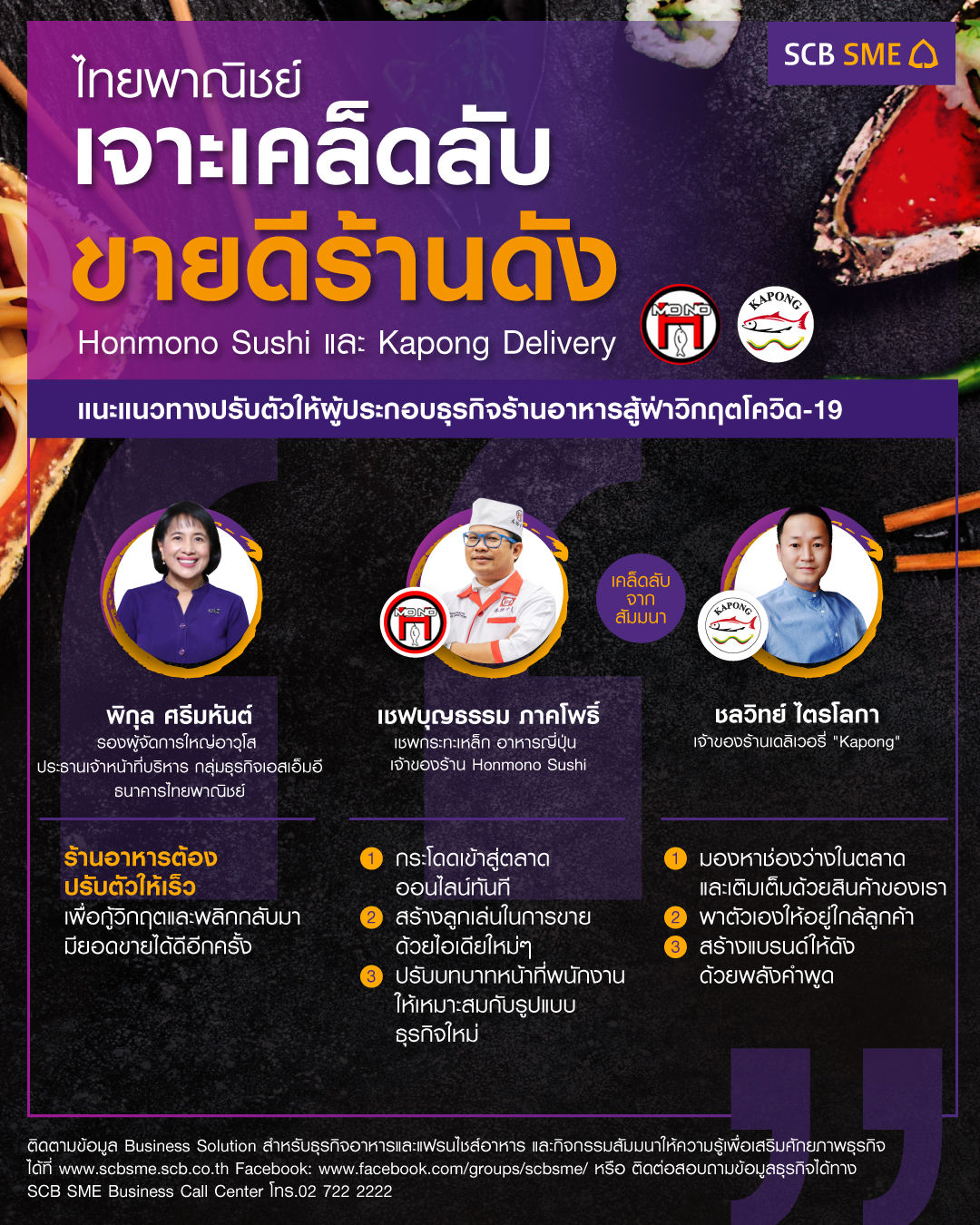
Chef Boontham Pakphoh, champion of Iron Chef Thailand and owner of Honmono Sushi, mentioned that the COVID-19 pandemic forced traditional restaurant businesses to accelerate their adaptations to survive. He advised restaurant operators not to pause and wait for the situation to improve before reopening normally, as it is difficult to predict how long we will have to live with this situation. Honmono Sushi itself was heavily impacted during the first wave of the outbreak in 2020, as the business relied solely on in-store revenue and had no delivery options. This posed a significant challenge during that time, prompting the business to quickly adapt and change its operational methods. As a result, they were able to cope well with subsequent waves of the outbreak. He shared three main tips for adaptation:
1) Jump into the online market immediately. The main channel that kept the business afloat during COVID-19 was social media platforms. Although the initial response was not as expected, learning and using this opportunity to engage with customers helped clarify their strengths, allowing them to understand and meet customer needs effectively, which also became a permanent sales channel for the business.
2) Create engaging sales strategies with new ideas. Entering the online sales channel revealed interesting sales formats, leading to new ideas that made selling more enjoyable, such as live food sales, ingredient auctions, and cooking demonstrations, which received positive customer feedback and increased follower engagement, resulting in continuous sales growth.
3) Adjust employee roles to fit the new business model. As the business model changed, employees needed to learn new roles. They were given opportunities to rotate through various responsibilities, such as serving as Admin to answer customer inquiries online and via phone, cooking, and delivering food to customers. This approach helped employees become well-acquainted with the restaurant, its menu, ingredients, and customers.
While traditional businesses are striving to adapt to survive this crisis, there are still those who have been directly affected by the COVID-19 fallout who refuse to give up and have successfully established new food businesses during the pandemic, such as Kapong Delivery.

Mr. Chonwit Trailoka, owner of Kapong Delivery, shared that he previously operated several businesses that had to close due to the overwhelming impact of COVID-19 in 2020. However, he immediately sought new survival strategies by applying lessons learned from previous businesses, such as managing storefront expenses and high GP fees paid to delivery agents. He pivoted to a new business model without a storefront, focusing on a Cloud Kitchen and primarily self-delivering. He also identified a market gap for fried sea bass, a popular dish with limited delivery options, leading him to launch Kapong Delivery in January 2021, during a time when COVID-19 was still rampant. The business remained strong with consistent sales. He shared three key factors that contributed to their success:
1) Identify market gaps and fill them with our products. It is crucial for businesses to adapt and continuously survey the market to meet customer demands. For example, while selling fried sea bass, they offered a unique half fish option with two flavor choices out of ten, along with family meal set promotions. Additionally, the restaurant's online presence played a significant role in influencing customer purchasing decisions, so they prioritized appealing food images and creative menu names.
2) Stay close to customers. For delivery, proximity to customers is essential due to shipping costs based on distance. Therefore, the business focused on investing in a Cloud Kitchen model, which has lower costs, to ensure their food delivery points are closer to customers, resulting in cheaper shipping fees that facilitate customer ordering. Having their own delivery service allows the restaurant to control delivery and promptly address customer issues, or they can join platforms like Robinhood Food Delivery, which does not charge GP fees, ensuring fair income for the restaurant.
3) Build brand recognition through word-of-mouth. This is a powerful sales tool due to its credibility and comes from real customer experiences. Word-of-mouth occurs when a restaurant creates a memorable experience for customers, leading them to share their positive feelings. Therefore, they must constantly think about how to make their food look appetizing when it reaches customers and encourage customers to take photos and share their positive experiences on social media.
Adapting and trying new things may be challenging and may not succeed on the first attempt, but falling and getting back up is a valuable lesson for restaurant businesses to develop themselves and ensure their survival during this crisis while moving forward more securely. SME operators can follow business tips and seminar activities beneficial for their businesses from Siam Commercial Bank and its partners in both the public and private sectors throughout the year
via the website www.scbsme.scb.co.th
Facebook: www.facebook.com/groups/scbsme
or contact the SCB SME Business Call Center at 02 7222222 for business inquiries.