Joint Private Sector Committee Warns Thai Economy at Risk of Recession for Another Year Due to COVID-19 Third Wave
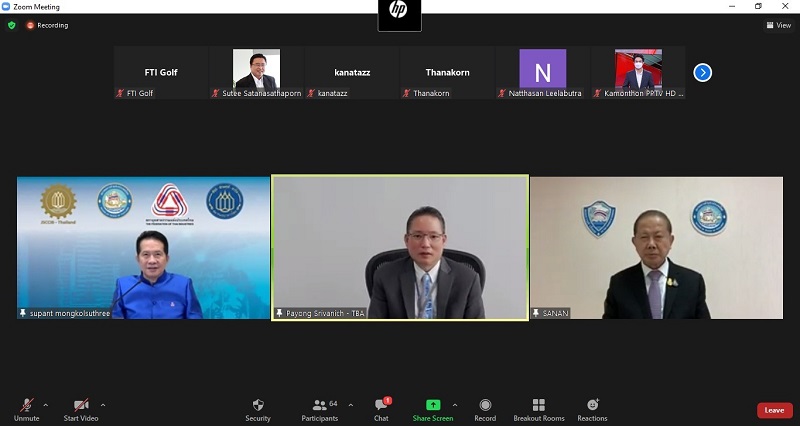
The Joint Private Sector Committee (JCC) meeting for August 2021 was held today (August 4) with Mr. Payong Srivanich, President of the Thai Bankers' Association, as the chair, alongside Mr. Sanan Angubolkul, Chairman of the Thai Chamber of Commerce, and Mr. Suphan Mongkolsuthee, President of the Federation of Thai Industries, participating as co-chairs in a video conference.
The JCC stated that the Thai economy is at risk of entering a recession for another year due to the new wave of COVID-19, which has impacted the second half of the year. The control of the COVID-19 outbreak has not been successful, with daily infection rates and the number of hospitalized patients continuing to rise significantly. Although lockdown measures have been extended until the end of August in several provinces, if the distribution of COVID-19 vaccines to the public continues to be slow, there is a high risk of needing to limit economic activities throughout the fourth quarter, diminishing the feasibility or benefits of the reopening plan.
This escalation and expansion of restrictions are adjustments based on the increasing outbreak in various provinces. It is estimated that this will have an additional impact of 300-400 billion baht (with dark red areas accounting for 78% of the country's GDP). The current situation is similar to the escalation in April last year, with significant reductions in economic activities and people's mobility. If a lockdown is necessary, other measures must be implemented concurrently, with an urgent need to control the spread of the virus, especially the Delta variant, which has a high and rapid transmission rate, and to enhance vaccination capabilities, including Home Isolation and Company Isolation.
“The Thai economy for the remainder of this year is therefore in a difficult recovery phase, and it is highly likely that the economy in the second half of the year will contract compared to the previous year, which may lead to the Thai economy entering a recession for the second consecutive year, even if the global economy recovers strongly.”
The intensifying outbreak has severely impacted businesses across all sectors, including exports. The prolonged economic stagnation due to strict outbreak control measures has affected the income of operators, particularly SMEs and labor workers, as reflected in the number of debtors under the care of various banks under the Bank of Thailand's debt restructuring measures, totaling 1.89 million accounts or approximately 2 trillion baht. In the near future, aside from the service, tourism, and general trade sectors, which are vulnerable, the COVID-19 outbreak among workers has begun to impact the manufacturing and export industries, which have been the sole engines of the Thai economy for several months.
Nevertheless, the JCC views that the Thai economy is still in crisis and facing significant risks due to the rapid and severe new wave of outbreaks affecting domestic demand. Meanwhile, the continuously recovering global economy still supports Thai exports in the future. The JCC has therefore revised its economic forecast for Thailand in 2021 to between -1.5% and 0.0%, depending on the severity of COVID-19 and additional government measures. Regarding exports, the JCC expects growth of 10.0% to 12.0% due to the strong recovery of the global economy, but it is crucial to manage the supply chain to prevent widespread infections, with the government urgently prioritizing vaccine distribution to the labor force. The general inflation rate is expected to remain within the range of 1.0% to 1.2%, with pressure from rising energy and transportation costs impacting producers' costs.
Meanwhile, the government must prepare for recovery and support for the economy, which is in a more severe crisis than anticipated. The business sector is battered and requires significant effort to revive exhausted operators, with the stability of businesses and households under risk.
Households are facing a debt burden exceeding 90% of GDP and require assistance to compensate for lost income during this period and to stabilize in the future. Given the deeper-than-expected economic situation, the government needs to build confidence by ensuring sufficient budget readiness. The public debt ceiling should be expanded from 60% of GDP to 65-70% to align with the mission of recovery and economic support during the crisis.
This includes prioritizing budget allocation under emergency circumstances. Additionally, the Bank of Thailand needs to consider ways to relax monetary policy and measures with financial institutions further, given that the policy interest rate is near 0% to help maintain the stability of the country's financial system.
All sectors must collaborate to integrate measures to limit the outbreak cycle by accelerating the procurement of primary and alternative vaccines to meet public demand and achieve herd immunity quickly, as well as speeding up the distribution of antigen test kits to quickly identify infected individuals.
Additional Proposals from the JCC to the Government During the COVID-19 Third Wave
- To align with economic necessities and alleviate the impact on the public from the COVID-19 outbreak, it is proposed to extend the period for reducing land and building taxes by 90% for another year for the 2022 tax year (effective from January 1, 2022, to December 31, 2022).
- It is proposed that the government increase the proportion of damage guarantees through the Small Industry Credit Guarantee Corporation (SCGC) to 60% or more to enable financial institutions to provide more loans to operators affected by COVID-19.
- Request the Revenue Department to exempt SMEs from taxes for 3 years, provided they maintain single accounting and file taxes through the E-Tax system.
- The government should issue a single command for managing the COVID-19 situation.
- It is proposed that the government allow the private sector to import vaccines freely without going through manufacturers or state agencies, under government supervision, with the government issuing purchase orders and covering expenses.
- Request the FDA to expedite the approval of other vaccine brands without waiting for vaccine companies to submit documents to increase options and opportunities for vaccine procurement.
- Request government support for a double tax deduction for the private sector that incurs expenses for purchasing rapid COVID-19 test kits and COVID-19 vaccines.
- Request the private sector to assist in the production and procurement of Favipiravir, which is in high demand.