COVID-19 and the Crisis of 'Full Beds': The Department of Medical Services Advises the Public to Take Fever Reducers and Andrographis Paniculata if Infected Without Symptoms or Comorbidities
The Department of Medical Services emphasizes that the RT-PCR test results will not hinder patient admissions as long as there are available beds. However, the current situation in hospitals, particularly for yellow and red cases, is extremely critical and at full capacity.
Dr. Somsak Arkhasilp, Director-General of the Department of Medical Services, stated that for individuals who test positive using self-screening COVID-19 kits or antigen tests, it is recommended to isolate at home. The process involves calling 1330. The National Health Security Office (NHSO) is aware that the lines may be busy due to the high number of tests being conducted. They recommend visiting the NHSO website to fill out a QR code form, and officials will contact you back to register for home isolation if symptoms are mild.
If individuals choose to self-manage in this manner, the NHSO will coordinate with warm community clinics or public health service centers in Bangkok to provide care for citizens in home isolation for asymptomatic or mildly symptomatic patients.
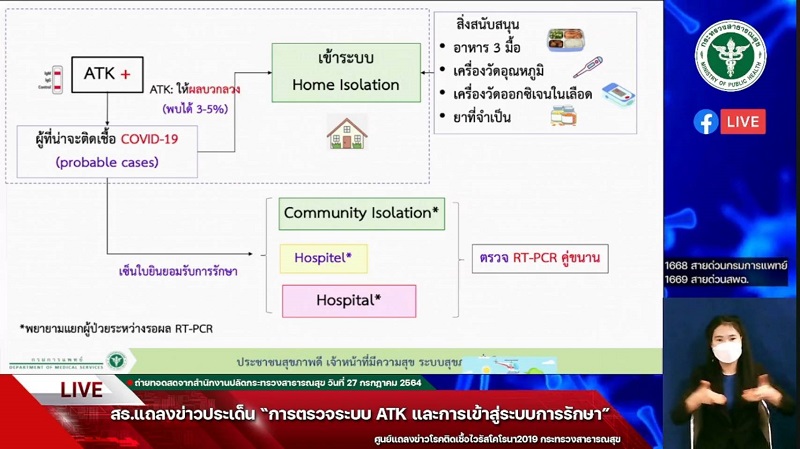
Once registered, the next step is to assess symptoms through follow-up calls. Equipment such as thermometers and pulse oximeters will be sent to monitor symptoms at home. Additionally, healthcare professionals will call twice daily to check on the patient's condition, and three meals will be delivered to ensure that individuals remain isolated in their rooms.

Regarding the administration of Favipiravir, it will be considered for patients who meet the criteria, such as those who begin to show symptoms like fever, cough, or chest tightness, or have risk factors and comorbidities such as heart disease, previous strokes, or obesity. The decision is at the physician's discretion; even asymptomatic patients may receive the medication. The current principle is to administer the medication promptly, as Favipiravir is most effective when given within 3-4 hours after symptoms appear. However, if there are no symptoms or comorbidities, the medication should not be given. The recommendation for Andrographis Paniculata is to provide it to asymptomatic individuals, but not simultaneously with Favipiravir.
In cases where a repeat COVID-19 test is needed after a positive self-screening result, Dr. Somsak indicated that scientifically, if there is a high rate of infection, the majority of positive results are likely accurate, with false positives being very rare. Currently, about 3-5% may be false positives, while over 95% are true positives, so there is no need for retesting. Home isolation can proceed immediately. However, if the result is negative, it is advised to retest in 2-3 days if possible, especially for those in high-risk groups or communities.
Currently, there are no red beds available in hospitals under the Department of Medical Services, such as Lerdsin Hospital and Nopparat Hospital, which are consistently at full capacity. Emergency rooms are overwhelmed with red cases waiting for admission.
The situation in most hospitals now is that ICUs are designated for COVID patients only, and non-infected patients cannot be mixed with infected ones, as this could lead to non-COVID patients contracting the virus. Therefore, if a patient needs to be admitted, especially to an ICU, an RT-PCR test must be conducted without waiting for results if beds are available. Discussions have taken place to allow patients to be admitted first while undergoing RT-PCR testing simultaneously. If possible, patients should be separated from others to prevent cross-contamination. If a patient is confirmed negative, they can be moved out of the COVID ward.
This principle will ensure that RT-PCR test results do not become a barrier to admission as long as there are available beds. Currently, the fastest RT-PCR test results can be obtained within 2-3 hours, and this includes patients who cannot isolate at home and must go to community waiting centers for COVID patients, but they should be separated and undergo RT-PCR testing simultaneously.
For those who cannot isolate at home, the principle is that they cannot separate themselves from others in the household, such as not being able to have a separate bedroom while living together. However, if isolation can be achieved in a separate room, shared bathrooms can be used, but it is advised to use them last and to maintain cleanliness, avoid eating together, and separate personal items and waste.
Community waiting centers are not field hospitals, but for patients who cannot isolate at home, the capacity of these centers will not be equivalent to field hospitals. The aim is to foster a community care approach, with the Bangkok Metropolitan Administration director overseeing these centers. However, in cases where patients have issues, hospitals will be on standby.
It must be acknowledged that the outbreak has exceeded the number of available beds. Currently, some patients are being transferred to Busarakham Hospital, which has available beds daily. The Army has also set up facilities similar to field hospitals, mobilizing doctors from military hospitals nationwide to assist. As hospitals in Bangkok, including medical school hospitals and those under the Bangkok Metropolitan Administration and the Department of Medical Services, are at full capacity, having military doctors assist in establishing initial reception centers and transferring patients, similar to what is done at Nimibutr Hospital, will allow for temporary patient admissions. When beds become available at Busarakham Hospital or elsewhere, patients will be rotated accordingly.
According to the Department of Medical Services, Ministry of Public Health, the situation for beds in Bangkok and surrounding areas is critical, with nearly all beds occupied as of July 24, 2021.
Red Patients
Negative pressure ICU beds: Total 297 beds, currently occupied 336 beds, available -39 beds (no beds available).
Converted negative pressure rooms: Total 570 beds, currently occupied 835 beds, available -256 beds (no beds available).
General ICUs: Total 421 beds, currently occupied 439 beds, available -18 beds (no beds available).

Yellow Patients
Isolation rooms: Total 4,358 beds, currently occupied 4,698 beds, available -340 beds (no beds available).
General rooms: Total 11,652 beds, currently occupied 12,959 beds, available -1,307 beds (no beds available).
Green Patients
Hospitals: Total 16,643 beds, currently occupied 15,622 beds, available 1,021 beds.
Field beds: Total 3,036 beds, currently occupied 2,779 beds, available 257 beds.
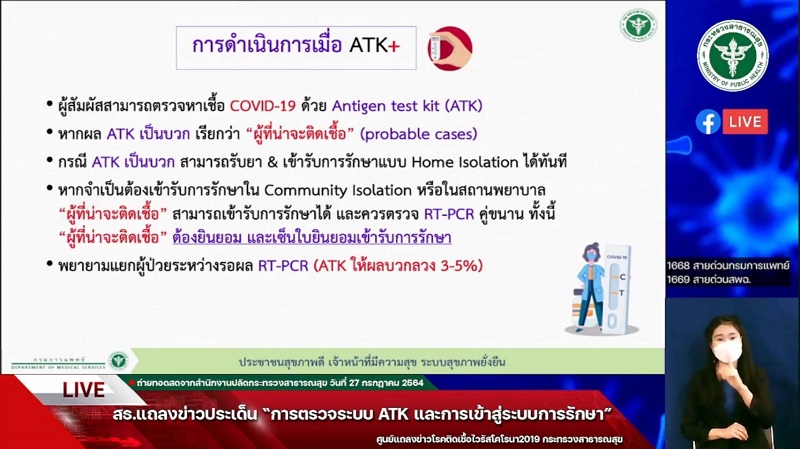
The latest information as of July 27, 2021, from the COVID-19 press center at the Ministry of Public Health, Dr. Somsak Arkhasilp stated that if a positive result is obtained from self-screening COVID-19 kits or antigen tests, it should be considered as a probable COVID-19 infection. Among these, 95% are true positives, but there may be 3-5% false positives. If individuals are in high-risk groups in high-risk areas and receive a negative result on the first test, they may need to retest.

If a positive result is obtained from self-screening COVID-19 kits, individuals can enter the home isolation system immediately without needing to retest with RT-PCR, provided they can isolate alone at home.
However, if home isolation is not possible, individuals should enter the "Community Waiting Center for COVID Patients," which has over 20 locations in Bangkok. The principle is for patients to enter first while undergoing RT-PCR testing simultaneously. They will be divided into two groups: those who tested positive with antigen tests and those waiting for RT-PCR results. To ensure accurate testing, they should not be placed close to each other, including in healthcare facilities, if possible, by separating the front and back of the patient ward awaiting RT-PCR results.
Currently, there are over 10 million Favipiravir pills in stock, and in August, 40 million pills will be gradually delivered weekly.
Efforts are being made to resolve the chaotic medication dispensing process by reducing complicated steps and collaborating with relevant agencies and civil society, such as the Department of Medical Services, to establish virtual hospitals. Patients registered in the 1668 system will receive medications delivered to their homes, and civil society volunteers will assist in registering COVID-19 patients for home treatment and delivering medications.
*** Citizens are reminded that if they test positive, feel well, and have no symptoms or comorbidities, they should take fever reducers and Andrographis Paniculata. However, if symptoms develop, the current guideline is to start medication as soon as symptoms appear. Patients with comorbidities who are asymptomatic can also receive medication immediately.
The NHSO reports that 37,000 individuals have entered the home treatment system, with 3,092 waiting to enter the system. The NHSO board has adjusted the criteria for advance payments to clinics and health service centers in the system to care for patients at home immediately, without waiting for retroactive payments.
Dr. Atthaporn Limpanyalert, Deputy Secretary-General of the National Health Security Office (NHSO), confirmed that if a positive result is obtained from the ATK, individuals can enter the home isolation system immediately without waiting for RT-PCR confirmation. Once registered, they will be matched with nearby healthcare facilities or warm community clinics.
For home treatment, patients must be classified as green, meaning they are asymptomatic or have very mild symptoms. Those who have previously been hospitalized for yellow symptoms and have now improved to green must be under 60 years old, have no comorbidities, and not be obese, as determined by a physician who assesses their suitability for home treatment. For patients who cannot be treated at home, confirmation testing will be required to enter treatment at healthcare facilities and waiting centers.
The NHSO will provide funding to clinics, service units, and healthcare facilities in the system to purchase medical equipment as needed for patient care, including medication costs, transportation for patient transfers, and x-ray expenses.
Currently, the NHSO has adjusted the payment criteria for caring for infected patients from retroactive payments to advance payments for clinics and healthcare facilities. For example, if a clinic has already admitted COVID-19 patients, the NHSO will provide advance payments based on the number of patients each facility has accepted, at 3,000 baht per person per week, to ensure clinics have initial funding for food, medication, and equipment for patients. Payments will be made every 15 days to clinics and healthcare facilities caring for patients in the home treatment system.
As for the data, there are currently 37,000 cases of individuals in the home treatment system. Today, 2,843 new cases have entered the system, and 35,511 patients have been matched with clinics and health service centers, with approximately 3,092 still waiting to enter the system.

Regarding the NHSO board's approval to purchase free ATK testing kits for the public, Dr. Atthaporn stated that the NHSO board has made a resolution, and they will coordinate with the Rajavithi Hospital network. Rajavithi Hospital will liaise with the Government Pharmaceutical Organization to proceed with the necessary steps. After that, they will open bids for companies to propose prices on July 29. By early August, ATK testing kits will be provided to hospitals, starting with those in high-risk areas, but they cannot be distributed directly to the public; they must go through hospitals first, which will then distribute them to at-risk individuals for self-testing at home.