
28th Anniversary of the Tom Yum Kung Crisis — From Lessons to New Challenges for the Thai Economy
“The baht floated on that day, the economy floats aimlessly today.” The 28th anniversary of the baht floating event marks the beginning of the economic crisis known as “Tom Yum Kung,” a crisis that fundamentally transformed the structure of the Thai economy and became a costly lesson that the government, private sector, and citizens still cannot forget.
The Economic Storm of That Day: An Indelible Memory
In 1997 — Thailand faced one of the most severe economic storms in history when the currency peg to a basket of currencies could not withstand the attacks from speculators, leading the government to announce the “floating of the baht” on July 2, 1997. The Thai currency plummeted from 25 baht per dollar to over 50 baht in a very short time.
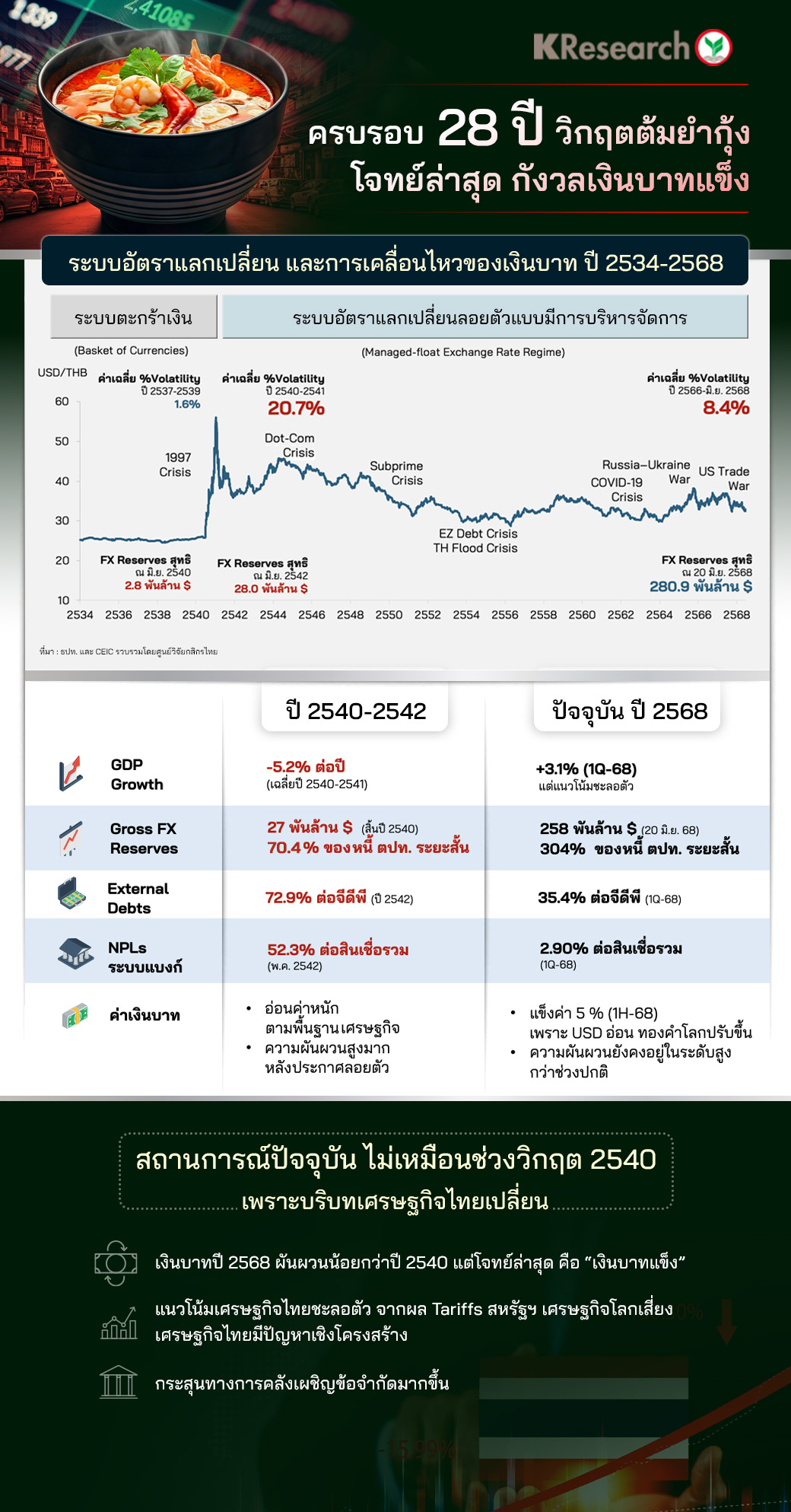
The economic impacts were severe and immediate.
-
GDP contracted by -5.2% annually.
-
Foreign debt soared to 72.9% of GDP.
-
Non-performing loans (NPL) in the banking system reached 52.3%.
-
International reserves dwindled to $27 billion.
At that time, Thailand was like a ship sailing through a storm without a rudder. The economy contracted significantly, confidence was shaken, businesses collapsed, and many people lost their jobs overnight.
The Economy in 2025: Stronger, but Not to Be Underestimated
Looking back at the context in 2025, we find that the overall Thai economic system has clearly improved its resilience. Kasikorn Research Center summarized the differences between the “Tom Yum Kung” crisis and the current situation as follows:
-
International reserves surged to $258 billion, more than three times the short-term foreign debt.
-
Non-performing loans (NPLs) in the banking system stand at only 2.90%.
-
Foreign debt has decreased to 35.4% of GDP.
-
GDP grew by +3.1% in the first quarter of the year.
-
The baht's volatility is lower than during the crisis (8.4% compared to 20.7% in 1997).
The banking system has become stronger, financial institutions have more sophisticated regulatory tools, and the government has tighter risk management mechanisms. The lessons from 1997 are embedded in the DNA of current monetary and fiscal policies.
Three Major Challenges in 2025: Not the Same Crisis, but Not Easy Either
Although the economic fundamentals appear stronger than before, the situation in 2025 is not without challenges, particularly three major issues to confront:
1. Strong Baht — A New Challenge Compounding the Old Crisis
Capital inflows and a rapidly appreciating currency, resulting from the weakening of the US dollar and soaring global gold prices, have caused the baht to strengthen by over 5% in the first half of 2025. While the baht's volatility has decreased, its continuous appreciation is beginning to impact the export sector, which remains a crucial engine for the Thai economy.
2. Weak Global Economy — Thailand Hard to Resist
The Russia-Ukraine war, followed by COVID-19 and the imposition of tariffs by the US, along with the slowdown in the Chinese economy, have affected global demand. As an exporting country, Thailand cannot easily avoid these tremors, compounded by domestic structural issues such as an aging workforce, competitiveness, and delayed infrastructure investments.
3. Limited Fiscal Ammunition — Due to High Public Debt
The government can no longer fully utilize fiscal policy to drive the economy due to the increased public debt level following the COVID-19 crisis, meaning that the available “ammunition” must be used with extreme caution. Any economic stimulus or relief measures are thus constrained by budget limitations and fiscal discipline.
Conclusion: Not the Same Crisis, but Still Not to Be Underestimated
2025 is not a year of crisis like the “Tom Yum Kung,” but that does not mean we are safe. Changes in the global context, politics, and technology force us to face new uncertainties that are more complex and prolonged.
The lessons from 1997 serve as a warning that…
Do not overlook small points that could trigger a storm.
Do not stop building resilience for the economy.
Do not just hope for growth, but aim for sustainable growth.
28 years have passed since the Tom Yum Kung crisis; Thailand is not as weak as before, but we can no longer afford to be complacent.