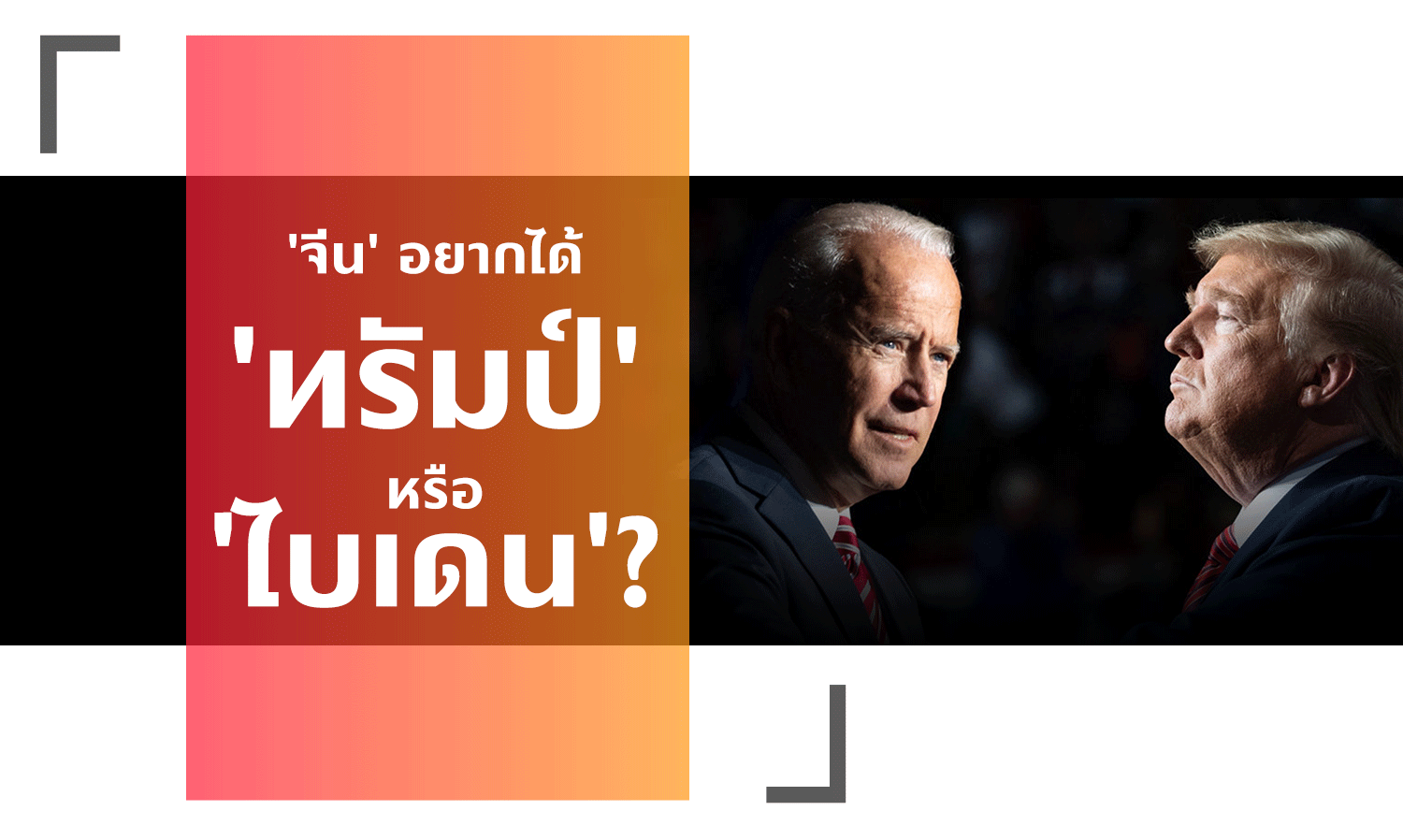
'China' Wants 'Trump' or 'Biden'?
Regardless of whether "Donald Trump" or "Joe Biden" wins the election and becomes the next President of the United States, China and the U.S. will remain significant strategic competitors. It's uncertain who "Xi Jinping" would prefer to win, as it would affect various policies, including trade, but the approaches would differ.
Throughout Trump's four years in office, he has consistently taken a tough stance against China, igniting a trade war, banning Chinese tech companies, and tweeting and speaking about China as a threat. Many feel sympathy for Chinese President Xi Jinping, who has been unfortunate to be in office alongside a bold leader like Trump.
However, it’s possible that deep down, Xi Jinping might prefer Trump to win the election and continue in office, as dealing with Biden could be more challenging than handling Trump.
Trump has caused significant short-term damage to China, but in the long run, he lacks a systematic strategic plan. Trump's way of thinking is that of a merchant skilled in seeking short-term profits, creating waves and shifting unpredictably, but he has made no effort to build a foundation for America's long-term strength. Trump has no policies regarding investment in infrastructure and new technologies, only cutting research and development budgets for American scientists.
If Trump remains in power and China can endure the pain and stop the bleeding in the short term, China might emerge victorious in this new Cold War in the long run.
Strategic warfare suggests that to win, one must have a favorable position, excellent allies, and control over destiny. The U.S. certainly has a favorable position, but during Trump's era, U.S. allies are not as united as before, as Trump has been provoking trade wars with them. The international organizations that Trump once led have seen the U.S. reduce its role across the board, from the World Trade Organization to withdrawing from the World Health Organization.
Previously, it was thought that the U.S. controlled destiny by standing on the side of righteousness, democracy, and human rights. However, during Trump's time, it seems the U.S. could no longer inspire faith or motivation in anyone. Trump himself appears indifferent to democracy or human rights, having praised Putin and Xi Jinping as strong leaders.
However, if Biden becomes president, the U.S. stance will still view China as a threat and a significant strategic competitor, but the approach will be more stable and predictable. The era of the rollercoaster ride dictated by Trump's tweets will come to an end.
In terms of trade, the approach will shift from Trump's unilateral trade war to seeking trade allies to encircle China and establish new international trade rules. It is clear that Biden disagrees with Trump's trade war, as it has harmed the U.S. as well. Therefore, it is highly likely that Biden will revive Obama's TPP concept (which has since been renamed CPTPP after the U.S. withdrawal).
The core idea of TPP is to form a trade bloc with U.S. allies, and since the U.S. is the world's largest consumer market, this trade bloc is significant. The U.S. will set new trade rules through TPP, and one day, China may express interest in negotiating to join TPP. When that day comes, it would mean China would have to bind itself to the global trade rules set by the U.S. The TPP thinking is thus a long-term strategic thought that would keep China within the rules and order of the U.S.
Biden will return to emphasizing international cooperation mechanisms through reforming the World Trade Organization, and he has already announced that on his first day as president, he will bring the U.S. back into the World Health Organization, from which Trump had withdrawn.
Regarding human rights and democratic values, while Trump showed little interest in pressuring China on these issues, for Biden, they will become major topics, whether it’s the detention camps in Xinjiang or the rights violations against protesters in Hong Kong, all of which will become hot issues used to pressure China on the global stage.
In terms of banning Chinese tech companies, Biden will likely adopt a regulatory approach by implementing strict rules regarding data security and systems, but it will not be a ban on U.S. businesses trading with Chinese companies as Trump did.
Biden will likely be open to cooperating with China on issues where both countries have mutual interests, such as climate change and public health.
In other words, Biden's policy towards China will resemble Obama's policy but will be more intense and aggressive. Many say Trump was a turning point in U.S.-China relations, but in reality, the U.S. began to view China as a competitor and a threat during Obama's era. However, Obama publicly told Xi Jinping that the U.S.-China relationship was the most important for global stability and appeared friendly, while behind the scenes, Obama began to strategize to contain and limit China's rise, initiating TPP and pivoting to Asia.
Biden will be a more straightforward Obama; he will not be polite or friendly with China like Obama but will be aggressive and take a tough stance against China, similar to Trump. However, behind the scenes, he will employ long-term strategic methods different from Trump, resembling Obama but more intense.
During the campaign, Biden also took a tough stance against both China and Xi Jinping, aligning with the sentiment in U.S. society. A Pew Research Center survey in March 2020 found that 66% of Americans held negative views of China, the highest since the survey began in 2005, and a 20% increase compared to the early days of Trump's presidency.
The saying that whether it's Trump or Biden, China and the U.S. will never love each other again indicates that they will remain strategic competitors. However, under President Biden, we will see a change in policy approach, focusing on a more systematic long-term strategy, emphasizing the pursuit of alliances to encircle China and returning to the importance of the U.S. role in international organizations and cooperation frameworks, unlike Trump's solitary punches over the past four years.
SOURCE : www.bangkokbiznews.com