Monitoring 'China' Bringing High-Tech Investment to Thailand
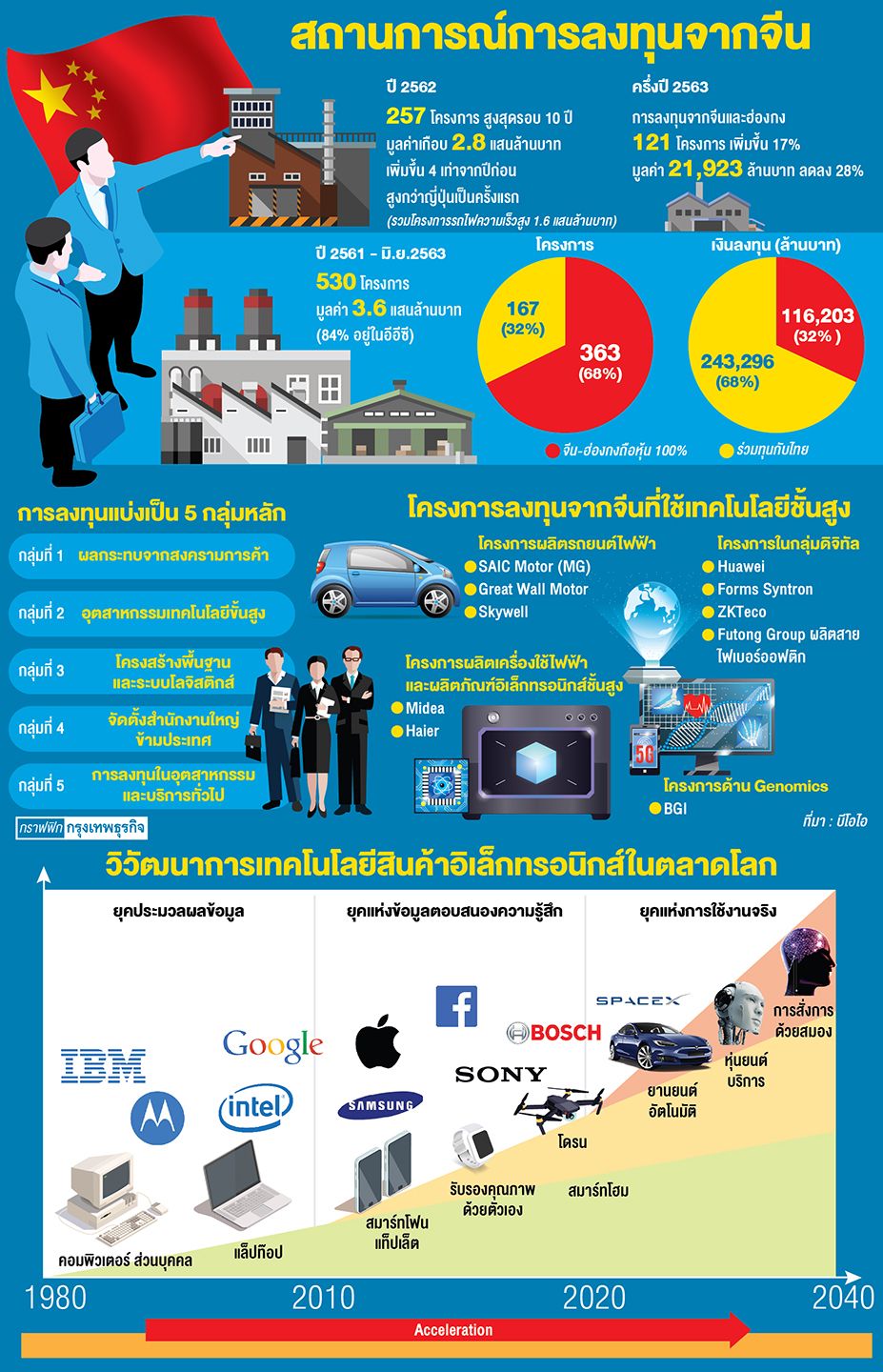
Despite the ongoing severity of COVID-19, in the first half of the year, China and Hong Kong invested in 121 projects in Thailand, an increase of 17% with a value exceeding 21 billion baht. It is expected that after COVID, several large-scale projects from China will invest further, with most Chinese investors being from the high-tech industry.
Mr. Narit Therdsathira, Deputy Secretary-General of the Board of Investment revealed that investment from China plays an increasingly important role in the Thai economy, which previously relied on Japan, the United States, and Europe as primary investors. Chinese investment has rapidly increased over the past decade due to both Thailand's attractive potential and rising production costs in China, along with Chinese government policies encouraging businesses to expand abroad.
Since the trade war intensified in 2018, the relocation of production bases from China and Hong Kong has become significantly noticeable, leading to a substantial increase in Chinese investment. In 2019 alone, there were as many as 257 projects, the highest in the past decade, with a total value of nearly 280 billion baht, more than four times the previous year (including a high-speed rail project worth 160 billion baht), making Chinese investment rank first, surpassing Japan for the first time.
“One strategy that the BOI uses to attract investment from China in the high-tech sector is to first attract major manufacturing companies (Anchor investors), akin to drawing in the mother hen, followed by her chicks, which are the other component manufacturers and suppliers.”
Confidence in Post-COVID Investment Growth
“The BOI is confident that if the COVID situation improves, there will be many large projects ready to invest, particularly in the electrical and electronics industry and the automotive sector.”
Investment trends from China to Thailand are expected to continue expanding, primarily driven by the trade war with the U.S. From the onset of the production base relocation trend in 2018 until June 2020, there were 530 projects from China and Hong Kong valued at 360 billion baht, with 84% of the investment located in the Eastern Economic Corridor (EEC). Among these, 363 projects were 100% owned by Chinese and Hong Kong investors, accounting for 68% of the total, with an investment of 116.203 billion baht, representing 32% of the investment, while 167 projects were joint ventures with Thai partners, making up 32% with an investment of 243.296 billion baht, accounting for 68%.
Investment from China and Hong Kong in recent times can be divided into five main groups: Group 1 involves the relocation of production bases in industries affected by the trade war, primarily exporting to the U.S. and Europe, such as the automotive tire industry with 7 projects valued at 44 billion baht, electrical appliances and electronics with 66 projects worth over 20 billion baht, and light industries (textiles, furniture, bags, sports equipment, jewelry) with 57 projects valued at 14 billion baht.
Group 2 focuses on investment in high-tech industries, which may not have high values but will greatly benefit Thailand in the future, including digital projects with 56 projects and an investment of 7 billion baht, medical projects with 9 projects and an investment of 814 million baht, biotechnology with 3 projects and an investment of 680 million baht, and robotics and automation with 3 projects and an investment of 94 million baht. Group 3 involves investment in infrastructure and logistics systems, such as high-speed rail projects with an investment of 160 billion baht, maritime transport with 5 projects worth 3.6 billion baht, distribution centers with 4 projects worth 760 million baht, and renewable energy projects with 17 projects valued at 1.2 billion baht.
Group 4 includes investments to establish regional headquarters, international trading companies, and trade and investment support businesses, totaling 44 projects with an investment of 1.1 billion baht. This group is also significant as it collaborates with Thailand to serve as a base for investment expansion and trade in the region. Group 5 involves investment in general industries and services to supply the domestic market and for export, such as steel and metal products with 69 projects valued at 51 billion baht, automotive and parts with 24 projects worth 12 billion baht, chemicals and plastics with 49 projects valued at over 10 billion baht, and agricultural and food industries, such as natural rubber products, processed food, agricultural product quality sorting, and natural raw material extraction with 42 projects valued at 6.9 billion baht, as well as tourism industries like hotels and cruise ships with 6 projects valued at 5.3 billion baht.
Announcing Major Businesses Entering Thailand
Mr. Narit stated that among the interesting high-tech investment projects from China, which are also target industries for Thailand, are the electric vehicle production projects from SAIC Motor (MG), Great Wall Motor, and Skywell, as well as high-tech electrical appliances and electronics projects from Midea and Haier. In the digital sector, Huawei has recently been promoted with Huawei Academy training in 5G, AI, and modern digital innovation, along with Forms Syntron developing platforms for financial businesses, ZKTeco developing biometric verification systems, Futong Group producing fiber optic cables, and BGI producing gene sequencing technology.
However, China and Hong Kong possess many strengths, with interesting technologies and innovations in areas such as Smart Electronics, electric vehicles, autonomous vehicles, robotics and automation, digital technology, particularly 5G - AI, smart city systems, biotechnology, as well as medical and genomics technologies. This group has begun to invest more in Thailand, and as Chinese investors recognize Thailand's potential and the progress of developing various ecosystems to support high-tech industries, especially projects in the EEC area such as EECi, Digital Park, aviation city, medical promotion zones, and smart cities, it is believed that high-tech groups will show increased interest in investing in Thailand in the future.
“During and after COVID, the BOI's main target will be in Asia, particularly China and Hong Kong, which will be important target countries. Attracting investment from the relocation of production bases will be a crucial mission for the BOI and will significantly impact Thailand's post-COVID economic recovery, as China's economy is recovering and strengthening ahead of other countries. It is anticipated that after COVID, investment from China and Hong Kong will have many opportunities to increase.”
Thailand is well-suited to be a hub for investment from China and Hong Kong, with competitive advantages in several areas, such as a conducive business environment, good relations with China and other countries, a central location in the region that connects to high-growth markets in CLMV, and high-quality infrastructure, particularly in the EEC area, which is a key industrial zone that attracts significant interest from Chinese investors. Additionally, Thailand has a comprehensive supply chain, a highly skilled workforce, and attractive incentives from the BOI. Furthermore, Thailand has recently been recognized internationally for its high capability in managing public health effectively, allowing it to control the spread of the virus at low levels, reflecting its status as a secure and low-risk country suitable for long-term investment.
EEC Office Offers Investment Support Packages
Mr. Kanit Sangsuphan, Secretary-General of the Eastern Economic Corridor Policy Committee (EEC Office) stated that the Eastern Economic Corridor Act of 2019 empowers the Eastern Economic Corridor Policy Committee (EEC) to grant additional benefits as deemed appropriate, even if these businesses are not listed in the BOI's agenda. The EEC Office will discuss with the BOI to consider incentives to attract investment into the Eastern Economic Corridor (EEC) together with the BOI to avoid duplication.
The EEC Office has consulted with Thai ambassadors in 20-30 countries to request their assistance in attracting investments from companies in target industries, particularly those with technologies that Thailand seeks to attract to invest more in the EEC, such as businesses related to 5G technology, logistics, medical and healthcare, urban development, and businesses utilizing advanced technologies. If any foreign companies that Thailand wishes to attract for investment are identified, special incentives will be considered, and the names of the desired companies will be sent to ambassadors for coordination, along with a note that the EEC will assist in designing the incentives.
SOURCE: www.bangkokbiznews.com