Thai Export Council Predicts Continued Decline in Exports, Urges Government to Increase Financial Assistance Measures

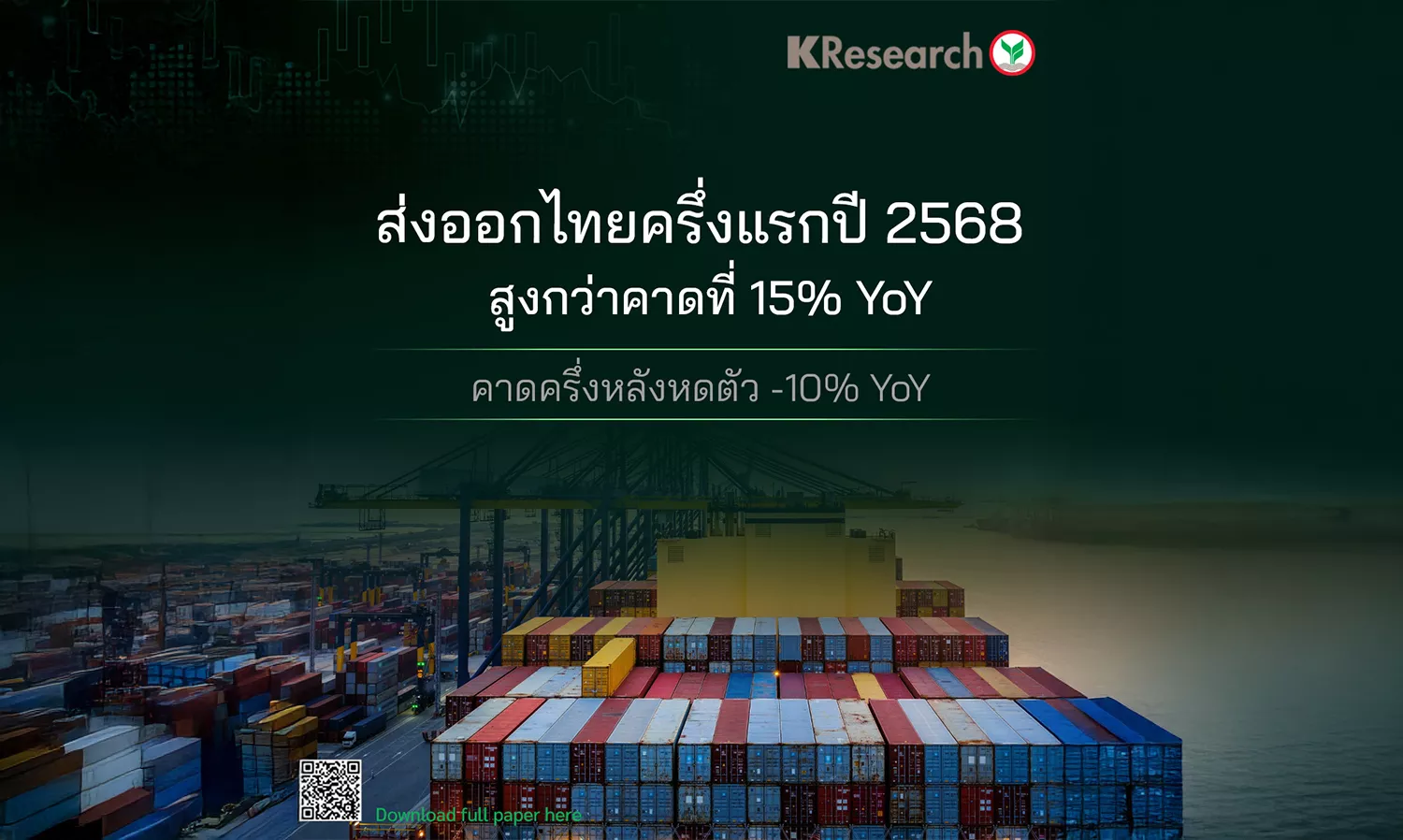
Ms. Kanya Phak Tanti Pipatnapong, President of the Thai National Shippers' Council (TNSC) stated that the TNSC expects Thai exports in 2020 to contract by -10% due to risks stemming from the ongoing global COVID-19 pandemic, which remains severe, and the potential for new outbreaks in various countries leading to continued lockdown measures.
Additionally, the global economy and trade have not recovered sufficiently, impacting purchasing power across countries worldwide. There is also a need to monitor international conflicts, such as between the United States and China, which have announced retaliatory policies against each other. Oil prices remain low compared to 2019 due to demand pressures from the COVID-19 situation, while the Thai baht is expected to weaken but still falls short of exporters' expectations of 34 baht per US dollar. Furthermore, businesses are facing liquidity issues, resulting in delayed payments and a need for access to credit lines to maintain their liquidity. Logistics challenges persist, with limited air freight capacity and rising maritime shipping costs.
In June 2020, exports totaled 16.444 billion USD, representing a decline of -23.17% compared to the same month last year (YoY). In Thai baht, exports amounted to 520.608 billion baht, down -23.06% YoY. Meanwhile, imports in June 2020 were valued at 14.833 billion USD, a decrease of -18.05% YoY, and imports in Thai baht totaled 475.986 billion baht, down -17.94% YoY, resulting in a trade surplus of 1.610 billion USD and 44.621 billion baht for June 2020 (excluding gold, oil, and military equipment, exports contracted by -17.20%).
June Exports Overview
Agricultural and agro-industrial products contracted by -9.9% YoY, with notable growth in fresh, frozen, canned, and processed fruits and vegetables, canned and processed seafood, fresh, chilled, frozen, and processed chicken, and pet food.
However, products that saw a decline included rice, rubber, cassava products, and granulated sugar. In the industrial sector, exports contracted by -25% YoY, with growth in semiconductor devices, transistors, diodes, computers, equipment and components, rubber products, furniture, and parts, while declines were noted in jewelry and ornaments (excluding gold), automobiles, equipment and components, oil-related products, and gold.
Overall, from January to June 2020, Thailand's total exports were valued at 114.342 billion USD, a contraction of -7.09% YoY, equivalent to 3.562 trillion baht, down -8.29% YoY. Imports were valued at 103.642 billion USD, a decrease of -12.62% YoY, or 3.269 trillion baht, down -13.94% YoY, resulting in a trade surplus of 10.700 billion USD and 293.152 billion baht from January to June 2020 (excluding gold and oil, exports contracted by -8.35%).
Nevertheless, the Thai National Shippers' Council urges the government to expedite financial relief measures for private sectors affected by COVID-19. They propose that the Small Industry Credit Guarantee Corporation (SICGC) increase guarantees for private sector loans from commercial banks on a company-by-company basis, maintain the exchange rate stability of the baht at 34 baht/USD, ease commercial bank loan policies (soft loans), and extend the duration of the loan decree to five years.