'COVID' Awakens the Second-Hand Housing Market, Pushing New Builds to 'Win or Lose' Based on Location!
Amidst the crisis, the second-hand housing market has transformed into an 'opportunity', where certain types of properties are priced similarly to new projects that have adjusted prices downward to clear stock. However, the key selling points of the second-hand housing market are 'location' and 'size', which cater to the new lifestyle needs.
Although the real estate market is experiencing a downturn after facing COVID-19, the second-hand housing market has emerged as an 'opportunity'. Some types of properties are priced similarly to new projects that have lowered their prices to clear stock. The key selling points of the second-hand housing market are 'location' and 'size', which meet the new lifestyle needs to ensure safety from infection, acting as a 'catalyst' for the growth of the second-hand housing market.
Sumitra Wongphakdee, Managing Director of Terra Media and Consulting Co., Ltd. stated that from the website Terra BKK, it was found that the index of second-hand housing prices in 2020 compared to 2019 remained 'stable', after years of average increases of 3-5% annually, due to the first-hand prices not increasing and being reduced to clear stock, especially for second-hand condominiums. This has resulted in the index of second-hand housing prices remaining stable this year, while the behavior of 'searching' for second-hand housing has increased, partly due to the greater supply.
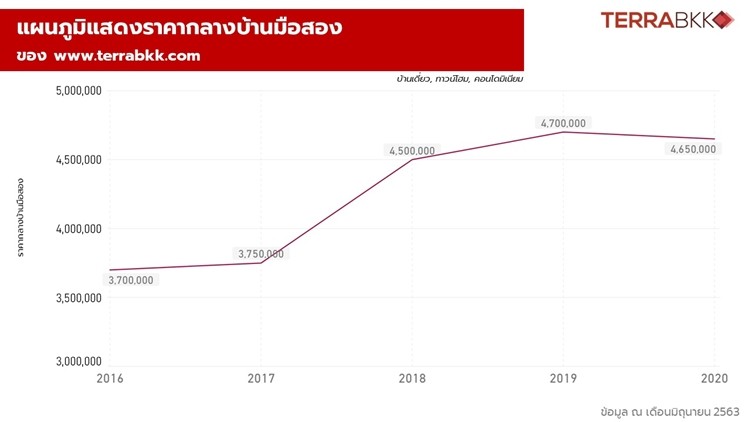
“From experience, the sales rate of second-hand houses tends to follow the sales figures of first-hand houses. If first-hand house prices rise, second-hand prices rise too; if first-hand prices fall, second-hand prices fall. According to data from the Real Estate Information Center, the transfer of ownership of second-hand houses compared between Q1 2019 and Q1 2020 showed that the number of units transferred did not drop, while first-hand house figures fell by 6.5%.”
Sumitra also mentioned that the stable prices have allowed the second-hand housing market to continue growing this year, which is the nature of second-hand housing that is a 'nature demand' that arises with economic cycles, differing from the real demand for actual living. The increase in the number of properties aligns with the first-hand market; as first-hand supply increases, second-hand supply follows. This means that the second-hand market is not stagnant compared to the declining new projects, but it does not imply that the increase in supply is solely due to owners facing financial issues.
In the second-hand housing market, there are condominiums, townhomes, and high-end houses, with many properties circulating into the second-hand system daily. Even if a property is transferred and occupied for only a few days, or if the owner changes their mind before moving in and decides to sell, it is still considered second-hand housing.
Currently, the average price of second-hand condominiums is about 17% lower than first-hand condominiums, indicating that the price difference is not significant. In comparison, second-hand townhomes are 27% lower than first-hand townhomes, and single houses are 30% lower, making the second-hand market for townhomes and single houses perform well. Meanwhile, second-hand condominiums must compete with first-hand ones, as their prices should be approximately 25% lower in the same location.
“These figures serve as an indicator showing that second-hand condominiums have not been adversely affected by COVID. If the location of a second-hand condominium is better than that of a first-hand one, the price does not necessarily need to be significantly reduced, as buyers may not perceive purchasing a second-hand condominium as buying something old. Some projects are well-maintained, and ultimately, it comes down to the choice of location.”

Sumitra further stated that in the long term, second-hand condominiums still hold potential for investment, as their prices are closely approaching those of first-hand condominiums. For example, second-hand condominiums are only 17% lower than first-hand ones, while first-hand condominiums currently offer discounts of 10%. In the case of a 3 million baht condominium, a discount of 300,000 baht is provided, leaving a price difference of about 7%. Therefore, competition will focus on location, emphasizing that if a new condominium project has a 'poor' location and inadequate amenities, it may not meet buyers' needs compared to a second-hand condominium with a better location and superior amenities. This could easily lead to losing customers to second-hand condominiums, especially among investors looking to buy for rental or speculative purposes.
Additionally, a significant factor driving the second-hand housing market to become a 'rising star' is the new normal in consumer behavior post-COVID, which has led to increased popularity for second-hand properties due to social distancing. Particularly in Bangkok, the market is expected to grow as land availability is limited, and people remain concerned about travel due to the need for social distancing. Previously, it was thought that traveling by electric train was convenient for finding housing in the outskirts, but now there are growing concerns about using public transport, leading people to reconsider locations closer to home and work to reduce the risk of infection. For instance, in Sukhumvit 24, no new projects are emerging, but there is a desire to expand workspaces by purchasing additional units in the same building, making second-hand condominiums increasingly desirable post-COVID.
“It’s about maintaining distance from others, not from family, which leads people to seek second-hand housing in familiar locations. This has resulted in a trend of purchasing second-hand condominiums or houses for renovation instead. This is evident from the increased foot traffic in community malls, while large department stores with high foot traffic see fewer visitors due to lingering safety concerns.”
Thank you for the information from www.bangkokbiznews.com