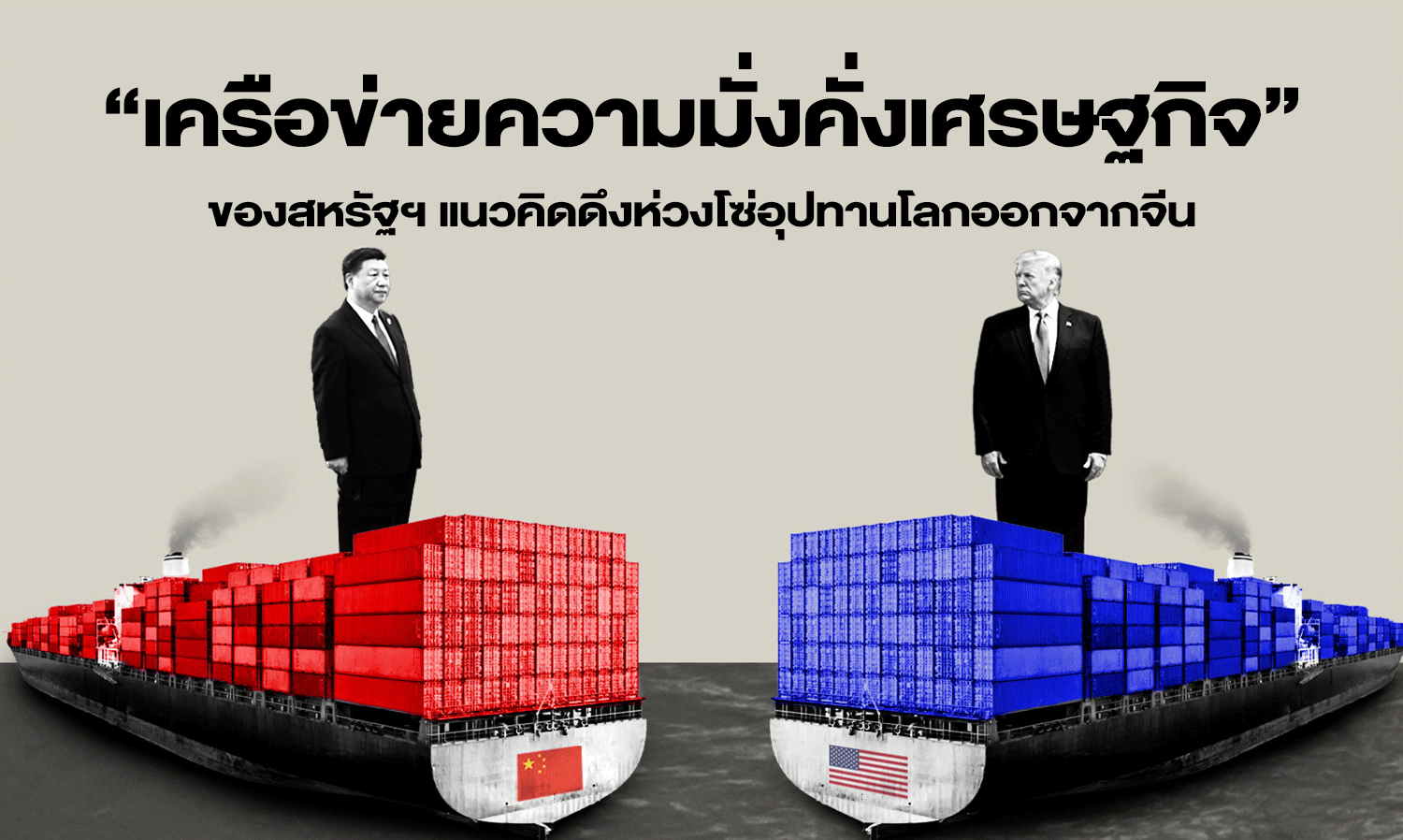
"Economic Prosperity Network" of the U.S.: A Concept to Shift Global Supply Chains Away from China
Reuters reports that the Donald Trump administration is accelerating efforts to move global manufacturing supply chains away from China. The deaths of Americans due to the COVID-19 pandemic and the resulting economic damage have become a driving force to relocate U.S. production and reduce dependence on Chinese supply chains by shifting manufacturing to friendlier countries.
U.S. officials told Reuters that the COVID-19 pandemic has raised concerns among people about doing business with China. Previously, the focus was primarily on the financial gains from business with China, but now economic damage has become a more pressing issue.
According to asia.nikkei.com, the Japanese government allocated a budget of about 240 billion yen, or $2.2 billion, in 2020 to subsidize Japanese companies that will change their manufacturing supply chains. Prime Minister Shinzo Abe stated that this budget supports investments that will strengthen domestic production in Japan. If production can be done within the country and has high value, it will be moved to Japan. If the products are produced in multiple locations and have lower value, they will be moved to ASEAN countries.
Economic Prosperity Network
Reuters also reports that the U.S. is pushing to create a coalition of partners who trust each other, called the “Economic Prosperity Network.” This group will consist of businesses and civil society organizations operating under the same standards in areas such as digital business, energy, infrastructure, research, trade, and education. The U.S. is working with Australia, India, Japan, New Zealand, South Korea, and Vietnam on this initiative.
An article titled The Great Decoupling from foreignpolicy.com states that even before the COVID-19 pandemic, hawkish elements within the Trump administration believed that decoupling the U.S. economy from China, which has been in place for 40 years, and reducing dependence on China for manufacturing and investment was the final step in the trade war between the U.S. and China.
Members of Congress and U.S. officials are taking steps to sever the economic ties between the two largest economies, such as expanding bans on sensitive exports, increasing tariffs on Chinese goods, pressuring American companies to bring manufacturing back to the U.S., or even withdrawing from the World Trade Organization (WTO), which is seen as benefiting China in expanding its economic reach.
The critical question is how far the U.S. can decouple its economy from China. During trade tensions with China, Donald Trump once told Fox News, "We can sever all ties." If U.S.-China relations develop as Trump suggested, a division into two camps reminiscent of the Cold War could occur.
Meanwhile, China is beginning to establish its own economic sphere of influence, such as the Belt and Road Initiative, which connects the Chinese economy with Asia, Africa, and parts of Europe. At the same time, both China and the U.S. are developing technologies that will drive the future economy, particularly in mobile communication and the internet.
The U.S. concept of the “Economic Prosperity Network,” which aims to create alliances with like-minded countries, partially seeks to encourage American companies to withdraw from China. If they cannot relocate production and jobs back to the U.S., at least they can move to friendlier countries like Vietnam or India.
The Meaning of “Decoupling”
After the COVID-19 pandemic, the U.S. government has increasingly limited economic relations with China. In May, the U.S. directed the Federal Retirement Thrift Investment Board, which manages hundreds of billions of dollars, to cease investments in Chinese companies and prohibited Huawei from using U.S. technology to design or produce semiconductor chips, while also revoking trade privileges for Hong Kong.
Decoupling can have various meanings, such as reducing U.S. risks to lessen dependence on China, finding ways to leverage China's need for U.S. technology, or withdrawing from the WTO. However, translating these ideas into effective policies requires significant technical knowledge.
Currently, both the U.S. government and the private sector lack such knowledge. Implementing decoupling policies amid this uncertainty risks causing damage to both the U.S. and China.
An article from foreignaffairs.com states that decoupling economic relations with China will also impact other countries globally. For instance, banning Huawei from accessing U.S. technology may encourage foreign companies to design supply chains that rely on non-U.S. technology. Therefore, instead of decoupling economically, the U.S. should consider the opposite approach, or recoupling, which involves managing supply chains to mitigate risks of accidents or attacks.
The foreignaffairs.com article points out that decoupling complex economic relationships is akin to performing a complicated surgery. Before proceeding, one must know where the patient's vital organs are located.
U.S. officials are beginning to discover that the Chinese economy is not an isolated organ from the global economy but rather a twin to the global economy, interconnected with the nervous system or blood circulation of the global economy.
However, the COVID-19 pandemic has highlighted the vulnerabilities and hidden risks of interconnected supply chains, particularly in the production of sanitary products. The tensions between the U.S. and China have also revealed hidden weaknesses in the high-tech sector. Decoupling supply chains may lead to unexpected outcomes. Thus, what is more necessary and important is to ensure that supply chains are resilient enough to handle future crises.
Economists from the University of Cambridge have studied the “Supply Chain Bottlenecks in Pandemic”, stating that goods and services reach consumers through supply chains, but disruptions can occur at each stage, causing operations to come to a halt, similar to a water pipeline that can stop the flow of water. Production chains also have what are called “bottleneck firms”; if the production of such firms halts, it will impact the entire production system.
Supply chain relationships with bottleneck production systems need to adapt, but this adaptation is not about “decoupling” but rather about establishing systems to reduce risks during crises, ensuring that supply chains are sustainable and balanced between efficiency and risk, which may involve reducing dependence on a single primary producer while promoting new producers.
References:
The Great Decoupling, May 14, 2020, foreignpolicy.com
The Folly of Decoupling from China, June 3, 2020, foreignaffairs.com
Supply Chain Bottlenecks in a Pandemic, covid.econ.cam.ac.uk
SOURCE: www.thaipublica.org