Covid-19's Impact on the Construction Industry: A Chain Reaction
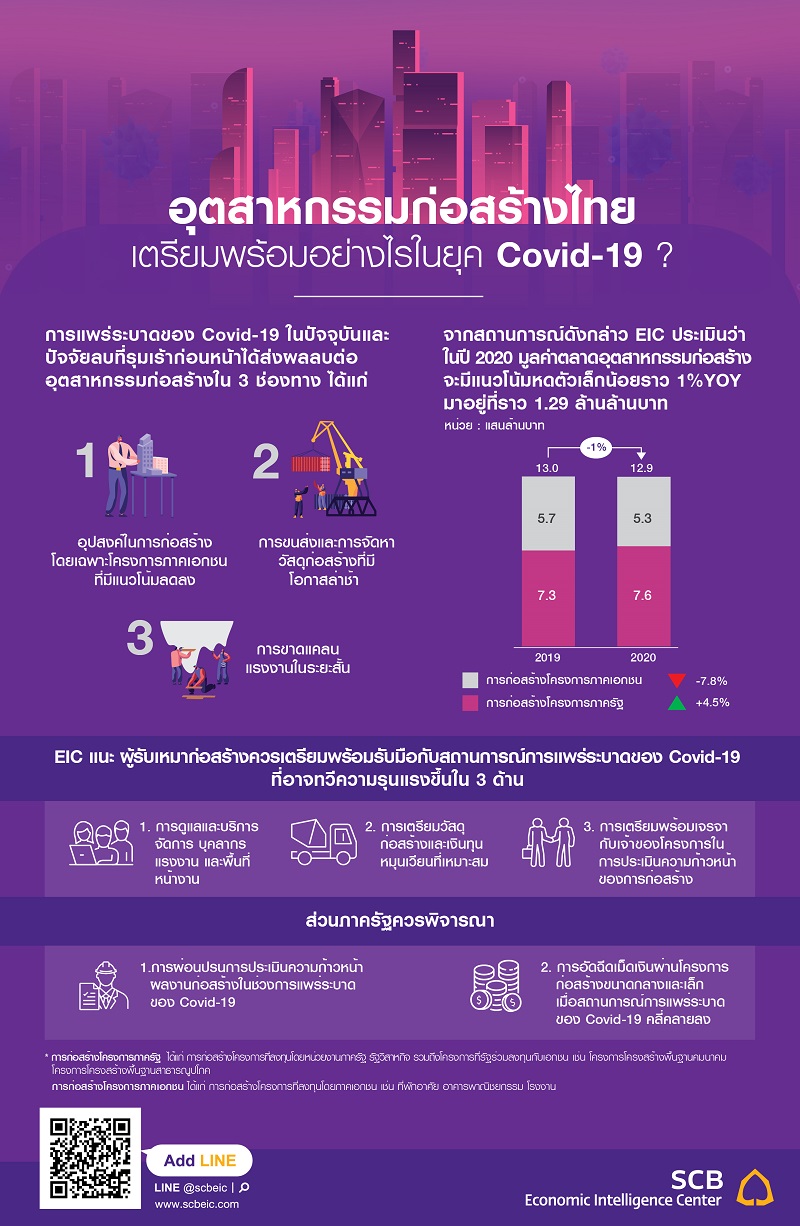
The current outbreak of Covid-19 and the preceding negative factors have affected the construction industry in three ways: a decrease in construction demand, particularly in private sector projects; delays in transportation and supply of construction materials; and a short-term labor shortage.
This is reflected in the construction permit data from the Real Estate Information Center of the Government Housing Bank, which shows that in the second half of 2019, the issuance of condominium construction permits decreased by about 37% YOY, dropping to 1.29 million square meters, and in January 2020, it fell by 70% YOY to 72,000 square meters.
Meanwhile, the issuance of construction permits for single-family homes and duplexes decreased by 4% YOY, down to about 12.6 million square meters, and in January 2020, it decreased by 3% YOY to about 2 million square meters.
Commercial and office buildings saw a 26% YOY decrease in construction permits, down to 3.05 million square meters, while in January 2020, it decreased by 28% YOY to 437,000 square meters.
The issuance of construction permits for rental office buildings decreased by about 26% YOY, down to 560,000 square meters, and in January 2020, it dropped by about 83% YOY to 59,000 square meters, showing a downward trend.
The Covid-19 outbreak has caused both domestic and international economies to slow down, leading to a contraction in factory investments and construction. However, the issuance of factory construction permits in January 2020 in some areas, such as Chonburi in the eastern region, still showed growth, increasing by 117% YOY to 131,000 square meters. In the future, as the Covid-19 outbreak subsides, the relocation of production bases from abroad, particularly from China to Thailand to mitigate business risks, is a positive factor for new industrial construction that should be monitored.
The Economic Intelligence Center (EIC) estimates that the market value of the construction industry in 2020 will likely contract slightly by about 1% YOY, down to approximately 1.29 trillion baht. This is divided into: 1. Public sector construction projects, which are expected to grow by about 4.5% YOY to 762 billion baht, and 2. Private sector construction projects, which are expected to contract by about 7.8% YOY to 528 billion baht. The EIC estimates that most public sector projects can still proceed, such as the Orange Line, Yellow Line, Pink Line, high-speed rail from Bangkok to Nakhon Ratchasima, and the motorway from Bang Yai to Kanchanaburi.
The EIC also recommends that construction contractors prepare to handle the Covid-19 outbreak, which may intensify, in three areas:
1. Managing personnel, labor, and worksite areas.
2. Preparing appropriate construction materials and working capital.
3. Being ready to negotiate with project owners to assess construction progress to reach conclusions that reduce disputes from contracts.
For the government, measures to assist the construction industry, particularly in terms of labor, are considered appropriate, such as increasing the hiring of construction workers in various areas by government agencies and relaxing regulations to allow foreign workers to stay in the kingdom longer temporarily.
In the near future, the EIC believes that the government should consider additional measures, particularly: 1. Evaluating construction performance that may have been delayed during the Covid-19 outbreak, and 2. Injecting funds through additional medium and small construction projects beyond those included in the emergency loan bill for economic recovery and management.
Source: Economic Intelligence Center (EIC)