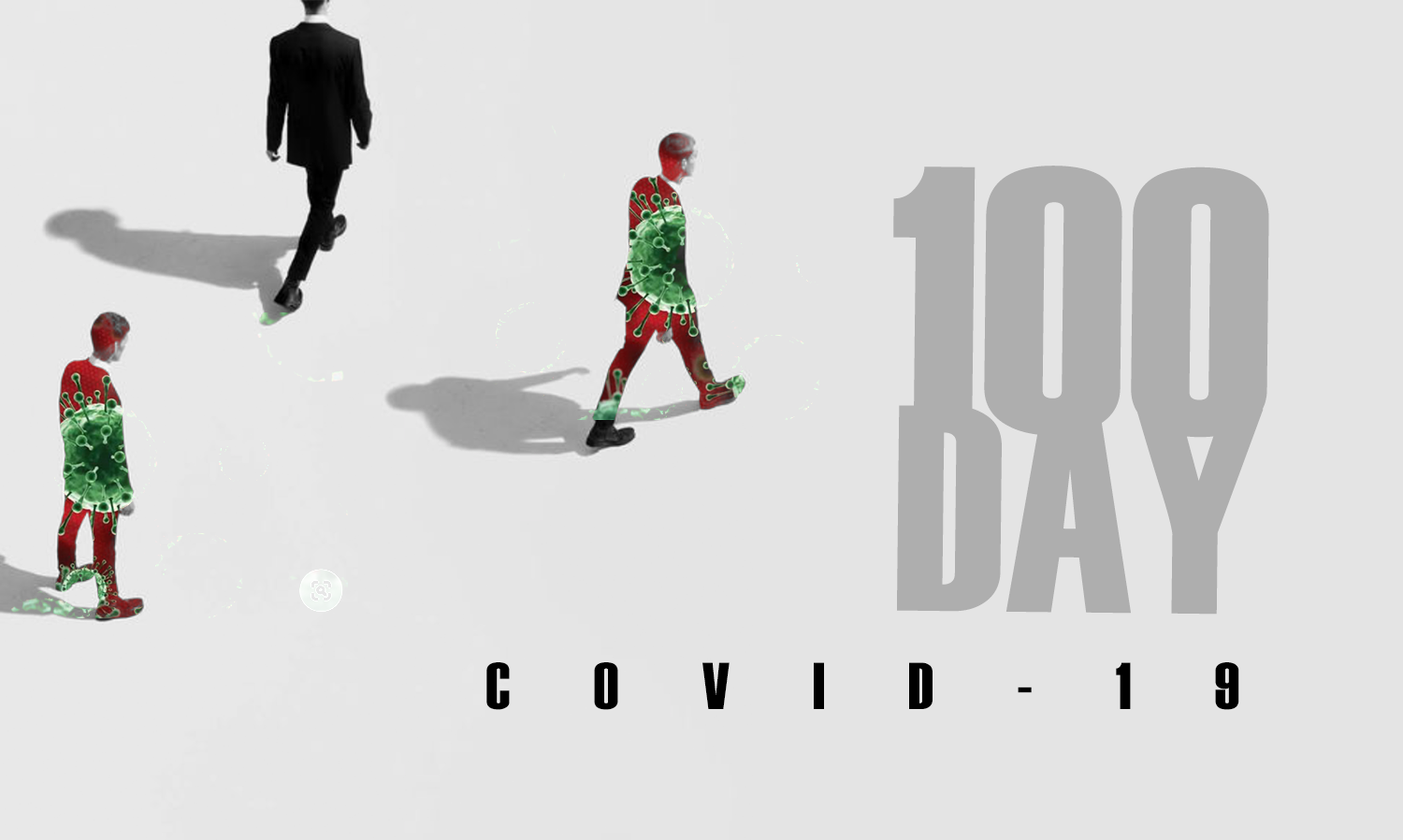
100 Days of COVID-19: What the World Has Endured
As the world prepares to celebrate the arrival of a new decade, having passed through a decade filled with numerous events, including natural disasters like earthquakes, volcanic eruptions, and tsunamis, as well as human-related events such as Brexit, the civil war in Syria, the refugee crisis, the rise of social media, and nationalism, one event occurred that would forever change the face of the new decade.
At 1:38 PM on December 31, 2019, the Chinese government website announced the detection of a "pneumonia of unknown origin" in the vicinity of the Huanan Seafood Wholesale Market in Wuhan, an industrial city with a population of about 11 million.
This disease was one of the illnesses confirmed by the World Health Organization in December, which also included reports of Ebola cases in West Africa, measles in the Pacific region, and dengue fever in Afghanistan. Apart from China, hardly anyone noticed this disease before, but within 100 days, it severely impacted the world. Travel came to a halt, economic activities were damaged, and over 1.6 million people were infected, including members of the British royal family, national leaders, politicians, and famous actors, with more than 95,000 fatalities.
Date 1
Wednesday, January 1
Closure of Wuhan Seafood Wholesale Market
Normally, this market would be bustling with customers all day, but on this morning, police erected metal barriers to block access to the market and ordered shop owners to temporarily close their businesses. Officials in protective gear collected samples from various areas and placed them in sealed plastic bags. Chinese social media users began discussing the issue after medical documents warning of severe cases at hospitals in Wuhan were shared online. Meanwhile, Taiwan began monitoring this anomaly and announced surveillance measures, requiring passengers on direct flights from Wuhan to undergo checks for fever before entering the airport. Within two days, Singapore and Hong Kong also began screening travelers from Wuhan. In Wuhan, eight hospital officials were accused of spreading rumors about the outbreak and were summoned to the Public Security Bureau. One of them was Dr. Li Wenliang, an ophthalmologist who shared information about the virus analysis he believed to be SARS in a chat group, while the "YY" application for live streaming began censoring messages such as "Wuhan pneumonia" and "Wuhan seafood market."
Date 9
Thursday, January 9
Discovery of a new strain of coronavirus
Chinese scientists revealed that patients in Wuhan were infected with a previously unknown coronavirus, and the night before, a 61-year-old man who died in a Wuhan hospital was the first fatality. This discovery allowed doctors to rule out patients believed to be infected with the virus but found to have ordinary pneumonia, and no new cases were reported for four days. However, this news did not attract much attention as a plane crash in Iran, which resulted in many fatalities, was believed to be caused by technical issues, and photos and videos circulated online raised suspicions that the plane might have been shot down. Later studies indicated that the outbreak caused the number of patients to double every week, and on January 10, Dr. Li Wenliang began showing symptoms.
Date 13
Monday, January 13
Thailand reports its first confirmed case
After the Wuhan authorities confirmed the latest virus infection over a week ago, nothing had happened since the city held its annual meeting between local Communist Party members and the central government. Thai authorities reported the first confirmed case, a 61-year-old man from Wuhan who was found to have a high fever after passing through a thermal scanner at the airport. The "Nervtag" infectious disease expert committee met in London to discuss this virus and concluded that the risk of an outbreak in the UK was very low, but they prepared for testing and monitoring. The Chinese government stated that there was still no clear evidence of human-to-human transmission, despite the discovery of infected medical personnel, while the World Health Organization expressed confidence in China's management. However, doctors in Wuhan faced a different situation, as in the following days, several hospitals in the city had to cope with a significant increase in patients, especially in cases unrelated to the seafood market.
Date 20
Monday, January 20
Confirmation of human-to-human transmission
Dr. Zhong Nanshan, a renowned respiratory expert in China, announced on television that two initial cases were found in Guangdong province that were not directly linked to Wuhan, confirming human-to-human transmission.
Later on Friday, four new infections were reported, and on Sunday, an additional 139 cases were found. The following day, cases were reported in Beijing and Shanghai, with the virus spreading internationally to Japan, South Korea, and the United States after a 35-year-old man who had recently returned from Wuhan visited a clinic in Washington state with a cough and high fever, becoming the first confirmed case in the country. Two days prior, President Donald Trump had attended a briefing on this virus, and by 6:00 AM today, over 100 COVID-19 patients were waiting to see doctors at the Xiahe Hospital in Wuhan.
Date 24
Friday, January 24
Virus reaches Europe
Before the Lunar New Year holiday, when millions of people would travel home, Wuhan announced a city lockdown. Most transportation services in and out of the city were canceled, with over 800 confirmed infections and 25 deaths, putting immense pressure on hospitals and medical staff. The entire population was ordered to stay at home. The virus reached Europe, with three Chinese individuals traveling to France testing positive. Officials stated they were tracing dozens of individuals who had close contact with the three. French Health Minister Agnès Buzyn said, "We must manage the outbreak like firefighting." Two days prior, at the Davos meeting, the US president was asked if he was concerned about the outbreak, to which he replied, "Not at all, and we can control it very well." On January 25, China expanded the lockdown measures to cover a population of 56 million. President Xi Jinping stated that the country was facing a concerning situation, and Dr. Liang Wudong, a physician at Xinhua Hospital in Hubei province, became the first doctor to die.
Date 31
Friday, January 31
The outbreak sets new records on Brexit day
The United Kingdom officially withdrew from the European Union at 11 PM on January 31, entering a transition period where both sides must negotiate post-Brexit cooperation on trade and security. Prime Minister Boris Johnson declared it the beginning of a new era for England. This day also marked the point when COVID-19 infections surpassed those of SARS, with the first confirmed cases reported in the UK, Italy, and Spain. Italian Health Minister Roberto Speranza stated that there was no need to panic, as everything was under control. No deaths had yet been reported outside of China, which had already seen 258 fatalities and over 11,000 infections, while US authorities announced a ban on foreign nationals who had traveled to China.
Date 35
Tuesday, February 4
First death outside China
As China reported over 20,000 infections and 425 deaths, a resident of Wuhan who had severe pneumonia the previous week died in a hospital in Manila, Philippines, marking the first death outside of China. Philippine authorities announced a travel ban from China. The WHO director stated that the outbreak abroad remained low and slow, although it could become severe, but there was no need to halt trade and travel. Dr. Li Wenliang's condition worsened, and news of his illness sparked significant discontent across China. On February 5, the US Centers for Disease Control and Prevention (CDC) began distributing coronavirus test kits nationwide, but they were found to be ineffective. In March, the US began testing 1,200 people per day, while South Korea and Germany tested over 12,000 people daily. In the following days, Trump stated during a speech that the outbreak would end soon, by April, because theoretically, when the weather warms up, the virus would disappear.
Date 50
Wednesday, February 19
Religious cult in South Korea raises concerns
By February 18, South Korea had only reported 30 cases, but the 31st case raised significant concerns among officials. A 61-year-old woman, a member of the "Shincheonji" church, evaded testing and treatment while participating in rituals with other members and engaging in activities such as buffet dining at a hotel. Officials believe she may have infected over 1,160 people. Iran reported its first two cases in Qom.
In Milan, during a Champions League match, Atalanta defeated Valencia from Spain 4-1, with tens of thousands of spectators in attendance at the San Siro stadium, including thousands of Spanish fans.
In Las Vegas, the Democrats held the ninth debate for the presidential nomination between Michael Bloomberg and Elizabeth Warren, with no mention of the coronavirus.
Date 56
Tuesday, February 25
The virus takes over the world
The number of global virus infections exceeded 80,000, and for the first time, the number of infections outside China surpassed those within China.
Italy reported its first death four days ago, and today the total rose to 11. Over 50,000 people in northern Italy were under lockdown measures, marking the first such action in Europe.
The death toll in Iran was the highest outside China, with at least 12 confirmed deaths and an estimated 50 more in Qom. Today, Deputy Health Minister Iraj Harirchi announced that he had tested positive for the virus, despite previously stating that the outbreak was under control.
Meanwhile, the US reported its 14th confirmed case, and Trump tweeted that the coronavirus was largely under control in the US, leading to a rebound in the stock market.
Date 66
Friday, March 6
Italy enters crisis; UK reports its first death
The death toll in Italy increased sixfold within six days, surpassing 230, while daily cases rose by over 1,200. Authorities in Rome ordered school closures, canceled Serie A football matches, and prepared to announce a lockdown in Lombardy.
Prime Minister Giuseppe Conte stated that the healthcare system might not cope, and problems could arise if the crisis continued. The UK reported its first death, a woman in her 70s, and the Prime Minister's office announced that the virus was likely to spread more severely. Three days prior, Boris Johnson stated in a press conference that he was still shaking hands with everyone when visiting a hospital with COVID-19 patients days earlier.
Date 71
Wednesday, March 11
WHO declares COVID-19 a pandemic
Trump announced that the government was implementing the most decisive and comprehensive measures in modern history to confront the virus, as the number of infections in the US surpassed 1,000 and the global total reached 116,000. The stock markets in the US and UK plummeted to their lowest since the 2008 financial crisis due to the virus outbreak and the oil war between Russia and Saudi Arabia. The death toll in Italy increased by 168 in a single day, the highest recorded globally. Online, images of an Italian nurse collapsed on a desk circulated, while the Italian Prime Minister stated that the country was facing its darkest hour. WHO declared COVID-19 a global pandemic.
Date 77
Tuesday, March 17
People worldwide begin to self-isolate
French President Emmanuel Macron stated, "We are at war," as countries across Europe began announcing travel bans across borders and continents. The death toll in Italy exceeded 450 per day, while Spain saw daily infections rise by over 17,000 that week. More than three-quarters of COVID-19 deaths were Europeans. Australians living abroad were urged by the government to return home as soon as possible. France banned cycling, and over 40 million people in California were advised to stay home. The UK Prime Minister's office announced a "herd immunity" strategy after estimates suggested COVID-19 could lead to over 500,000 deaths in the UK and collapse the healthcare system. In Burkina Faso, the Deputy Speaker of the House of Representatives died from COVID-19, with over 1,000 infections reported in Africa.
Date 83
Monday, March 23
UK announces lockdown
The global number of infections exceeded 370,000, with the UK reaching 6,600 cases, prompting Boris Johnson to deliver a televised address announcing the closure of all non-essential businesses and urging citizens to stay home. In Spain, nearly 400 deaths were reported in a single day, while New York state saw an increase of 5,000 cases, bringing the total to 20,000. By the end of that week, the US became the country with the highest number of infections in the world. However, that week, China reported no new infections for the first time, including in Hubei province. On March 24, Indian Prime Minister Narendra Modi announced a three-week lockdown policy, leading to one of the largest human migrations in India since 1947, meaning that over 3.5 billion people worldwide were living under quarantine.
Date 93
Thursday, April 2
Confirmed cases surpass 1 million
At 8:40 PM UTC, Johns Hopkins University reported that the number of confirmed cases had exceeded 1 million, with over 50,000 deaths. Among the infected was Boris Johnson, who exhibited mild symptoms. In India, the first death was reported in the overcrowded "Dharavi," the largest slum in Asia, in Mumbai, raising concerns that the outbreak in India could be more severe than the official figures indicated, which showed 2,069 cases.
The death toll in Spain surged by 950 in a single day, the highest ever recorded. Data from US authorities indicated that last week, 6.6 million people filed for unemployment, while nearly 250,000 were infected, and 6,000 had died. New York state set up a field hospital in Central Park and had to use refrigerated trucks to store bodies.
Date 99
Wednesday, April 8
The virus continues to spread
Boris Johnson was discharged from the ICU but remained hospitalized in Europe. Several countries facing severe outbreaks began to see a decrease in infections and deaths. China reported no deaths for the first time since the outbreak began and reopened Wuhan. On April 4, the global death toll peaked at 6,500, but in some poorer and densely populated countries, where no official cases had been reported, it might be premature to conclude this. Singapore, praised for its rapid and strict response measures, began implementing stricter measures again amid signs of a potential second outbreak, with 287 new cases reported on April 9. While the world rushed to develop vaccines, it was expected that they might not be available for at least another 18 months. Meanwhile, Pakistani authorities announced the reopening of the construction industry, as over a quarter of the population was living in poverty. Prime Minister Imran Khan stated that the country was hanging by a thread between controlling the virus outbreak and ensuring that people do not die from hunger and that the economy does not collapse.
SOURCE : www.workpointnews.com