Understanding Consumer Behavior in the COVID-19 Era: Real Estate Marketing Strategies for 2022
TerraBKK reveals that COVID-19 has significantly impacted consumer behavior, particularly in the selection of real estate, where there is now a greater emphasis on functionality, usable space in homes, security systems, pricing and promotions, environment, construction materials, and exterior design. Meanwhile, the location of projects has become a secondary consideration for consumers when deciding to purchase real estate in this situation.

Ms. Sumitra Wongphakdee, Managing Director of Terra Media and Consulting Co., Ltd. stated at the real estate seminar on the Economic Index for 2022 organized by the Housing Business Association, the Thai Real Estate Association, and the Thai Condominium Association that TerraBKK conducted an online survey with 1,000 respondents to explore consumer behavior in real estate purchasing during the COVID-19 era. The results showed that over 50% of respondents belong to the Gen Y group, with the majority expressing interest in purchasing single-family homes as their top choice, followed by condominiums, townhomes, vacation homes, and duplexes in that order.
Data collected over the past five years indicates that during the years 2020-2021, when COVID-19 was spreading, consumer demand for housing changed, particularly with a significant increase in the desire to purchase land for self-construction. Although the market share for duplexes is small, consumer demand has doubled. Meanwhile, demand for commercial buildings has also increased, reflecting economic growth as these buildings are primarily used for business operations. Demand for condominiums has seen a slight increase as well.


It is clear that online channels remain the primary means for consumers to gather information about products, with Facebook ranking first, followed by general websites, developer websites, search engines, and Pantip websites in that order.
Consumers tend to compare products from well-known brands. Historically, most consumers have been able to afford real estate from famous brands at prices 20% higher than lesser-known brands. However, due to the impact of COVID-19 on income, most consumers have lost confidence in purchasing real estate during this period.

Based on the data, consumer behavior during and after COVID can be categorized into four groups:
Home Body refers to individuals who will spend more time at home, leading to a demand for usable space within the home, particularly for cooking, work areas, and pet spaces.
Tidy describes those who do not prefer pets, enjoy online shopping, and prioritize workspace, indicating a high need for privacy and organized storage.
Wellbeing represents individuals who prioritize health and seek green spaces to enhance their well-being.
Outdoorsy includes those who wish to spend more time outdoors, with demands similar to the Wellbeing group. This information can be utilized by real estate developers to target specific customer segments and enhance home functionalities to meet these needs.

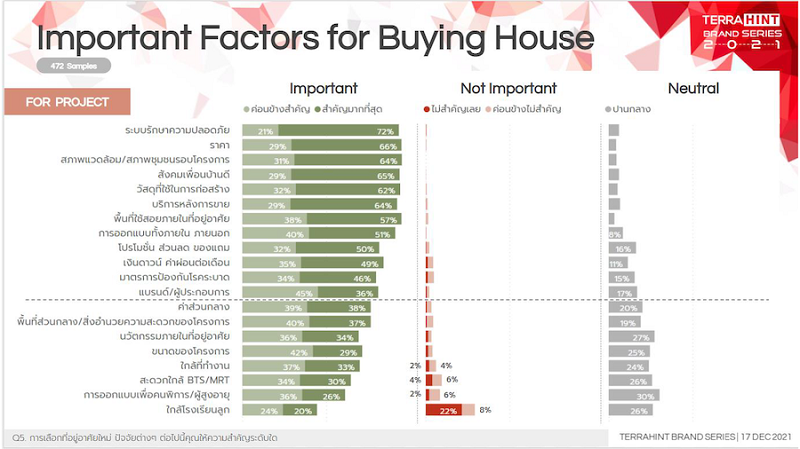
Additionally, the current consumer behavior in selecting housing emphasizes high security, which must be complemented by both security personnel and technology to create a maximum security system.
This trend indicates that consumers today prioritize functionality, usable space in homes, security systems, pricing and promotions, environment, construction materials, and exterior design, while location has become a secondary consideration when deciding to purchase real estate in this context.
As for the Metaverse, it must be acknowledged that it will significantly impact people, especially with the changes in society. The aging population means that past housing solutions may no longer meet current demands, while the younger Gen Z will be the future customer base. Therefore, new advertising strategies to reach this demographic must incorporate the Metaverse, potentially including sales offices embedded within it, as another channel to create a better living experience. It is believed that the Metaverse will be linked with AR and VR technologies to enhance user experiences.
In terms of payment methods, future changes will cater to customer convenience, with Cryptocurrency being one option that the younger generation is interested in for investment and asset exchange. The real estate sector should adapt to accept cryptocurrency payments to attract this new customer group.
Ultimately, successful marketing requires a deep understanding of customer segments. The real estate business may need to align pricing and promotions with customer demands more closely, while technology should increasingly focus on energy efficiency to reduce electricity consumption in homes.