Bank of Thailand and Thai Bankers Association Accelerate Assistance for Debtors Affected by COVID-19
The Bank of Thailand (BOT) has announced additional measures to assist debtors affected by COVID-19, aiming to alleviate the impact on borrowers more effectively. This follows the measures announced on August 20, 2021, which supported sustainable assistance for debtors impacted by COVID-19. The additional measures include:
1) Maintaining liquidity and providing new funding for SMEs and individual borrowers, along with measures to support sustainable debt restructuring, effective from September 3, 2021.
The measures to maintain liquidity and provide new funding for SMEs and individual borrowers are designed to help sustain businesses and ensure sufficient living conditions, including:
1.1) Improving the criteria for rehabilitation loans for SMEs to align with the prolonged pandemic situation and high uncertainty, to assist certain groups that have not yet accessed rehabilitation loans, providing them with more opportunities for support, including:
(1.1) Expanding the loan limits for SMEs that previously had low or no credit limits with financial institutions, as they primarily relied on personal funds or company income for their operations.
(1.2) Increasing guarantees and reducing guarantee fees for high-risk borrowers, including micro-SMEs and sectors severely affected, particularly tourism and services, to encourage financial institutions to lend more to vulnerable borrowers.
Financial institutions can submit rehabilitation loan applications to the BOT based on the above criteria starting from September 6, 2021.
2) Temporarily relaxing criteria for individual borrower loans regarding credit cards, regulated personal loans, and digital personal loans to reduce debt repayment burdens and increase liquidity for borrowers capable of repayment, effective from September 3, 2021, until the end of 2022, including:
(2.1) Doubling the credit limit to twice the salary for credit cards and personal loans for individuals earning less than 30,000 THB. Additionally, for personal loans, borrowers can apply for loans without limits on the number of service providers.
(2.2) Maintaining the minimum credit card repayment rate, which was reduced during the previous pandemic, at 5% until the end of 2022.
(2.3) Increasing the credit limit for digital personal loans from a maximum of 20,000 THB to 40,000 THB and extending the repayment period from a maximum of 6 months to 12 months.
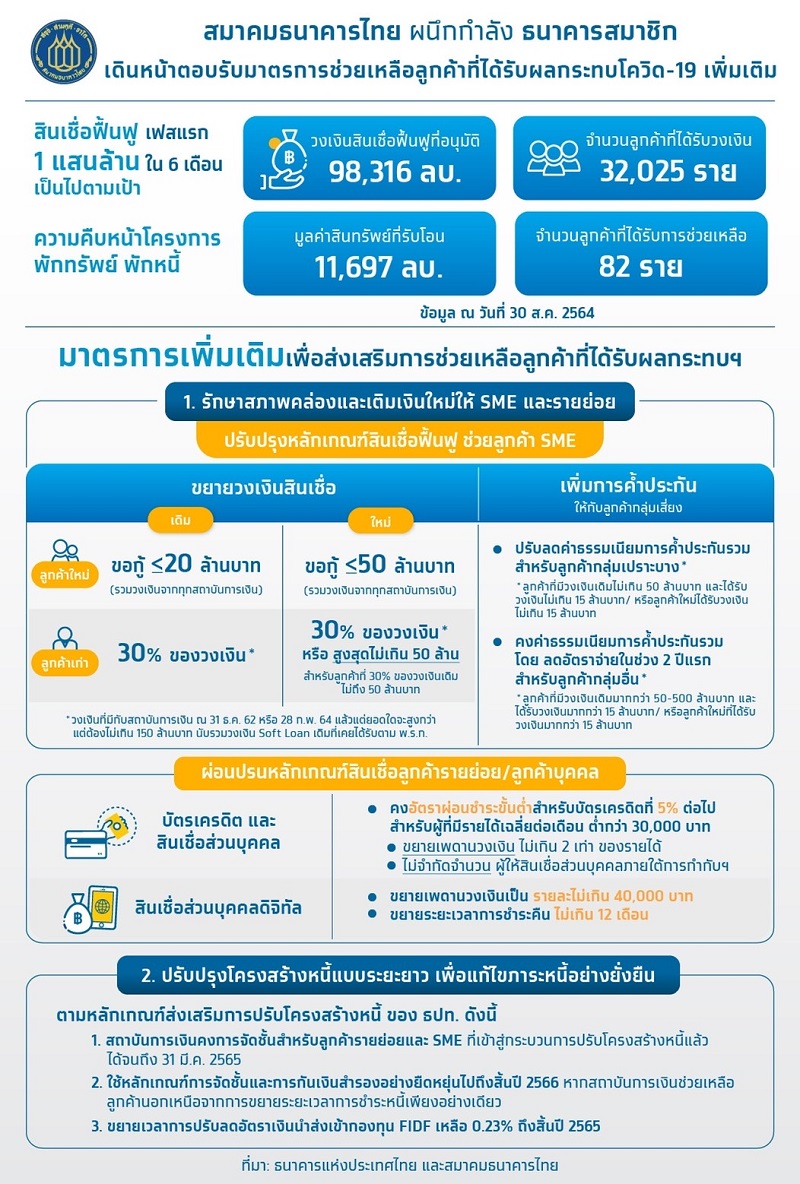
Measures for sustainable debt restructuring aim to assist financial institutions in helping debtors affected by adjusting long-term debt structures that are appropriate for each debtor's issues, aligning repayment schedules with the significantly reduced income of borrowers, and gradually increasing payments as income begins to recover. The BOT has relaxed criteria for classification and reserve requirements related to the intensity of assistance to support the aforementioned debt restructuring, effective from September 3, 2021.
Mr. Ronnadol Numnon, Deputy Governor for Financial Stability at the BOT, stated that the measures for debt restructuring and increasing liquidity for SMEs and individual borrowers have been adjusted to align with the heightened risks and prolonged situation, to help borrowers still heavily impacted manage liquidity through this crisis. It is essential to consider fairness for both debtors and creditors without creating inappropriate incentives (moral hazard), ensuring that financial institutions can effectively assist severely affected borrowers. Debtors genuinely impacted should receive assistance tailored to their individual circumstances. The BOT will collaborate with the Thai Bankers Association to expedite and closely monitor assistance for affected debtors.
Mr. Payong Srivanich, President of the Thai Bankers Association, stated that member banks are ready to assist both individual and SME borrowers according to the BOT's additional measures, whether in terms of increasing liquidity or restructuring debt to help borrowers resolve issues sustainably in the long term. Now that financial institutions are aware of the details of the measures announced by the BOT, each institution will develop assistance options (product programs) tailored to the problems and status of each borrower and closely monitor and support borrowers to ensure that banks remain a vital mechanism capable of adequately and comprehensively assisting distressed borrowers and supporting economic recovery in the future. Banks are also preparing internally and communicating with branch staff, allowing borrowers to contact banks to begin preliminary preparations.
Currently, the comprehensive vaccine procurement plans, the gradually improving trend of new infection numbers, and the export benefits from the global economy are all positive factors affecting the Thai economy in the upcoming period. It is hoped that the resolution of issues and assistance for debtors this time will enable them to stand back up and continue their businesses.
SMEs and individual borrowers seeking to increase liquidity and restructure existing debts can now contact their financial service providers for assistance. For more information, they can directly contact their financial service providers or the Financial Consumer Protection Center (FCC) at 1213.