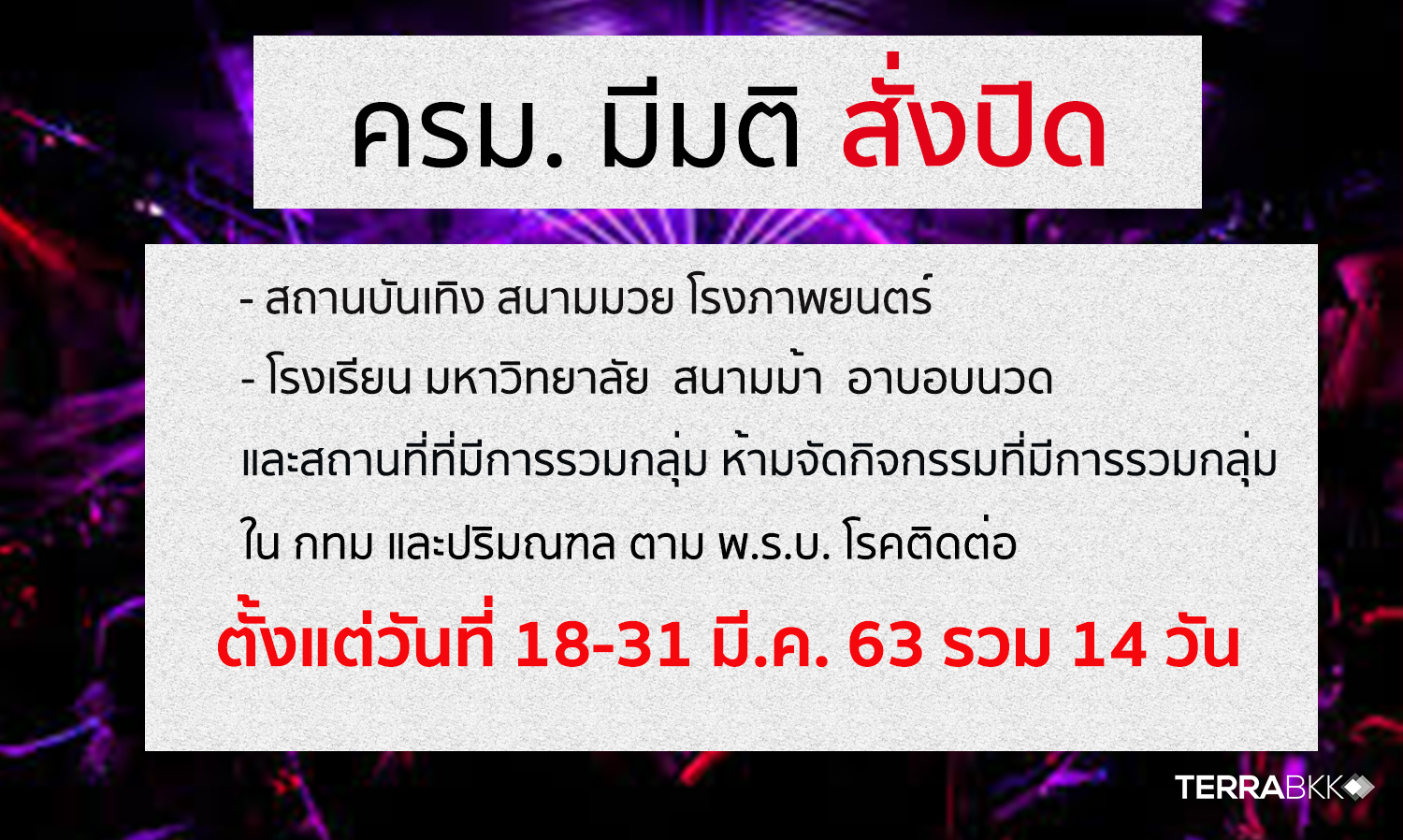
Summary of Cabinet Resolution: Closure of Service Venues and Educational Institutions in Bangkok and Surrounding Areas for 14 Days
Dr. Narumol Pinyo Sinwat, Spokesperson for the Prime Minister's Office stated that the Cabinet meeting today (March 17, 2020) made a strong decision to prevent the spread of COVID-19 by closing certain high-risk areas in Bangkok and its vicinity for 14 days, from March 18 to March 31, 2020.
The preventive measures aim to “reduce the chances of disease transmission in high-risk locations.” These measures include:
- Ordering a temporary closure until the situation improves for boxing stadiums, sports arenas, horse racing tracks in Bangkok and surrounding areas, pubs, entertainment venues, traditional massage parlors, and theaters for 14 days.
- Canceling large gatherings that pose a high risk of disease transmission, such as concerts, trade shows, religious, cultural, and sporting events, with provincial governors and provincial communicable disease committees to approve any exceptions.
- Reducing congestion in transportation to minimize the risk of virus transmission in public transport systems across the country, thereby reducing the chances of disease spread and containing outbreaks within the country. The Songkran holiday from April 13-15 will be postponed.
- Suspending inter-provincial movements of large groups, such as military camps, prisons, and schools, unless necessary, with measures in place to prevent disease spread, including restrictions on the movement of migrant workers.
- All agencies are to consider staggered work hours and work-from-home arrangements and promote the use of online systems, such as remote meetings, with all government agencies required to create work-from-home plans and report their progress to the COVID-19 center.
Public health measures emphasize that the country will close its borders but will not shut down cities to prevent and control the introduction of the virus into Thailand. Therefore, measures for foreigners traveling from four high-risk countries and two special administrative regions are as follows:
- Entry requires a medical certificate not older than 3 days.
- Health insurance is mandatory.
- Consent to use the government tracking application.
- These measures apply to all entry points, including land, water, and air.
- Immigration will check the passports of foreigners to determine their last country of residence and whether it is a disease outbreak area, and report to the Ministry of Interior.
- State quarantine measures will be enforced for 14 days.
For foreigners arriving from countries with ongoing outbreaks that have not yet been declared as disease outbreak areas, the following measures must be taken:
- Entry requires a medical certificate not older than 3 days.
- Health insurance is mandatory.
- A contactable residence in Thailand is required.
- Consent to use the government tracking application.
- These measures apply to all entry points, including land, water, and air.
- State quarantine measures will be enforced for 14 days.
Government officials and state enterprise employees are prohibited from traveling abroad unless absolutely necessary, and the public is advised to refrain from traveling to countries with disease outbreak areas and ongoing outbreaks. Thai citizens residing abroad are encouraged to delay their return to Thailand until the outbreak situation improves.
It is advised to “close places that pose a high risk of disease transmission,” such as locations where people regularly gather for activities that could easily spread the virus, even with precautions in place. Alternatives to gatherings include universities, international schools, tutoring institutes, and all educational institutions, which will be temporarily closed from Wednesday, March 18, 2020, for a period of 2 weeks. Educational institutions must strictly implement disease prevention measures according to the Ministry of Public Health's standards.
Strictly implement disease prevention measures according to the Ministry of Public Health's standards, developing systems and mechanisms for quarantining individuals suspected of being infected with dangerous communicable diseases at their residences, as per the Communicable Diseases Act of 2015.
Foreigners, including Thais returning from abroad, are required to use the tracking application, and sufficient medical personnel, equipment, and supplies must be procured to handle Phase 3, including hospitals, beds, doctors, nurses, medical personnel, volunteers, medications, medical supplies, and protective gear.
Thai citizens residing abroad are advised to delay their return to Thailand until the outbreak situation improves.
Preventive medical supply measures include “accelerating domestic production and sourcing from abroad to meet demand.”
- Accelerate the production of face masks and cloth masks as alternatives for protection.
- Increase the availability of alcohol gel, promoting the general public to use cloth masks when entering crowded places/communities, and ensure sufficient production of cloth masks.
- Seize face masks from illegal sources and distribute them to centers for further distribution.
- Survey the demand for essential medical supplies, such as PPE for medical personnel, N95 masks, and other necessary equipment, and coordinate with foreign sources.
- Ensure sufficient procurement, including monitoring online sales, stockpiling, and product distribution.
Information measures from the government come from two sources:
- The Ministry of Public Health provides specific medical and public health information.
- The COVID-19 Information Center provides an overview of all related aspects.
International measures include establishing a team to care for Thais abroad.
- The Ministry of Foreign Affairs will utilize TEAM THAILAND abroad as a task force (Team Thailand COVID-19) to care for Thais abroad, led by the ambassador.
Measures for assistance and relief
- For businesses, factories, establishments, hotels, and tourism-related businesses, the relevant agencies should consider measures to support businesses affected by the need to delay layoffs, such as assistance in reducing hotel room rates. The Ministry of Industry proposes waiving fees for factory owners.
- For individuals affected economically, relevant agencies should consider measures to assist those impacted by economic hardships and payment obligations, such as motorcycle loans, and allow financial institutions to defer payments for various professions outside the system (vendors, daily wage workers, etc.) and farmers (fruits, flowers, orchids, etc.) affected, and consider measures to present as economic relief measures from the outbreak situation in Phase 2.
- The Ministry of Justice, Ministry of Commerce, and relevant agencies should strictly oversee issues related to the impacts of the COVID-19 situation, such as informal debts, enforcement actions, and pawn sales.
- Boost morale and support for medical personnel.
These government measures to address the impacts stemming from the outbreak of the disease that have been presented to the Cabinet should be disseminated and publicized through various channels by the COVID-19 Information Center.
Currently, the country is controlling the situation and prolonging Phase 2 as long as possible by implementing control, prevention, treatment, and communication measures in all aspects. Addressing the COVID-19 issue is the top priority as it directly affects the lives of the people. Once the outbreak situation improves, the government will proceed with recovery efforts in other areas, including the economy.
The government will closely and carefully assess the COVID situation both domestically and internationally, as well as daily economic issues, to prepare for and adjust/increase measures in line with the evolving situation.
Source: Prime Minister's Office