Thai Export Growth Target for 2020 Remains at 0-1%, Excluding Impact of Coronavirus
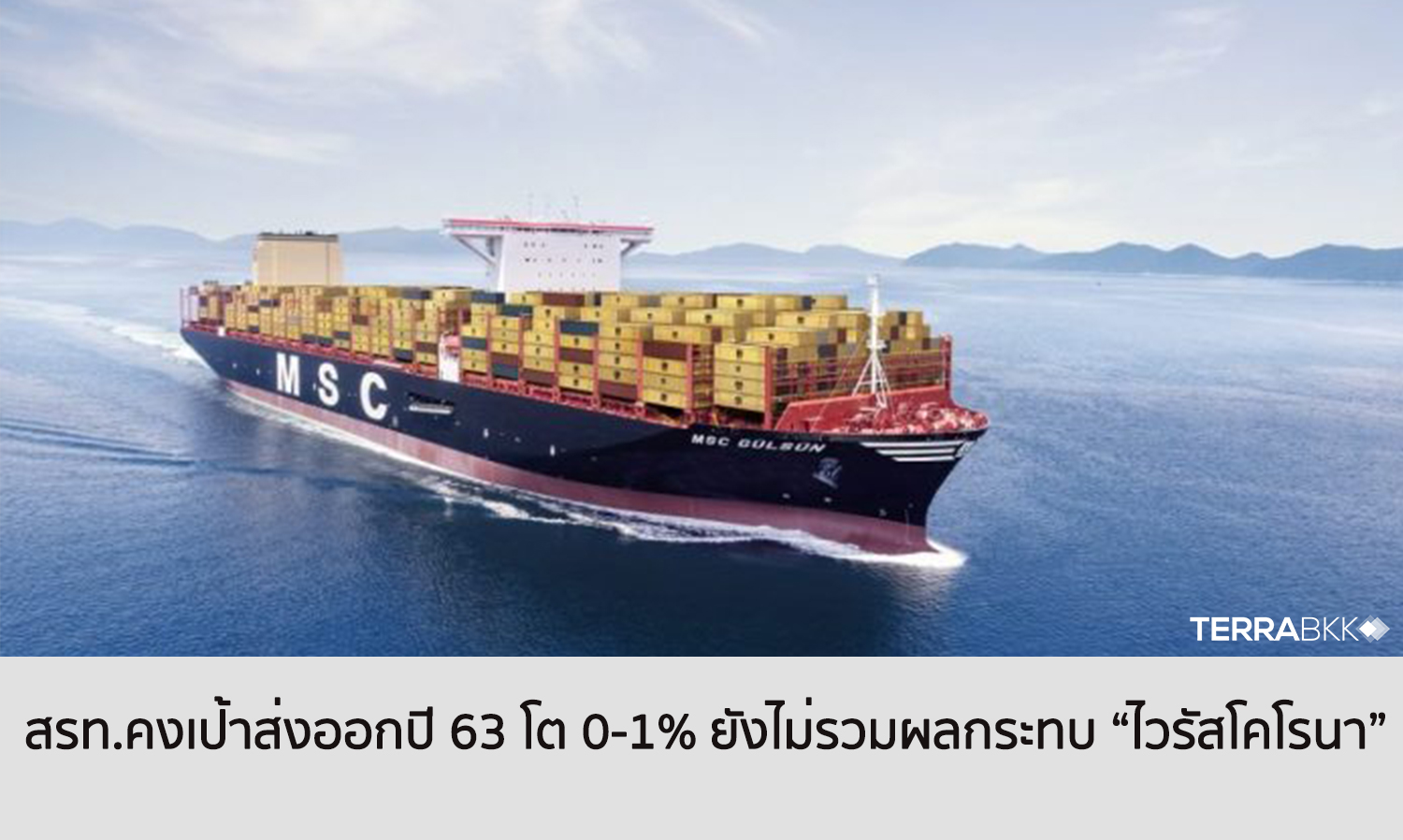
The Thai National Shippers' Council (TNSC) maintains its forecast for Thai exports in 2020 to grow by 0-1% based on the assumption of an exchange rate of 30.50 baht per US dollar, which does not yet account for the potential impacts of the coronavirus outbreak.

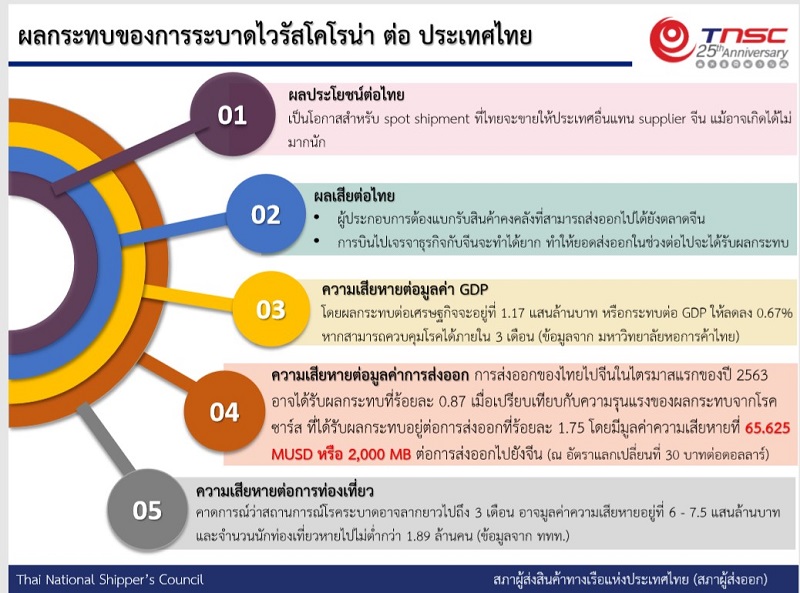
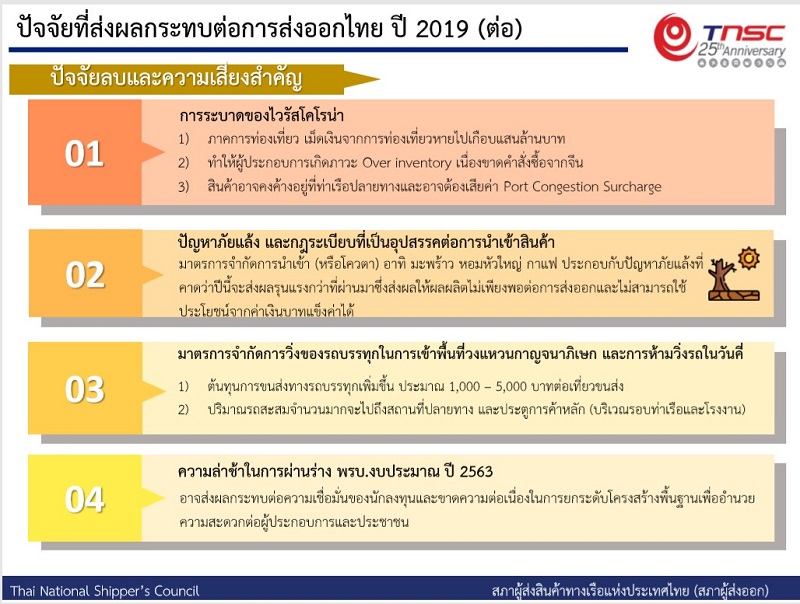
Ms. Kanya Phak Tanti Pipatthanapong, President of the Thai National Shippers' Council (TNSC) stated that the risk factors that could pose significant obstacles include: 1. The spread of the coronavirus in many countries worldwide, which may negatively impact the tourism sector, resulting in a loss of nearly 100 billion baht, as well as affecting investments and Thai exports in the short term due to the inability to export to China. In 2019, China accounted for over 11.8% of Thailand's total exports. It is expected that Thai exports to China in the first quarter of 2020 may lose several billion baht in revenue.
2. In the case of a strengthening baht, the Bank of Thailand (BOT) has urged domestic operators to expedite the import of raw materials for stockpiling in preparation for production. If certain raw materials are restricted or subject to quotas, it will impact the industrial sector that does not produce solely for export.
3. The impact of measures limiting truck operations in the Greater Bangkok area and the ban on trucks operating on odd days to reduce air pollution will affect operators, such as increasing transportation costs by approximately 1,000 to 5,000 baht per trip.
4. Delays in passing the 2020 budget bill may affect investor confidence and disrupt the continuity of infrastructure development in the country, which facilitates both domestic and foreign investors, as well as the general public.
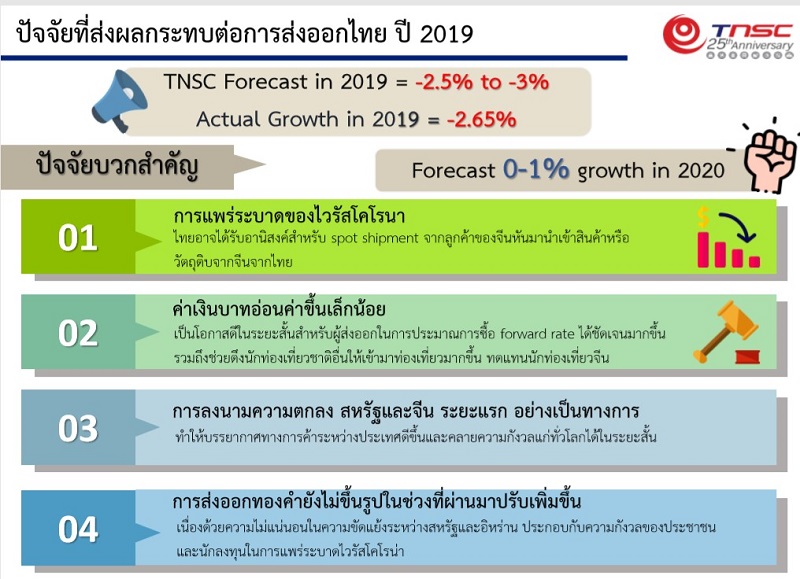
The key positive factors include: 1. The spread of the coronavirus in many countries worldwide may have positive effects, such as Thailand potentially benefiting from spot shipments as Chinese customers turn to import goods or raw materials from Thailand as substitutes. 2. A slight depreciation of the baht presents a good short-term opportunity for exporters to better estimate forward rates, as well as attracting tourists from other countries to replace Chinese tourists. 3. The signing of the initial agreement between the U.S. and China continues to have a positive outlook, easing the international trade atmosphere. 4. Gold exports have not yet increased significantly in recent times.
For Thai exports in December 2019, the value was 19,154 million US dollars, contracting by -1.28% compared to the same month last year. The export value in baht was 573,426 million baht, contracting by -9.6% compared to the same month last year. Meanwhile, imports in December 2019 were valued at 18,559 million US dollars, growing by 2.5% compared to the same period last year, and the import value in baht was 563,799 million baht, contracting by -6.0% compared to the same period last year, resulting in a trade surplus for Thailand in December 2019 of 596 million US dollars and 9,627 million baht (exports excluding gold and oil in December grew by 1.2%).
For the overall period from January to December 2019, Thailand's total exports amounted to 246,245 million US dollars, contracting by -2.7% compared to the same period last year, with an export value in baht of 7,627,663 million baht, contracting by -5.9% compared to the same period last year. Meanwhile, imports were valued at 236,640 million US dollars, contracting by -4.7% compared to the same period last year, or an import value of 7,627,663 million baht, contracting by -5.9% compared to the same period last year, resulting in a trade surplus for Thailand from January to December 2019 of 9,605 million US dollars and 190,352 million baht (exports excluding gold and oil from January to December contracted by -2.65%).