“Thai Economy in 2020 Amidst Crisis, Opportunities, and Challenges: How Will It Move Forward?”
As we enter the new year of 2020, there are already several concerning news items regarding the economy, particularly the escalating tensions between the Middle East and the United States. Many believe that this tension will exacerbate negative factors affecting the global economy, especially with oil prices remaining high.

Mr. Klint Sarasin, Chairman of the Joint Private Sector Committee (JCC) stated during a meeting of the Joint Private Sector Committee that the economic indicators for Thailand in the last quarter of 2019 still reflect a slowdown, with exports continuously contracting due to the economic slowdown of trading partners and the impact of a strong baht. This has led to a decline in imports, industrial production, and private investment. Although government measures have provided some support, private consumption indicators have also slowed down, with only tourism continuing to grow, buoyed by the Visa on Arrival measures. Analyzing the economy for the entire year, the JCC predicts that Thailand's economy in 2019 may only grow by 2.5%.
In 2020, Thailand's economy will still face several ongoing pressures from 2019, including the global economic slowdown, currency volatility, and new negative factors such as the tensions in the Middle East between the U.S. and Iran, which could push oil prices to remain high. Additionally, the severe drought in the country not only affects agricultural production and farmers' purchasing power but may also lead to rising prices for fresh food. The upward trends in oil and food prices will pose greater limitations on the government's monetary policy aimed at stimulating the economy.
Given these negative factors, the JCC urges the government to expedite the implementation and disbursement of the annual budget for 2020. At the same time, an emergency response plan for drought issues and events in the Middle East should be prepared. Furthermore, monitoring the movement of the baht to ensure it does not affect the country's competitiveness remains essential, as it impacts not only exports and tourism but also connects to the manufacturing sector and employment. Thailand must create a favorable environment focusing on security and safety, leveraging its tourism potential and becoming a regional food hub.
For the economic forecast for Thailand in 2020, the JCC estimates that exports may still have limited recovery potential or could contract by 2.0% to 0.0%, leading to an economic growth rate of around 2.5-3.0%. The general inflation rate is expected to be in the range of 0.8-1.5%, assuming global crude oil prices remain high at $70 per barrel for six months.

The Thai National Shippers' Council (TNSC), represented by Ms. Kanya Phak Tantipipatanapong, Chairwoman of the TNSC, stated that the TNSC maintains its forecast for Thai exports in 2019 to contract by -3% to -2.5%, based on the assumption that the baht in 2019 averaged 33 (±0.5) baht per U.S. dollar. The forecast for 2020 is for exports to grow by 0-1%, based on the assumption that the baht will be 30.5 baht per U.S. dollar. If the baht strengthens beyond the TNSC's assumptions, exports could risk contracting by up to 5%. The ongoing appreciation of the baht due to foreign capital inflows remains a significant risk factor. While a stronger baht may lower the costs of imported raw materials and production factors, operators find it challenging to sell products due to the global economic slowdown, which continues to weaken consumer demand. Additionally, the drought is another factor affecting the production of rice and sugarcane for farmers in the Northeast and Northern regions, impacting operators who rely on these raw materials for export.
Certainly, the tensions from the U.S.-Iran political conflict have led to a 3% increase in oil prices and heightened concerns about oil production levels in the Middle East, alongside a continuous decline in U.S. crude oil reserves.
However, amidst these risks, Thai exports still have significant positive factors supporting their continuation, particularly the successful Phase 1 trade agreement between the U.S. and China, where the U.S. suspended tariff increases on $156 billion worth of imports from China on December 15. The U.S. also reduced tariffs on Chinese goods by 7.5%, while China is set to purchase $40 billion worth of agricultural products from the U.S. This agreement is expected to be signed on January 15, 2020, in Beijing, with China also reducing tariffs on over 850 U.S. products effective January 1, 2020, slightly improving the trading atmosphere, although it remains to be closely monitored until actual implementation. Additionally, negotiations for Phase 2 of the trade agreement may begin immediately.
For the overall Thai exports from January to May 2019, the total value was $227,090 million, contracting by -2.8% compared to the same period last year (YoY), which translates to an export value in baht of 7,054,237 million baht, a contraction of -5.6% YoY. Meanwhile, imports totaled $218,081 million, contracting by -5.2% YoY, or 6,873,512 million baht, a contraction of -7.9%. This resulted in a trade surplus of $9,009 million and 180,725 million baht from January to November 2019.
International conflicts will continue to be a risk factor challenging the Thai economy, impacting the “Investor Confidence Index for the next three months”, which has remained stable for five consecutive months. Most investors are concerned about international conflicts, domestic economic conditions, and political situations.
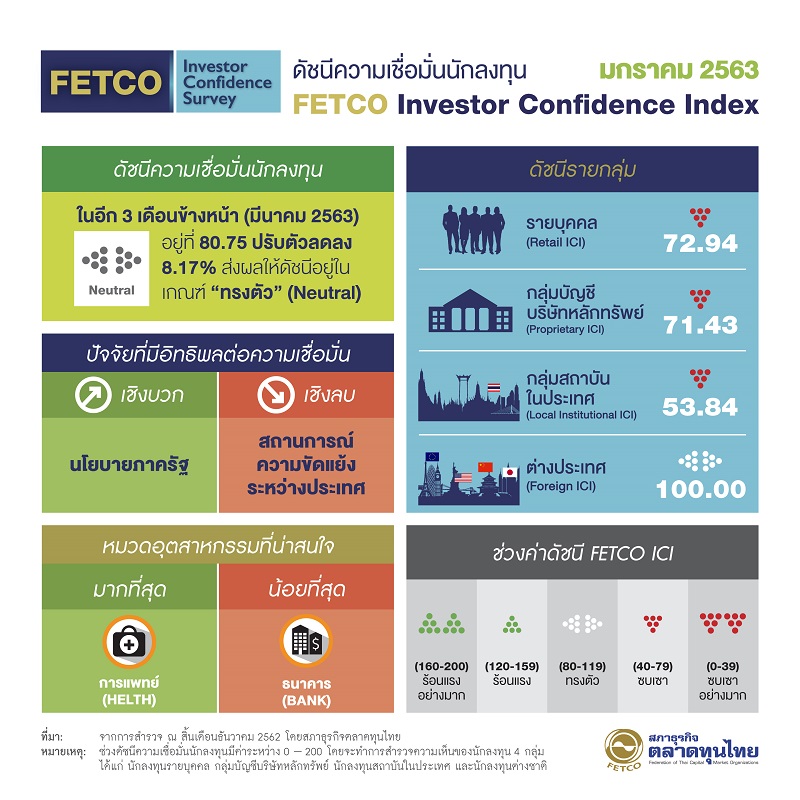
Mr. Paiboon Nalinthrangkun, Chairman of the Thai Capital Market Business Council stated that although the forecast for Thailand's economy continues to show slowing growth, the factors supporting investor confidence in the next three months are primarily government policy expectations, followed by corporate earnings. However, investors remain concerned about international conflicts, which are the biggest drag on investor confidence. Key global economic factors to monitor include the economic situation following the Phase 1 trade agreement, the potential for Phase 2 trade negotiations, the direction of Brexit, which may see the UK exit the EU with an agreement before the deadline after the elections, and the monetary policy direction of the U.S. and EU, which are likely to maintain interest rates in 2020. Domestic factors to watch include the disbursement of the 2020 government budget, economic stimulus policies, and addressing export issues due to the strong baht affecting domestic economic recovery, as well as the political situation in the country and the Bank of Thailand's monetary policy in 2020.
The FETCO Investor Confidence Index for January 2020 indicates that the overall confidence index for all investor groups over the next three months (March 2020) remains in the “neutral” zone (index range 80 - 119), having decreased by 8.17% to a level of 80.75. The investor confidence index for securities company accounts has dropped into the bearish zone, while the index for domestic institutional investors has also fallen into the bearish zone. The index for foreign investors remains unchanged in the neutral zone, while the index for individual investors has increased but remains in the bearish zone. Among the business sectors, the most interesting are the medical sector (HEALTH) and the banking sector (BANK), while the least interesting sector is the banking sector.
In December, the stock market index fluctuated between 1548-1579 points, with the index decreasing in the first half of the month to a low of 1548 points, then gradually rising to around 1570-1580 by the end of the month, benefiting from the positive outcomes of the U.S.-China trade negotiations in the Phase 1 trade agreement, while investors anticipated buying LTFs at the end of the year.