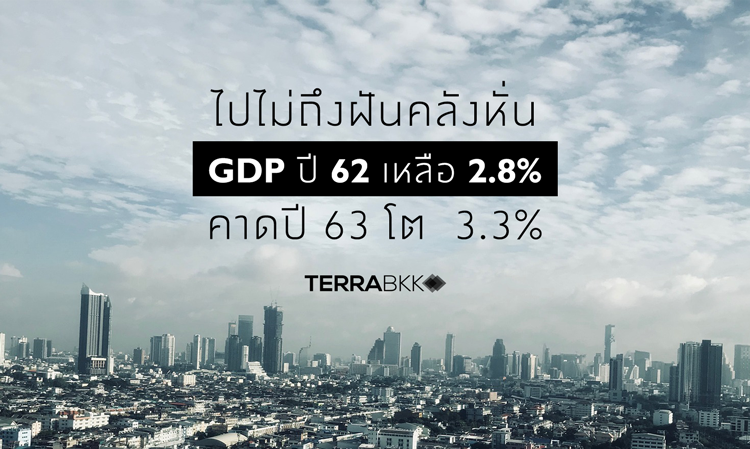
Unfulfilled Dreams: Ministry Cuts GDP Forecast for 2019 to 2.8%, Expects 3.3% Growth in 2020
The Ministry of Finance indicates that Thailand's economy in 2019 is expected to slow down to a growth rate of 2.8%, down from the previous year, with a projected acceleration to 3.3% in 2020.
Mr. Lavaron Sangsnit, Director of the Fiscal Policy Office, as the spokesperson for the Ministry of Finance, announced the economic forecast for Thailand in 2019, stating, "The Thai economy in the second half of the year is expected to grow at 3.1%, leading to an overall growth rate of 2.8% for the year (with a forecast range of 2.6% to 3.0%), a decline from the previous year's growth of 4.1%. This slowdown is primarily due to weakened external demand, influenced by the economic conditions of trading partners and a slowdown in global trade resulting from the trade war between the U.S. and China, which is expected to lead to a contraction in export value by 2.5% (with a forecast range of -2.7% to -2.3%). Meanwhile, the number of foreign tourists visiting Thailand is still expected to increase compared to last year, supported by the extension of the Visa on Arrival (VOA) fee waiver measures.
For private consumption and investment, continuous growth is anticipated, supported by economic stimulus measures in the second half of 2019, particularly the "Chim Shop Chai" project in both phases, assistance measures for low-income individuals through the state welfare card program, relief measures for farmers affected by drought, income insurance programs for rice farmers, and palm oil farmers, housing loan measures from the Government Housing Bank, reduced transfer and mortgage registration fees for home buyers, and accelerated budget disbursement measures that will help support consumer spending. Regarding the stability of Thailand's economy, it is expected that the general inflation rate in 2019 will be at 0.8% (with a forecast range of 0.6% to 1.0%), a decrease from the previous year due to declining global crude oil prices.
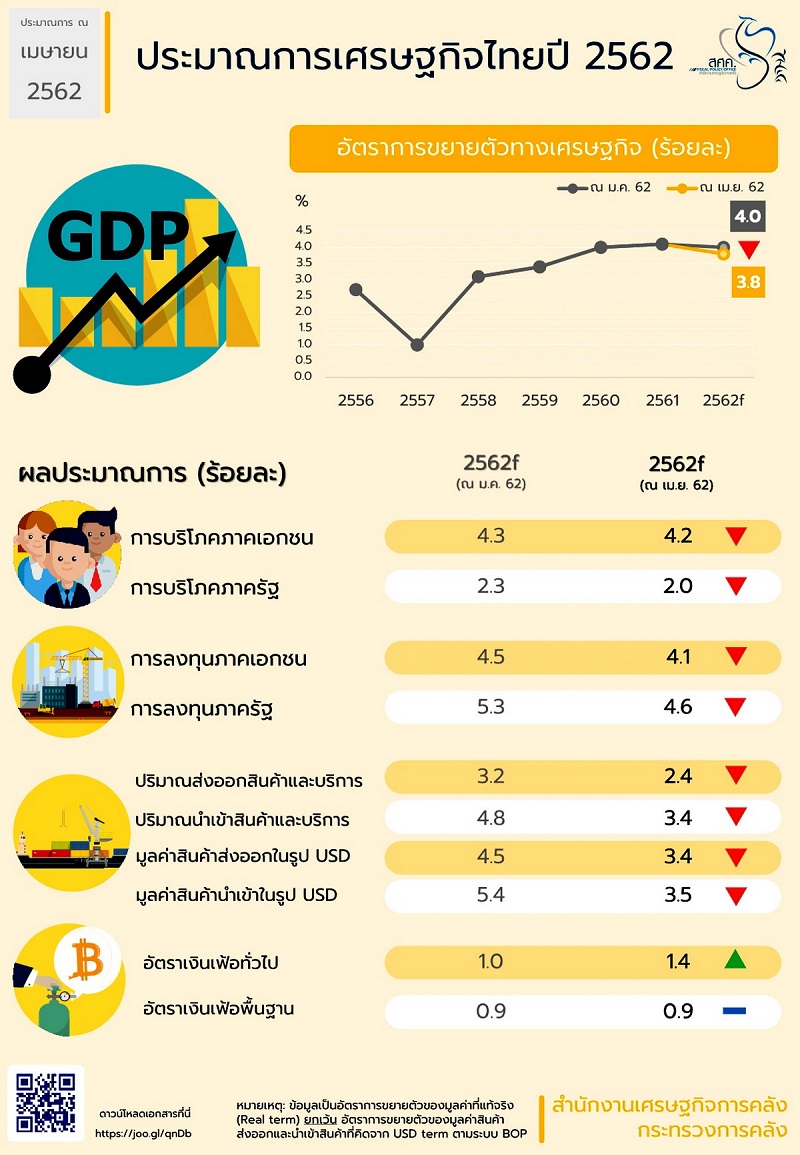
For Thailand's economy in 2020, the Fiscal Policy Office expects a growth acceleration to 3.3% (with a forecast range of 2.8% – 3.8%), supported by private and public spending, including the 3.2 trillion baht budget for the fiscal year 2020 expected to take effect early next year and large-scale public infrastructure investments. Additionally, increased public investment will help boost business confidence and stimulate more private investment in the country. For external demand, exports of goods and services are expected to grow at an accelerated pace compared to the previous year, in line with the continued growth of Thailand's trading partners and the anticipated recovery in global trade volume. In terms of domestic stability, the general inflation rate in 2020 is expected to be at 0.9% (with a forecast range of 0.4% – 1.4%), slightly higher due to the recovery of domestic demand."
In making the economic forecast for Thailand, it is essential to consider closely monitored risk factors such as the U.S.-China trade war, the United Kingdom's withdrawal from the European Union (Brexit), the slowdown of the Chinese economy, and the monetary policies of developed countries.