Krungsri Research Indicates Thai Economy in Slowdown Phase, Warning Signs Before Weakening, Risk of Recession in the Second Half of 2020
Krungsri Research, Krungsri Bank Public Company Limited, analyzes the trend of the Thai economy and finds a possibility of entering a recession in the second half of 2020 if the trade war escalates, following a low growth rate in the second quarter of this year.
The Thai economy in the second quarter of this year expanded at its lowest rate in five years, raising concerns that it may enter a recession. Krungsri Research conducted an analysis of the risks and probabilities of a recession in the article “Is a recession around the corner in Thailand?” and found that the Thai economy is currently in a slowdown period, with the probability of entering a recession increasing for 11 consecutive quarters to 15.7%. However, the calculated probability remains below the critical threshold of 40%, indicating that the chance of the Thai economy entering a recession is still relatively low. Nevertheless, external volatility remains a factor that could increase risks to the Thai economy in the future.
Krungsri Research has revised its forecast for Thailand's economic growth down from 3.2% to 2.9% due to the ongoing global economic slowdown and increasing risks. The clearer slowdown in the global economy and uncertainties from the trade war have led to a more severe contraction in Thai exports, from -1.5% to -2.8%. Additionally, domestic demand is expected to recover more weakly than anticipated, even though the Thai economy still benefits from government measures and monetary policies that are likely to remain accommodative in the near future.

The global economy and the Thai economy are showing signs of an unexpected slowdown, raising many questions such as: What is the current state of the Thai economy? Will the Thai economy enter a recession? And when will it enter a recession? Generally, the economy grows in cycles, encompassing both expansion and contraction, referred to in economics as the economic cycle or business cycle, which consists of four phases: recovery, prosperity, slowdown, and recession.
Krungsri Research employs economic modeling tools to analyze and answer these questions. The developed model can identify the state of the economy at different times. Furthermore, this model can be used to calculate the probability of the Thai economy entering a recession. Historical data shows that if the calculated probability exceeds 40%, it can be indicated that the Thai economy is likely to enter a recession in the next 2-3 quarters. Looking back to 1990, the model has successfully predicted 3 out of 4 recessions, including the 1997 Tom Yum Kung crisis, the 2008 global financial crisis, and the 2014 domestic political crisis, with the exception of the recession caused by severe flooding that the model could not predict.
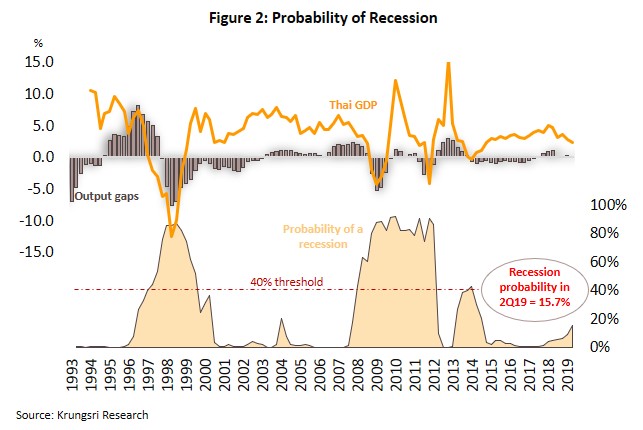
According to the latest Thai economic figures under Krungsri Research's model, it is found that the Thai economy is currently in a slowdown phase, with the probability of entering a recession increasing from 8.9% in the previous quarter to 15.7% in the second quarter, marking an increase for 11 consecutive quarters, reflecting that the Thai economy is facing increasing risks. However, the calculated probability has not exceeded the critical level, so the Thai economy does not currently show signs of entering a recession in the next 2-3 quarters. If the Thai economy grows as Krungsri Research predicts at 3.2% and 3.4% in the third and fourth quarters respectively, the probability of a recession will rise to 22.3% and 17.2% in the third and fourth quarters respectively, indicating that the Thai economy is unlikely to enter a recession at least until the second half of 2020.

Although the probability of entering a recession is still below the critical level of 40%, risks from external factors may increase the chances of the Thai economy entering a recession. Typically, recessions arise from both demand and supply factors. The main demand factors stem from tight fiscal and monetary policies, declining confidence, and external risks, while supply factors are often unpredictable events such as severe natural disasters. Currently, risks from fiscal and monetary policies are relatively limited as both policies are trending towards being more accommodative. Therefore, the risks to the Thai economy are likely to stem primarily from external factors.
Krungsri Research analyzes that in a worst-case scenario, if global economic growth declines by 1% for two consecutive quarters or by 0.5% for four consecutive quarters, the probability of Thailand entering a recession will exceed the critical level in the fourth quarter of this year and the first quarter of next year, respectively. In other words, if the global economy grows significantly below expectations, such as the risks from the trade war severely undermining global economic growth, it may lead the Thai economy to trend towards a recession in the second half of 2020.

Thank you for the information from thaipublica.org